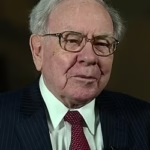
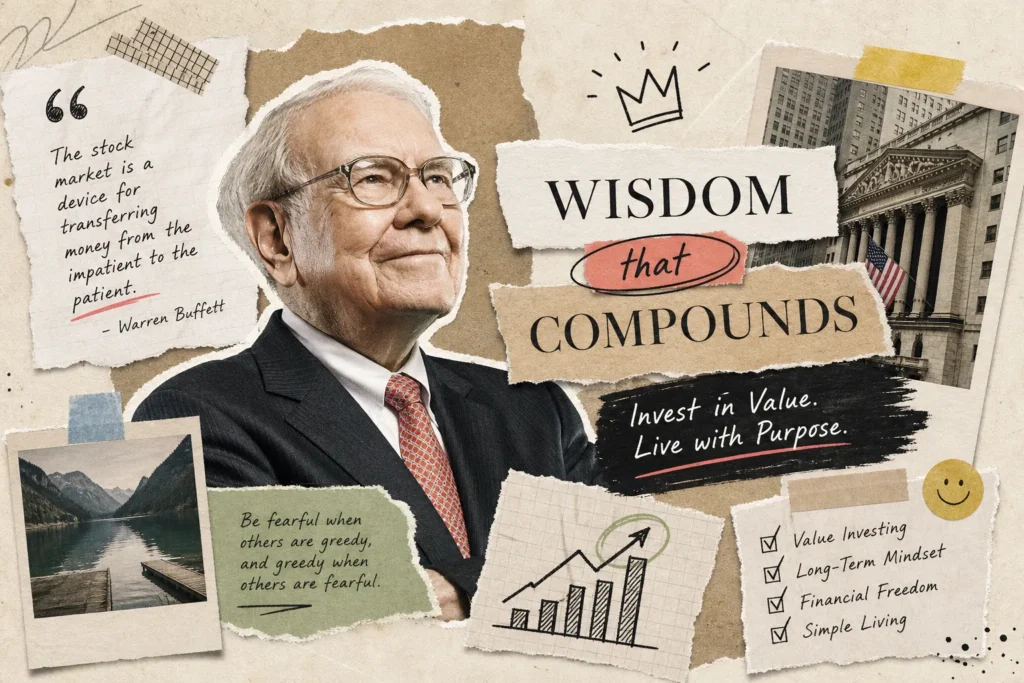
Few people in history have compressed complex financial wisdom into sentences short enough for a coffee mug, a caption, or a sticky note on a laptop screen. Warren Buffett sits near the top of that list, and this post collects the most famous Warren Buffett quotes about investing and life, each with its original source and a plain-English takeaway you can actually use. His words appear in boardrooms, university commencement speeches, social media feeds, and journaling notebooks because they cut through noise and deliver something rare: durable truth in plain language.
At RainbowQuotes, the Warren Buffett author spotlight is one of the most popular destinations on the platform. Readers come back regularly, searching for his clearest lines on money, patience, reputation, and life. Whether you’ve been following Buffett for decades or are encountering his philosophy for the first time, this collection covers 25 of his most widely cited Buffett aphorisms, each with its original source and a straight-talking takeaway.
Most famous Warren Buffett quotes about investing and life: Capital protection
Buffett’s investing philosophy doesn’t start with finding winners. It starts with avoiding catastrophic mistakes. Several of his most famous Warren Buffett quotes on investing orbit a single idea: permanent capital loss is the investor’s worst enemy, and every decision should be filtered through that lens first.
His most quoted rule is also his bluntest: “Rule No. 1 is never lose money. Rule No. 2 is never forget Rule No. 1.” This line has circulated through shareholder meetings and public interviews since at least the 1980s, though some sources note it may be a borrowed maxim rather than a line Buffett coined himself. Either way, his use of it carries a specific meaning: capital preservation is the primary filter, not return maximization. He isn’t saying losses never happen. He’s saying that avoiding a permanent loss of capital should override the temptation to chase the next hot opportunity.
Two quotes work as a natural pair beneath this principle. “Price is what you pay; value is what you get” appeared in Buffett’s 2008 Berkshire Hathaway annual letter, where he credited it to his mentor Benjamin Graham. Alongside it, his line “The three most important words in investing are margin of safety”, widely attributed to Buffett in interviews and letters, reinforces the same logic: the market price is just a number someone is willing to trade at today. Intrinsic value is the real question, and buying below it is how you protect yourself when you’re wrong.
Rounding out this group is a quote with wider application than pure investing: “The most important thing to do if you find yourself in a hole is to stop digging.” Buffett has referenced this idea in various interviews to explain that cutting losses on a bad position matters more than hoping for recovery. It applies just as cleanly to business decisions, relationships, and habits that aren’t working.
Patience as a strategy: Buffett’s most quoted lines on time and compounding
The 10-year test
If capital protection is the foundation, patience is the engine. Several Warren Buffett quotations on investing are really different angles on one idea: time amplifies the results of good judgment, and impatience destroys them.
Two quotes frame his “10-year test” for stock ownership. “If you aren’t willing to own a stock for 10 years, don’t even think about owning it for 10 minutes” appeared in the 1996 Berkshire Hathaway shareholder letter. His companion line, “Only buy something that you’d be perfectly happy to hold if the market shut down for 10 years,” reinforces the point: buying a stock is buying a business, not renting a price movement. Short-term thinking and long-term results are fundamentally incompatible.
The forever hold
Perhaps no quote captures Buffett’s approach to great businesses more cleanly than “Our favorite holding period is forever,” which appeared in the 1988 Berkshire Hathaway annual letter. The common misreading is that Buffett never sells anything. His full context is narrower: when Berkshire owns portions of outstanding businesses with outstanding management, that’s the kind of holding he prefers permanently. The See’s Candies investment illustrates this precisely, Berkshire paid $25 million for the company in 1972 and collected over $1.65 billion in pretax earnings through 2011 simply by holding it.
“The stock market is designed to transfer money from the active to the patient” delivers the same idea from a different direction. And one of Buffett’s most-shared quotes on social media stretches the concept beyond investing entirely: “Someone is sitting in the shade today because someone planted a tree a long time ago.” Frequently attributed to Buffett in interviews on long-term thinking and generosity, this line resonates because it applies to every compounding effort in life, not just a brokerage account.
Quality over bargains: what Buffett actually looks for in a business
Why price isn’t everything
Not all cheap things are good deals. Some of Buffett’s most important Buffett quotes on investing push back on the idea that a low price automatically equals a good investment, and together they mark a clear evolution in his thinking from his early “cigar butt” bargain-hunting days.
“It’s far better to buy a wonderful company at a fair price than a fair company at a wonderful price” appeared in the 1989 Berkshire Hathaway annual letter and reflects the influence of Charlie Munger on Buffett’s approach. Coca-Cola and American Express are the clearest historical examples: Berkshire paid fair prices for both during periods when the market was skeptical, then held for decades as quality compounded. The lesson isn’t to overpay. It’s that the quality of the underlying business matters more than the size of the discount.
Staying inside your circle
Two quotes define the knowledge boundary Buffett operates within. “Never invest in a business you cannot understand” and “Risk comes from not knowing what you’re doing” became highly visible during the late 1990s tech boom, when Buffett famously avoided internet stocks. He wasn’t anti-technology. He simply couldn’t reliably model the economics, and he stayed out. His circle of competence held, and he avoided the crash that followed.
On diversification, “Wide diversification is only required when investors do not understand what they are doing” is often repeated as blanket anti-diversification advice. That misses Buffett’s actual point. The quote is directed specifically at investors who can properly evaluate individual businesses. For everyone else, broad diversification is sensible protection. His lighter take on the same idea: “Whether we’re talking about socks or stocks, I like buying quality merchandise when it is marked down.”
Fear, greed, and temperament: the emotional side of Buffett’s wisdom
Contrarian thinking done right
Buffett has consistently argued that the biggest threat to an investor isn’t a market crash, it’s their own emotional reaction to one. Some of his most famous sayings are essentially instructions for managing psychology rather than portfolios.
“Be fearful when others are greedy and greedy when others are fearful” first appeared in Buffett’s 1986 Berkshire Hathaway annual letter, published in early 1987. The context matters: Buffett was discussing how fear and greed spread through the investment community like contagious diseases. The quote is genuine, but it’s frequently misapplied as a license for reckless contrarianism. In Buffett’s framework, it works only when paired with rigorous fundamental analysis of the underlying business. Buying distressed assets simply because they’re distressed isn’t the point.
Temperament over intellect
“The most important quality for an investor is temperament, not intellect” reinforces this from a different angle. Buffett has returned to this idea in numerous interviews and student Q&A sessions over the years. Emotional steadiness during volatility is worth more than raw intelligence, because intelligence without discipline tends to produce overconfidence. His companion line, “The greatest enemies of the equity investor are expenses and emotions,” adds a practical layer: fees and feelings are the two leaks that drain most portfolios over time.
“You only find out who is swimming naked when the tide goes out” appeared in Buffett’s 2001 Berkshire Hathaway annual letter and refers to hidden leverage and risk that only becomes visible during a downturn. Paired with “In the business world, the rearview mirror is always clearer than the windshield,” these two quotes explain why Buffett doesn’t rely on economic forecasts: past data feels precise; future predictions are always foggy. The practical response is to build a margin of safety rather than bet on a forecast.
Life philosophy, reputation, and investing in yourself
Not everything Buffett says is about stocks. Some of his most circulated lines are about character, judgment, and how you build something that lasts. These famous Buffett quotes about life travel far beyond finance because they point at universal truths that apply whether you’re running a company or deciding how to spend your afternoon.
“It takes 20 years to build a reputation and five minutes to ruin it. If you think about that, you’ll do things differently” is one of his most repeated lines in talks with business students. Buffett leaned on this idea during the 1991 Salomon Brothers crisis, when he stepped in as interim chairman following the firm’s treasury auction scandal, underscoring that this isn’t abstract wisdom. It’s a decision rule for daily conduct. (Note: while the quote’s precise first appearance is difficult to pin down, it has circulated in verified form since at least a 1991 USA Today profile and subsequent student talks.)
“The most important investment you can make is in yourself” is another line Buffett has returned to repeatedly in university talks. He connects it to developing communication skills, clear thinking, and personal integrity, assets no market can reprice or take away. He has specifically pointed to public speaking and writing as skills that multiply every other capability you have. Unlike a stock, your own abilities compound for your entire career.
One important note on sourcing: several quotes attributed to Buffett online are misattributed or outright fabricated. “I’d rather be approximately right than precisely wrong” is more closely associated with John Maynard Keynes, and the Buffett attribution remains unverified. Buffett’s longtime assistant Debbie Bosanek has explicitly confirmed that at least one widely shared social media screenshot contained a quote Buffett never said. When you cite Buffett, verify the source. The RainbowQuotes Warren Buffett spotlight includes attribution notes for exactly that reason, so you don’t accidentally repeat a misquote.
The through-line in Buffett’s thinking
Across these 25 Warren Buffett quotes about investing and life, a few consistent principles emerge. Protect capital first. Buy quality and hold it patiently. Stay inside what you actually understand. Manage your psychology as carefully as your portfolio. Build your reputation like it’s the one asset you can never replace, because it is.
These aren’t just investing rules. They’re a framework for making better decisions in every corner of life, which is exactly why Buffett’s words show up in so many places that have nothing to do with the stock market. A line about digging holes or planting trees carries the same logic as his letters to shareholders: clarity, patience, and honesty tend to outlast cleverness.
That through-line, from capital protection to character, is what makes these Warren Buffett sayings worth returning to. If this collection sparked a deeper curiosity about Buffett’s thinking, the RainbowQuotes Warren Buffett author spotlight is a curated place to keep exploring, with fresh picks added regularly. Find the quote that resonates most, save it somewhere visible, and let it do what the best lines always do: keep you honest when it matters.