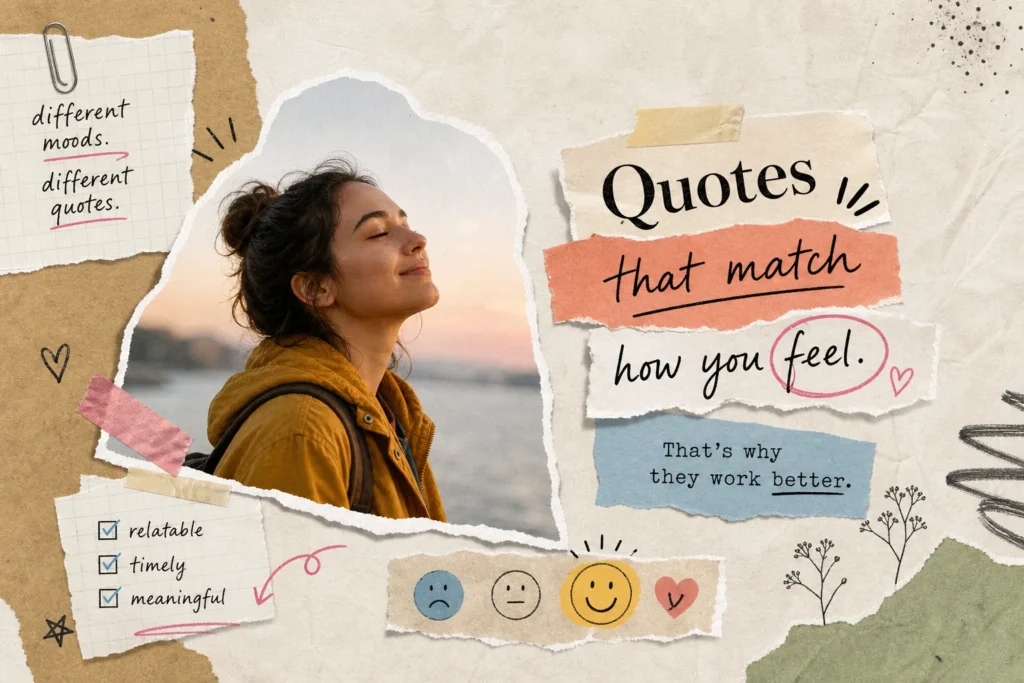
You’ve been there: forty-five minutes of scrolling through quote after quote, and not one of them lands. They all feel either too peppy, too vague, or written for someone else’s life entirely. The problem isn’t that good quotes don’t exist. The problem is how most people find them, and that’s exactly where mood-based quotes change everything.
Mood-based quotes are selected specifically because they resonate with a particular emotional state, not just a general topic. Instead of searching for “inspirational quotes” and getting a wall of results that could apply to anyone, anywhere, anytime, you start with how you actually feel right now and find language that mirrors that experience. That philosophy is the entire foundation of RainbowQuotes, built from the ground up so that every quote on the platform is discoverable by emotional state, not just keyword.
This article covers what mood-based quotes actually are, why they work differently than generic browsing, the seven emotional categories that cover nearly every state you’ll find yourself in, and three concrete ways to use them every day. It also ends with a practical breakdown of sharing best practices, including image sizes and attribution rules worth knowing.
What mood-based quotes actually are
A mood-based quote is not just an inspirational one-liner someone thought sounded nice. It’s a piece of language chosen because it fits a specific emotional state with intention. That’s a meaningful distinction. Most quote databases organize content by author name, topic keyword, or theme. You type in “success” and get hundreds of results ranging from hustle culture slogans to philosophical meditations, with no filter for where you are emotionally when you read them.
Mood-matching goes a layer deeper than subject matter. It starts with the question “how do you feel right now?” rather than “what topic are you searching for?” That shift moves the experience from searching to discovering, and the difference in usefulness is significant.
How they differ from a standard quote database
Standard quote sites organize horizontally: author, theme, keyword. Mood-based filtering organizes vertically, by emotional context. Think of it this way: a standard database is a library with books sorted only by genre. A mood-based platform is a librarian who asks how your day went before handing you a recommendation. When you search by mood, you’re not just narrowing down a list. You’re filtering for emotional fit, and that’s the variable that actually determines whether a quote resonates or bounces right off you.
The role of emotional context in finding the right words
The same words land completely differently depending on where you are emotionally. Churchill’s “Success is not final, failure is not fatal” hits like a motivational push when you’re already moving. When you’re in the middle of a genuine setback, it can feel dismissive. A quote about resilience comforts when you’re struggling and motivates when you’re already in motion. Context is everything, and mood-based discovery accounts for that in a way keyword search simply cannot.
Why mood-matching quotes hit harder than random scrolling
When a quote mirrors your exact emotional state, your brain processes it as validation rather than instruction. That’s when it actually sticks. Research on emotional processing, including work by psychologist James Gross on emotion regulation, suggests that emotionally congruent content holds attention longer and feels more personally relevant. That’s what converts a quote from words you read into words that stay with you.
Voltaire captured something real when he wrote, “The most important decision you make is to be in a good mood.” Van Gogh’s line, “The little emotions are the great captains of our lives,” pointed at the same truth: mood is a driver, not a side note. Fred Rogers made it even more direct, facing your emotions and expressing them takes strength, not weakness. Naming your emotional state first is not navel-gazing. It’s a genuinely useful act that sets up everything that follows.
The emotional resonance effect: why the right quote at the right moment lands differently
Emotional resonance happens when the language of a quote matches the internal experience of the reader. That alignment creates a felt sense of being understood, and that feeling is what separates a quote that moves you from one you immediately scroll past. Consider reading “Keep going” when you’re already energized versus when you’re exhausted and ready to quit. Same words, completely different impact. It’s also why mismatched quotes feel hollow at best and actively annoying at worst.
What happens when you skip the mood-matching step
Reading an aggressively upbeat motivational quote while you’re grieving or angry doesn’t just fail to help. It can increase disconnection, making you feel like the content was designed for someone in a completely different situation. Intentional mood selection matters more than most people realize, because the wrong quote at the wrong moment can make silence feel more supportive than any words at all.
The seven mood categories and what each one gives you
RainbowQuotes organizes its library of 10,000+ quotes around seven emotional filters: Inspirational, Loving, Calm, Focused, Hopeful, Healing, and Motivation. Each filter serves a different emotional need, and knowing which one to reach for in a given moment is half the value. Thich Nhat Hanh’s “Smile, breathe and go slowly” belongs in Calm. Churchill’s resilience lines belong in Motivation. Anne Frank’s observation that feelings cannot be overlooked belongs in Healing. These aren’t arbitrary categories, they map to distinct emotional states with distinct needs, giving you quotes for every mood worth naming.
Action-oriented moods: Inspirational, Motivated, and Focused
These three categories serve you when you need to move or execute. Inspirational quotes spark energy and remind you why the work matters. Motivation quotes specifically address resistance, the gap between knowing what to do and actually starting. Focused quotes quiet mental noise and direct attention toward a single task or priority. When you’re in any of these states, you don’t need comfort. You need language that amplifies forward momentum, and these filters deliver exactly that. Think of them as your go-to mood-lifting sayings for days when inertia is the enemy.
Restorative moods: Calm, Hopeful, Healing, and Loving
These four categories serve you when you need to soften, recover, or reconnect. Calm quotes slow your nervous system and bring you back to the present moment. Hopeful quotes open up possibility when things feel stuck or unclear. Healing quotes hold space for pain without minimizing it, the way Fred Rogers’ words do when he acknowledges that anything human is mentionable. Loving quotes reconnect you to relationships, to others, and to yourself. These uplifting quotes work not by pushing you forward but by meeting you where you are.
On RainbowQuotes, switching between these categories takes a single tap, so you’re never more than a moment away from the right emotional register.
Three ways to put mood-based quotes to work every day
Finding the right quote is only step one. What you do with it determines whether it actually changes anything. The three most effective uses are journaling, morning affirmations, and social sharing, and each one draws on mood-based discovery differently.
Using a mood quote as a journaling anchor
Select a quote that matches your current emotional state, write it at the top of the page, and then write freely for five to ten minutes around it. This isn’t about analyzing the quote academically. It’s about using it as a mirror: write what it brings up, where you agree or resist it, and what it reveals about where you are right now. This approach, using a short mood quote as an entry point rather than a prompt, functions as emotional processing through reflection rather than performance. RainbowQuotes’ curated journaling collections make it easy to find a quote that fits your mood before you even open your notebook.
Building a morning affirmation ritual around your mood
Check in with your mood first thing, then select a quote that matches where you actually are before your day gets moving. This works better than picking the same motivational line every morning out of habit, because your emotional state changes daily. The mood filter adjusts the message to fit your reality, not where you think you should be. That alignment is what makes a morning quote feel useful rather than performative. Short mood quotes work especially well here, brief enough to hold in mind, specific enough to mean something.
How to share mood-based quotes on social media to connect, not just broadcast
Sharing a quote that reflects your emotional state, or the mood you want to shift into, creates authentic connection with your audience. People engage far more with quotes that feel emotionally honest than with generic positivity that could have come from anywhere. The save-as-image and one-tap share features on RainbowQuotes make this process seamless: find the quote, format it, post it, without friction between the feeling and the share.
Sharing quote graphics the right way
Once you’ve found a quote that fits, turning it into a shareable image should be simple. Knowing the right dimensions saves you from cropping headaches and blurry exports, and understanding attribution etiquette protects your credibility with your audience.
Image dimensions that work across every platform in 2026
The optimal sizes for quote graphics right now are straightforward. Instagram and Facebook both perform best at 1080 x 1350 px (4:5 portrait). Pinterest works best at 1000 x 1500 px (2:3). X works at 1200 x 630 px (1.91:1). Portrait formats dominate on Instagram and Facebook because they occupy more vertical screen space on mobile, holding attention longer as users scroll. For file format, PNG is the better choice for text-heavy quote graphics because it preserves sharpness in typography; JPG handles photos and gradient backgrounds more efficiently. If you want one master template, start at 1080 x 1350 px and crop from there.
RainbowQuotes’ save-as-image feature handles all of this automatically. The formatting is already optimized for mobile feeds, so you don’t need to open a design tool or guess at dimensions.
Attribution and sharing etiquette that protects your credibility
The public domain rule for quotes is straightforward in the United States: works published before 1923 are generally in the public domain, and quotes from figures like Eleanor Roosevelt, Ralph Waldo Emerson, Mark Twain, Winston Churchill, and Gandhi are generally safe to share as images without formal permission. That said, always credit the author regardless. Attribution isn’t just a legal consideration, it adds weight to the quote itself and signals to your audience that you’re a credible source, not someone who screenshots things without thinking.
For living authors or content published after 1923, the situation is different. Quotes from contemporary writers, speakers, or creators often require permission for commercial use or branded social media posts. When in doubt, stick with classical sources or use platforms like RainbowQuotes where the curation already accounts for attribution. The credibility you build by getting this right is worth far more than the effort it takes.
The bottom line on mood-based discovery
Mood-based quotes are not a trend or a novelty feature. They represent a more intentional, more effective way to use language for emotional clarity, daily focus, and genuine connection with others. The difference between a quote that changes your day and one you forget immediately comes down to resonance, and resonance requires matching the words to where you actually are, not where you hope to be or where a search engine sends you.
Generic browsing gives you a lot of words. Mood-based discovery gives you the right ones.
RainbowQuotes was built specifically for this. Whether you need Inspirational, Loving, Calm, Focused, Hopeful, Healing, or Motivation, every filter is one tap away from 10,000+ quotes curated to match exactly how you feel right now. Start there, and see how differently the right quote lands.