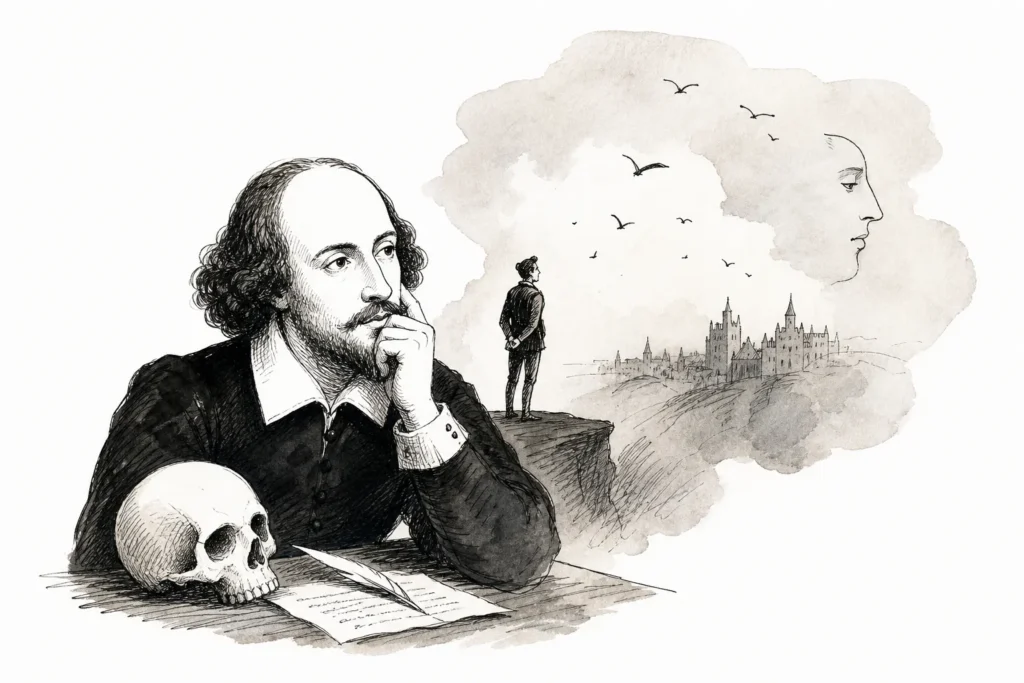
Shakespeare wrote about truth the way a surgeon uses a scalpel: with precision, no wasted motion, and results that land somewhere close to the bone. If you’ve been searching for truth quotes Shakespeare actually wrote, with real sources and plain-English meaning, you’re in the right place. His lines on honesty, self-knowledge, and the stubborn tendency of truth to surface no matter how hard people try to bury it still appear in graduation speeches, therapy rooms, and Instagram feeds. That staying power is not an accident. Shakespeare never delivered truth as abstract philosophy. He put it in the mouths of real, flawed characters under pressure, and the lines carry that weight to this day.
If you want a ready library of these quotes to browse, save, and share, RainbowQuotes has Shakespeare’s truth quotations formatted as share-ready images with full attribution included. But before you save a favorite line, it is worth knowing exactly where it comes from and what it actually means. That context is what separates a quote that feels borrowed from one that genuinely lands. What follows covers the most powerful truth quotes Shakespeare wrote, their real sources, and how to use them with confidence.
Why Shakespeare’s words on truth still hit so hard
He wrote characters who lied, deceived, and then got exposed
Shakespeare’s obsession with truth was not a philosophical hobby. It was the engine of almost every plot he wrote. Nearly every major play turns on deception, concealment, or a character who refuses to see reality clearly. Polonius spies and manipulates while dispensing wisdom. Iago orchestrates an elaborate lie that destroys everyone around him. Lady Macbeth convinces herself that ambition justifies bloodshed, then unravels. Because truth in Shakespeare is always in tension with power, appearances, and self-interest, his quotes on the subject feel earned. They did not arrive at tidy moral conclusions from a safe distance.
What made his famous Shakespeare truth quotes different from moral lectures
Generic motivational quotes tend to tell you what you should feel. Shakespeare’s lines on truth describe what actually happens when honesty is tested under pressure, and that grounded quality is why they translate so well across centuries and contexts. The quotes covered here span three distinct dimensions: honesty with other people, honesty with yourself, and truth’s relentless tendency to surface no matter how carefully it has been hidden. Each one carries a specific human situation behind it. That specificity is exactly what makes them useful in writing, speaking, and everyday conversation today.
Top truth quotes Shakespeare wrote about self-knowledge
“To thine own self be true”, the full scene behind Hamlet’s most quoted line
This line comes from Hamlet, Act 1, Scene 3, spoken by Polonius as he sends his son Laertes off to France. The exact original wording is: “This above all: to thine own self be true, / And it must follow, as the night the day, / Thou canst not then be false to any man.” That context adds a layer of dramatic irony that most people miss. Polonius is one of the play’s most scheming, manipulative characters. He gives his son genuinely wise advice immediately before spending the rest of the play surveilling, deceiving, and meddling in everyone’s affairs. The line is real wisdom delivered by someone who rarely follows it himself.
What this means stripped of the Early Modern English
The modern takeaway is straightforward: if you are honest with yourself about who you are and what you value, you become much harder to manipulate and much less likely to deceive others. The logic is almost mechanical. Self-knowledge is the foundation of integrity. This is why the line resonates so naturally with personal development readers, journalers, and anyone doing values work. It is not telling you to be selfish. It is telling you that clarity about your own character is a precondition for genuine honesty with everyone else in your life.
Truth and lies in Shakespeare, quotes on what refuses to stay buried
“Truth will come to light” from The Merchant of Venice
The speaker here is Launcelot Gobbo in The Merchant of Venice, Act 2, Scene 2. The full original wording: “Truth will come to light; murder cannot be hid long; a man’s son may, but at the length truth will out.” Shakespeare saw concealment as inherently temporary. The quote applies to whistleblower stories, workplace cover-ups, and long-held personal secrets with equal force today. The phrase “truth will out” has since entered the English language as a standalone saying, which tells you how completely this idea took hold.
“Time’s glory is to unmask falsehood”
This line comes from The Rape of Lucrece, one of Shakespeare’s longer narrative poems: “Time’s glory is to calm contending kings, / To unmask falsehood, and bring truth to light.” Shakespeare positioned time itself as a force aligned with truth, not with power or privilege. The modern takeaway is that patience tends to expose deception in ways that direct confrontation often cannot. For anyone navigating a situation where the truth is obscured but not gone, this line offers both reassurance and a long-term perspective that is genuinely useful.
The quiet, undeniable force of truth, honesty quotes Shakespeare embedded in his plays
“Truth hath a quiet breast” from Richard II
“Truth hath a quiet breast” comes from Richard II, Act 1, Scene 3. Thomas Mowbray, Duke of Norfolk, speaks it just before a pre-duel confrontation, expressing that a clear conscience gives him inner calm. The line makes a point that holds up across any era: genuine truth does not need to argue loudly for itself.
“Truth needs no color”
“Truth needs no color; beauty, no pencil” makes the same point from a different angle, real truth, like real beauty, requires no embellishment or spin. Both lines are compact enough to memorize, short enough to work as captions, and precise enough to use in a speech without overstating the point. They are among the truth lines from Shakespeare’s plays that translate most cleanly into single-line shareable quotes; you can find both formatted and attributed on RainbowQuotes.
“The instruments of darkness tell us truths”
Banquo speaks this warning in Macbeth , Act 1, Scene 3, right after the witches have correctly prophesied that Macbeth will become Thane of Cawdor and Ross arrives to confirm it. The full passage: “And oftentimes, to win us to our harm, / The instruments of darkness tell us truths, / Win us with honest trifles, to betray’s / In deepest consequence.” Banquo is warning Macbeth that evil forces sometimes use accurate information to lead people toward destructive choices. Just because something is technically true does not mean the person sharing it has your best interest in mind. Shakespeare understood that truth can be weaponized, and he gave that insight to the one character in Macbeth clear-eyed enough to see it coming.
Quotes people get wrong and the exact wording to use
The most common wording errors with Shakespeare on truth and honesty
Several of Shakespeare’s most recognizable lines circulate in altered forms, and the changes are usually small enough that people do not notice them. The most frequently cited examples include:
- “All that glisters is not gold“( The Merchant of Venice) is almost universally quoted as “glitters,” which is the modern spelling but not what Shakespeare wrote.
- “The lady doth protest too much, methinks” ( Hamlet) loses the closing “methinks” in most modern usage, which subtly shifts the meaning.
- “Alas, poor Yorick! I knew him, Horatio” ( Hamlet) is routinely quoted as “I knew him well,” a phrase that does not appear in the text at all.
These slips happen for predictable reasons: archaic words get modernized, lines get shortened for convenience, and misquotes spread because they sound right even when they are wrong. The underlying ideas survive the distortion, but the altered versions will be recognized immediately by anyone who has read the original text.
Why accuracy matters when you cite Shakespeare
Quoting Shakespeare in a speech, an essay, or a social media post with exact wording signals that you have genuinely engaged with the source. It also protects you from the specific awkwardness of citing a misquote that someone in your audience immediately recognizes. The practical fix is straightforward: verify the wording against a primary-source edition before you use it, and skip anonymous aggregator sites that repeat errors without attribution. Platforms that include the play name, speaker, and original wording, like RainbowQuotes, give you a reliable starting point for any Shakespeare quote you want to share with confidence.
How to put these truth quotes Shakespeare wrote to work today
Using them in speeches, essays, and journaling
These lines are not decoration. They are frameworks for thinking, and they work across a range of practical contexts. Opening a presentation with “To thine own self be true” and tracing that theme through your talk gives the audience an anchor. Closing a persuasive essay with “Truth will come to light” reinforces your argument without overstating it. Using “Truth hath a quiet breast” as a journaling prompt opens a genuinely useful question: where in your life are you performing rather than living honestly? Each quote carries enough specific weight to generate real reflection, and that is what separates a useful quote from an empty one.
Saving and sharing as images for Instagram and Pinterest
Many readers arrive at these lines wanting a clean, shareable image for social media. That is a completely reasonable use of Shakespeare’s work, and it works best when the attribution is accurate and the image is visually polished. RainbowQuotes lets you browse Shakespeare quotes about truth and honesty, save favorites, and download them as share-ready images sized for Instagram or Pinterest, with full attribution included. For content creators, wellness accounts, educators, and coaches who post regularly, having a reliable source for exact wording and accurate sourcing removes a real friction point in the content workflow. You get the line, the context, and the image in one place.
The thread that runs through all of it
These truth quotes Shakespeare wrote work because they were never abstract philosophy. Every one came out of a specific human moment: a father sending his son away, a clown making an offhand observation, a warrior steadying himself before combat, a prophet warning against manipulation. That grounding is exactly what makes them useful centuries later, whether you are writing a speech, choosing a caption for a difficult week, or simply trying to put a complicated feeling into words.
Save the exact wording. Note the source play. And use these lines with confidence, you now know exactly what Shakespeare meant. When you understand the context, the quote does more work for you and holds up under scrutiny in any setting where someone asks where it comes from.
For more famous Shakespeare truth quotes with full attribution, explore the complete collection on RainbowQuotes. Every line comes with the source play, the original speaker, and a one-tap option to save it as a shareable image. The right words for your moment are already there.