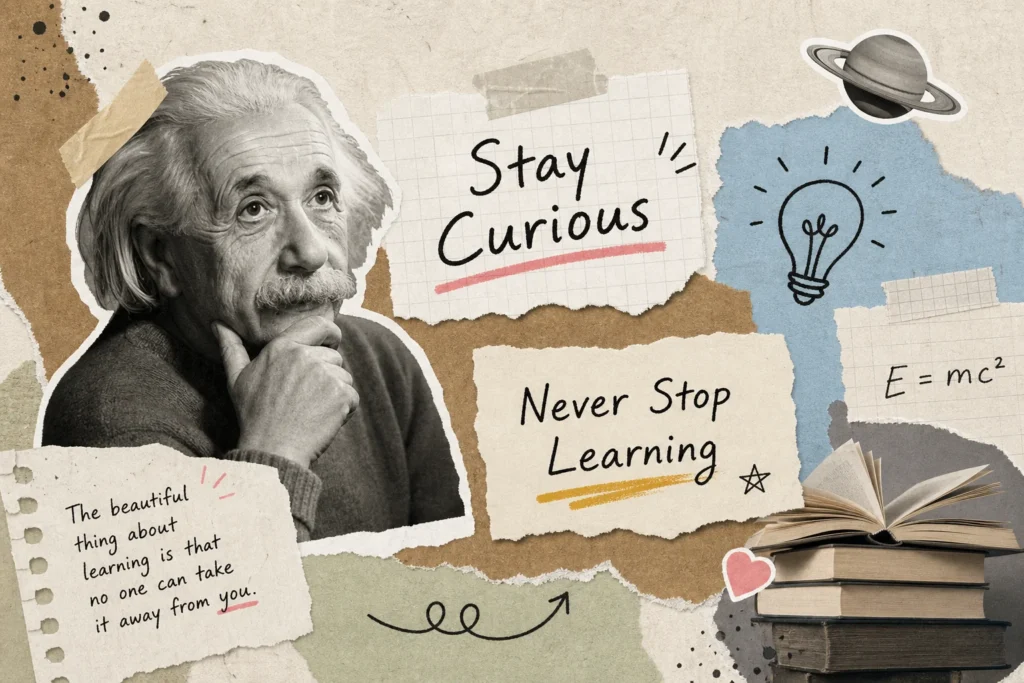
Albert Einstein didn’t just change how we understand the universe. He changed how we think about thinking itself. His words on curiosity and learning have outlasted textbooks, academic debates, and decades of shifting educational philosophy. Whether you’re a teacher hunting for a classroom anchor or a student grinding through a hard semester, these quotes land differently because they come from someone who actually lived the ideas behind them. Here are some of the best Albert Einstein quotes about curiosity and learning that still guide teachers, students, and self-directed learners today.
Before you dig in, it’s worth bookmarking the RainbowQuotes Einstein author page, where his curiosity and learning quotes are organized in one place and available as shareable picture quotes ready for Instagram, Pinterest, or classroom use. It saves you the hunt.
Here are 12 of the best Albert Einstein quotes about curiosity and learning, each with a short note on where it came from and how to put it to work right now.
Best Albert Einstein Quotes About Curiosity and Learning: Never Stop Questioning
Einstein believed the question mattered more than the answer. That conviction runs through everything he said about learning, and it’s why educators return to this group of quotes more than any other. These three come from the same verified source, and they deserve to be read together.
1. “The important thing is not to stop questioning”
This line comes from a LIFE magazine article published on May 2, 1955, written by journalist William Miller and titled “Old Man’s Advice to Youth: Never Lose a Holy Curiosity” (verify the precise byline against the original print edition, as different descriptions of the article use slightly varied headings). The full passage reads: “The important thing is not to stop questioning. Curiosity has its own reason for existence. One cannot help but be in awe when he contemplates the mysteries of eternity, of life, of the marvelous structure of reality. It is enough if one tries merely to comprehend a little of this mystery each day.” Note that the pronoun “he” reflects the language conventions of 1955. For students, this is quiet permission to ask the question that feels too basic. For teachers, it’s a classroom philosophy compressed into one sentence. Use it as a journal prompt, a poster, or the opening slide of any lesson you want students to actually remember.
2. “Never lose a holy curiosity”
Pulled directly from the same May 2, 1955 LIFE piece, this phrase gave the article its title and its emotional weight. The word “holy” does serious work here. Einstein wasn’t describing curiosity as a useful habit or a career skill. He elevated it to something sacred, something worth protecting deliberately. For self-directed learners, this functions as a mindset anchor rather than a caption. Put it somewhere you’ll see it during the parts of learning that feel dry or discouraging, because that’s exactly when it applies.
3. “Curiosity has its own reason for existing”
Also from the 1955 LIFE passage, this quote pushes back against one of the most common messages schools send: that learning must produce an outcome, a grade, or a credential to count as worthwhile. Einstein rejected that framing entirely. Curiosity doesn’t need justification. For teachers and coaches, this is one of the most liberating quotes you can put in front of a room full of people who have been trained to ask “will this be on the test?” before engaging with any idea.
What Einstein Actually Believed About Real Learning
Einstein was skeptical of how schools operated in his time. His 1949 autobiographical essay in Albert Einstein: Philosopher-Scientist, edited by Paul Arthur Schilpp, made that skepticism explicit. These three quotes challenge the idea that education means transferring information from one person to another, and they remain some of the most referenced Einstein quotes on curiosity and education in teacher training materials for good reason.
4. “Education is not the learning of facts, but the training of the mind to think”
The attribution for this one is broad and not tied to a single verified original source, Quote Investigator and similar quotation-history resources list its provenance as uncertain, but the sentiment is consistent with Einstein’s documented views on schooling. The quote hits hardest for students who feel trapped in cycles of memorization with no room to reason, question, or explore. For educators, it’s a direct argument for Socratic methods, project-based learning, and critical thinking assignments over test-prep drilling. Put it at the top of your syllabus and see how it shifts the first day of class.
5. “It is a miracle that curiosity survives formal education”
Quote Investigator traces this popular short form back to a longer 1949 passage where Einstein wrote: “It is, in fact, nothing short of a miracle that the modern methods of instruction have not yet entirely strangled the holy curiosity of inquiry; for this delicate little plant, aside from stimulation, stands mainly in need of freedom.” The condensed version evolved from there. Einstein wasn’t being cynical without purpose. He was making a real case for freedom in learning, arguing that curiosity above everything else needs room to breathe. For teachers, this quote is a mirror, not an accusation. It asks one honest question: what is your classroom doing to curiosity?
6. “I never teach my pupils. I only attempt to provide the conditions in which they can learn”
The original source for this one isn’t firmly established, treat it as widely attributed, but the idea maps directly onto Einstein’s documented educational philosophy. This is arguably the most important line for educators in the entire list. It reframes the teacher’s role completely: not an authority dispensing knowledge, but an environment designer creating the conditions where discovery becomes possible. Coaches, therapists, and mentors find this one especially resonant because it describes exactly how meaningful transformation works in any context.
Where Imagination Meets Learning: Einstein’s Most Shareable Quotes
Einstein’s views on curiosity and learning were inseparable from his belief in imagination. These three famous Einstein sayings are among his most quoted lines, the ones you’ll see most often in graduation speeches, classroom posters, and social feeds. There’s a reason for that: they translate ideas about how discovery actually works into language anyone can feel.
7. “Imagination is more important than knowledge”
This is one of Einstein’s most verified quotes. The earliest documented source is a 1929 Saturday Evening Post interview by George Sylvester Viereck, where Einstein also said: “Knowledge is limited. Imagination encircles the world.” Knowledge tells you what already exists. Imagination takes you somewhere no one has mapped yet. For students entering creative fields, research roles, or any path that requires original thinking, this quote reframes a “wrong answer” as the starting point of something interesting rather than the end of a conversation.
8. “Logic will get you from A to B. Imagination will take you everywhere”
A natural companion to Quote 7, this one earns its place on the list because of how cleanly it carries across formats. It’s punchy, structured, and immediately memorable. As an Instagram caption paired with a minimal background image, it lands sharply. As the opening line of a graduation speech, it opens the door to everything that follows. For anyone who has felt boxed in by conventional thinking or told that the “practical” path is the only path, this quote gives real breathing room. Note: the original source for this version isn’t firmly established, so treat it as widely attributed to Einstein.
9. “Look deep into nature, and then you will understand everything better”
Widely attributed to Einstein, this quote offers something the others don’t: a reminder that learning happens beyond screens and textbooks. For curious learners who feel disconnected from academic content, this is a reorientation worth saving. For educators, it’s a quiet justification for field trips, observation assignments, science journaling, and any activity that asks students to pay close attention to the physical world rather than a slide deck.
On Effort, Mistakes, and Staying With the Questions
Some of Einstein’s most encouraging Albert Einstein quotes about curiosity and learning have nothing to do with brilliance. They’re about persistence, the value of failure, and the habit of staying with a problem long after most people would walk away. Einstein spent years on dead ends before his breakthrough papers of 1905, this group of quotes carries that biography behind it. It’s especially powerful for students and for anyone working through a problem that refuses to resolve quickly.
10. “I have no special talent. I am only passionately curious”
Some sources link this to a 1952 letter Einstein wrote to Carl Seelig, cited with archival reference AEA 39-013, though the earliest widely traceable publication is the 2010 Princeton University Press volume The Ultimate Quotable Einstein. The full archival provenance hasn’t been independently confirmed in widely available sources, so treat the Seelig attribution as probable but unverified. The idea itself, however, is consistent with everything Einstein said and believed about learning. This quote democratizes genius. It says the differentiator isn’t raw talent, it’s a quality of attention anyone can develop. For students who feel they lack natural ability, this reframe is genuinely motivating. Not in a hollow “believe in yourself” way, but in a specific and actionable one.
11. “A person who never made a mistake never tried anything new”
Widely attributed to Einstein, this is one of the best quotes for curious learners to keep visible during any process where failure feels costly: a project, an experiment, a creative risk, a new skill. It reframes the mistake as evidence of engagement rather than proof of inadequacy. As a classroom poster, it changes the culture around risk-taking. As a motivational caption paired with a bold image quote, it’s one of the most shareable lines on this entire list.
12. “It is not that I’m so smart. But I stay with the questions much longer”
Widely attributed to Einstein, with no firmly established original source, this quote teaches patience as an active learning skill. Most people abandon a hard question when the discomfort gets loud enough. Einstein identified the habit of staying with the question, sitting with the uncertainty and refusing to settle for a quick answer, as the real differentiator between ordinary and extraordinary thinking. For self-directed learners especially, this one functions as both a challenge and a permission: you don’t need to be faster or smarter. You need to stay longer.
How to Put These Einstein Quotes About Curiosity and Learning to Work Right Now
Reading quotes is easy. Using them is where the shift actually happens. The quotes above aren’t just worth admiring. They’re worth deploying in specific, practical ways depending on where you are and what you need.
For students and classrooms: Use “The important thing is not to stop questioning” as a daily journal prompt opener. Print three or four of the shorter quotes as desk cards for study sessions. When a failed exam or a rejected draft feels like a verdict, return to Quote 11 and Quote 12. They won’t fix the grade, but they’ll reframe what the failure is actually telling you.
For social posts, captions, and speeches: Quotes 7, 8, and 10 are strong starting points for Instagram, Pinterest, and LinkedIn captions, pair them with a minimal background image for clean, focused content. In a graduation speech or class presentation, Quote 12, “I stay with the questions much longer,” works beautifully as a closing line. It lingers. In a keynote, Quote 5 is the one that makes a room go quiet.
- Quote 7 (“Imagination is more important than knowledge”) translates well across platforms and audiences
- Quote 8 (“Logic will get you from A to B”) is a strong choice for a punchy opening slide
- Quote 10 (“I am only passionately curious”) resonates deeply with self-improvement and career audiences
Einstein’s Curiosity Was a Discipline, Not a Personality Trait
These quotes aren’t decorative. Together, they form a coherent philosophy, one that covers how to approach learning, how to treat failure, how to think about imagination’s role in discovery, and how to protect the quality of attention that makes breakthroughs possible. Einstein didn’t stumble into curiosity. He practiced it, defended it, and wrote about it with real urgency until the end of his life.
Pick one quote from this list. Put it somewhere you’ll see it tomorrow morning. Let it ask something of you. That’s all Einstein was ever asking his readers to do.
For shareable image versions of the best Albert Einstein quotes about curiosity and learning, visit the RainbowQuotes Einstein collection. Every quote is formatted and ready to use, just verify the sourcing notes above when attribution matters most.