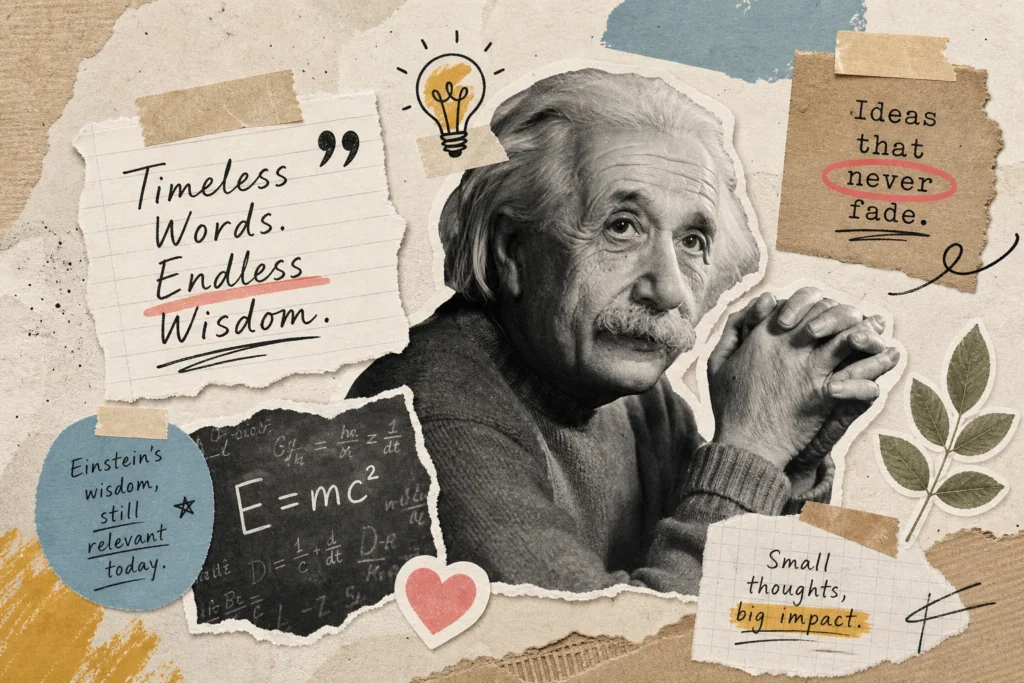
Albert Einstein left behind far more than equations. His words on curiosity, imagination, and human nature have kept circulating for more than 70 years after his death because they compress deep truths into sentences anyone can carry around. These 20 famous Einstein sayings, organized by theme and traced to their original sources, show why a single line from him can still reframe how you approach a problem, a failure, or an ordinary Tuesday morning.
At RainbowQuotes , Einstein is a popular author whose quotes readers return to consistently. That pattern tells you something real: people still reach for his ideas when they need a way to make sense of their own lives. The demand is not nostalgia. It is recognition.
Each saying below comes with its original source context and a short note on why it still resonates. You’ll also find a section on the most common misattributions so you can quote him accurately and confidently.
Famous Einstein Sayings on Science and the Nature of Knowing
“The whole of science is nothing more than a refinement of everyday thinking.” Einstein published this in Physics and Reality (1936), a deliberate pushback against the idea that science belongs to a separate, elevated realm. He believed scientific thinking was continuous with the curious, questioning mind anyone could develop. That framing is exactly what makes science communication compelling when it works: great science writing reminds you that discovery starts with a question you already recognize. (For a primary-source citation, see the Digital Einstein Papers or Alice Calaprice’s The Quotable Einstein , which documents variant phrasings of this passage.)
“The only source of knowledge is experience” and “Truth is what stands the test of experience” belong together as expressions of Einstein’s empirical conviction. He did not separate ideas from observation. Thinking without grounding in the real world was, for him, a dead end. These sayings pair naturally with one of his most underappreciated quotes: “No amount of experimentation can ever prove me right; a single experiment can prove me wrong.” That one line contains more scientific humility than most textbooks manage in a chapter.
“Everything should be made as simple as possible, but not simpler.” This reflects his entire method. He pursued elegance in equations and plain language in communication, and he understood that oversimplification is its own form of dishonesty. Note that this phrasing is a widely circulated paraphrase; variant forms appear in secondary sources, with The Quotable Einstein being the most reliable place to check the closest documented wording. For anyone writing, teaching, or presenting ideas today, the principle remains the most practical standard available.
Famous Einstein Sayings on Imagination and Creativity
“Imagination is more important than knowledge.” This is probably the most quoted line in the Einstein archive, and it is genuine. The earliest verified source is a 1929 interview in The Saturday Evening Post, where the full passage reads: “I am enough of an artist to draw freely upon my imagination. Imagination is more important than knowledge. For knowledge is limited, whereas imagination embraces the entire world.” The context matters: Einstein was discussing scientific intuition and prediction, not making a broad argument against learning. The imagination he described was the ability to envision what has not yet been proven, not a license to skip rigorous work.
“Logic will get you from A to Z; imagination will get you everywhere” and “The true sign of intelligence is not knowledge but imagination” work as a pair. Together they describe a vision of thinking that is not linear but generative. In coaching and leadership development, these sayings help people recognize the difference between competent execution and genuine breakthrough. Both matter, but they are not the same thing.
“Creativity is intelligence having fun.” This quote’s direct sourcing is less documented than others, no dated letter, interview, or essay in the primary archives firmly establishes it, as a search of the Digital Einstein Papers and The Quotable Einstein confirms. It circulates widely because it captures something real about how he worked: intelligence that never plays calculates without discovering. The idea holds up even when the precise origin does not.
Einstein on Life, Human Nature, and What Genuinely Matters
“Life is like riding a bicycle. To keep your balance, you must keep moving.” This quote comes from a 1930 letter to his son Eduard, which makes it unusually personal. It is Einstein being a father, not a physicist, and that context gives it a different kind of weight. In a culture that treats stability as the goal, this saying reframes forward motion as the actual source of equilibrium. You do not find balance by stopping. You maintain it by continuing.
“There are only two ways to live your life. One is as though nothing is a miracle. The other is as though everything is a miracle.” This appeared in a LIFE magazine profile published on May 2, 1955. Einstein believed curiosity and awe were not childlike indulgences but serious mental habits that drove discovery. Choosing to see the world as miraculous was not sentimentality for him; it was a disciplined orientation toward reality that kept the mind open and alert.
“Two things are infinite: the universe and human stupidity; and I’m not sure about the universe.” This widely attributed saying deserves caution. It appears in secondary accounts of conversations but is not confirmed in any dated letter, interview transcript, or published essay in the primary archives, a point reinforced by the absence of a verified entry in the Digital Einstein Papers. That does not mean Einstein never said it, but the attribution warrants real skepticism. The reason it endures is obvious: it is both genuinely funny and painfully accurate about human behavior, which makes it irresistible to share regardless of whether the sourcing is solid.
Famous Einstein Sayings on Success, Education, and Peace
“Try not to become a man of success, but rather try to become a man of value.” This comes from a 1955 LIFE magazine interview, also documented in Alice Calaprice’s The Quotable Einstein , which provides the publication context, and the distinction Einstein drew is still sharp. Value is what you contribute; success is what you receive. The two are not the same, and confusing them produces a specific kind of emptiness. Pair this with “A person who never made a mistake never tried anything new” and you have a workable philosophy of achievement: aim for contribution, expect failure, and keep going.
“Education is what remains after one has forgotten what one has learned in school” and “It is a miracle that curiosity survives formal education” are both traced to Einstein’s address at the State University of New York at Albany on October 15, 1936, documented in The Quotable Einstein and verifiable through the Digital Einstein Papers. He was not condemning teachers. He was drawing a line between the retention of facts and the development of a genuinely inquiring mind. These quotes work as classroom conversation starters precisely because they create productive friction: they ask students and educators alike to examine what learning is actually for.
“Peace cannot be kept by force; it can only be achieved by understanding.” Einstein was deeply political, and his pacifism shaped his public statements from the 1920s through the end of his life. Separately, in his 1932 letter to Sigmund Freud, published as Why War?, he argued that a real solution to conflict required supranational institutions capable of settling disputes between states. “Only a life lived for others is a life worthwhile,” published as a statement to The New York Times on June 20, 1932, sits alongside that conviction: his scientific fame and his humanitarian commitments were never separate threads for him. (Note: if you plan to cite the “peace by force” line in a formal context, cross-reference it against The Quotable Einstein , as primary-source documentation for the exact phrasing varies across secondary compilations.)
Famous “Einstein Quotes” That Are Actually Misattributions
“Insanity is doing the same thing over and over again and expecting different results.” This is not Einstein’s. The earliest documented version traces to a 1981 Narcotics Anonymous pamphlet, and Rita Mae Brown used a version in her 1983 novel Sudden Death, attributing it to a fictional character. The Einstein attribution appears in print around 1990 and has no documentary basis in the archives. This is the single most important misattribution to correct: the entire authority of the quote rests on its supposed source, and that source is wrong. For a readable analysis of how quotations get misattributed and why certain Einstein lines are misunderstood, see BigThink’s examination of a famous Einstein quote.
Quote misattribution follows a consistent pattern. Famous names get attached to sayings because the name amplifies the perceived weight of the message. A good observation travels further with Einstein’s name on it than without, so the name gets added, then reshared, screenshot, and reposted until the false attribution becomes the default assumption. The cycle is hard to break once it starts.
Three authoritative resources can help you verify before you share:
- TheDigital Einstein Papers, which contains more than 30,000 documents and is the standard scholarly source for tracing a quote to a specific letter, speech, or published text.
- The Albert Einstein Archives at Hebrew University, which holds the primary manuscripts and correspondence.
- The Quotable Einstein, edited by Alice Calaprice, which documents each entry with source notes drawn from those archives.
If a quote cannot be traced to a dated document in one of those sources, treat the attribution with real skepticism. That applies even to lines that sound exactly like something Einstein would say, which, as the insanity quote proves, is precisely why false attributions spread so easily.
How Educators and Coaches Can Put These Sayings to Work
The education quotes work best as discussion openers rather than decorations. Use “It is a miracle that curiosity survives formal education” to open a conversation about learning culture with students or staff. Use “Imagination is more important than knowledge” to frame a creative project brief, but share the full 1929 context so the quote does its real work. Use “Peace cannot be kept by force” to anchor a social studies or ethics unit with genuine intellectual content behind it.
For coaches and therapists, the success and failure quotes do specific practical work. “A person who never made a mistake never tried anything new” is a powerful reframe for clients stuck in perfectionism or risk avoidance. It shifts the conversation from “how do I avoid failure” to “what does my avoidance of failure cost me”, which is exactly the question worth sitting with.
If you want these sayings formatted as ready-to-share visual content, RainbowQuotes features a dedicated Albert Einstein author collection with picture quotes designed for social media posts, classroom slides, and coaching materials. Finding a great quote is one step, but reformatting it into something shareable takes time most educators and coaches simply don’t have. The RainbowQuotes Einstein collection is built to make that part easier, with formatted quotes you can use directly in your materials.
Why These Words Still Belong in Your Collection
These famous Einstein sayings endure not because he was famous but because he had an extraordinary ability to look at complex realities and compress them into a sentence that feels true on first reading. That skill is rare in scientists, in philosophers, and in anyone.
The four domains covered here, science, imagination, life and human nature, and peace, each reveal a different facet of the same person: rigorous, playful, empathetic, and deeply concerned with how humans treat each other and the world they share. These are not random quotable moments. They are a coherent set of beliefs expressed over a lifetime.
If any of these famous Einstein sayings landed for you, the best way to honor them is to use them accurately and pass them on with their original context intact. That is what good curation looks like, whether in a classroom, a coaching session, or a post designed to stop someone mid-scroll and leave them with something genuinely worth thinking about. For accessible curated lists that highlight both the clever and the contested lines attributed to Einstein, see the World Economic Forum’s roundup of Albert Einstein quotes.