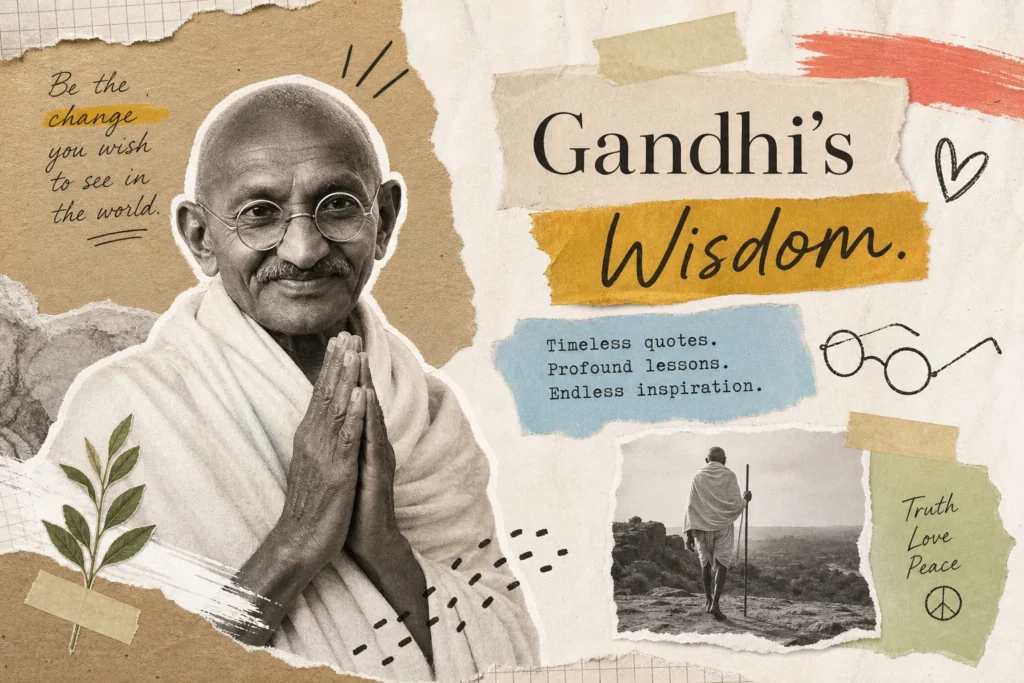
Gandhi’s famous sayings appear on classroom walls, graduation stages, Instagram feeds, and bumper stickers across America, widely circulated in popular culture more than 75 years after his death in 1948. That kind of staying power doesn’t happen by accident. His sayings endure because he didn’t write motivational content from a comfortable desk. He wrote from inside a real political struggle, through imprisonments, hunger strikes, and mass campaigns like the Salt March, and he tested every idea against his own life first.
When people search for a Gandhi saying to share, reflect on, or use in a speech, they often end up on curated collections like RainbowQuotes, where his words are organized by theme and easy to browse. This article covers the most important ones: what they actually mean, where they came from, and which popular versions are paraphrases rather than verbatim quotes. That distinction matters when you’re citing Gandhi in front of an audience or building a teaching moment around his ideas.
Three themes run through his most enduring words: personal change, nonviolence, and self-discipline. Each one cuts across cultural lines, which is why Gandhi’s philosophy found a second home in American civic life long before quote culture made him a household name.
Gandhi Famous Sayings on Being the Change You Want to See
“Be the change you wish to see in the world”: What It Really Means
This is Gandhi’s most recognized saying, and also one of the most misunderstood. The modern phrasing is a simplified version of a longer passage he wrote in Indian Opinion in 1913. The original text reads: “We but mirror the world. All the tendencies present in the outer world are to be found in the world of our body. If we could change ourselves, the tendencies in the world would also change. We need not wait to see what others do.” The clean, bumper-sticker version is likely a later paraphrase, Quote Investigator traces the slogan form to a 1974 self-help context (specifically, Arleen Lorrance’s “The Love Project”) rather than directly to Gandhi’s pen.
The core idea, however, is authentically his: external change starts with internal action. You don’t wait for conditions to improve before you act with integrity. For anyone following a personal development routine, this logic feels immediately familiar. Daily habits, mindset work, and consistent choices are all applications of the same principle Gandhi described in that 1913 Indian Opinion passage.
“The future depends on what we do in the present”
This saying is Gandhi’s call to stop waiting for the perfect moment to act. The present action, however small, is what builds tomorrow. Americans familiar with habit-formation research will recognize the same compound logic: small daily decisions accumulate into outcomes that look large in hindsight. Gandhi wasn’t writing productivity advice, but he understood that urgency lives in the present tense, not in some future when conditions finally align.
“My life is my message”
Short and direct, this Mahatma Gandhi quote captures his belief that character speaks louder than any declaration. Your actions are your argument, not your words. For anyone in a leadership or teaching role, this lands with particular weight. You can cite principles all day; what people actually absorb is what they observe you doing when the stakes are real. Expanding that idea slightly: the gap between what we say and what we do is where credibility is lost or earned, and Gandhi closed that gap more deliberately than almost any public figure of his era.
“Also read: Gandhi Wisdom Quotes: Timeless Lessons for Modern Life“
Gandhi Famous Sayings on Nonviolence and Peaceful Resistance
“Nonviolence is the greatest force at the disposal of mankind”
Gandhi published versions of this idea in Young India , his weekly newspaper, though researchers recommend citing the Gandhi Heritage Portal or the Collected Works of Mahatma Gandhi for the precise volume and date. The meaning is often misread as a call to passivity, but Gandhi was describing the opposite. Nonviolence, in his framework, was an active and disciplined force that required more courage than physical combat. You chose restraint not because you lacked the power to strike back, but because restraint took a deeper kind of strength. In the American context, this connects directly to how Dr. Martin Luther King Jr. studied Gandhi’s principles and applied them during the civil rights movement. King called Gandhi “the guiding light of our technique of nonviolent social change,” and built the Montgomery Bus Boycott and later campaigns on the same foundation.
“An eye for an eye makes the whole world blind”
This exact phrasing is a later popularization. Gandhi’s biographer Louis Fischer described Gandhi’s position in his 1950 biography this way: “An eye-for-an-eye-for-an-eye-for-an-eye… ends in making everybody blind.” That’s Fischer’s paraphrase, not a verbatim Gandhi quotation. The meaning still holds, and it’s authentically Gandhian in spirit. Cycles of retaliation consume everyone in them. As commentary on 2026 discourse, it fits a recognizable pattern: online arguments, political polarization, and social media conflicts tend to escalate through reciprocal escalation rather than resolve through restraint.
“Nonviolence is a weapon of the strong”
Published in Young India , this Gandhi nonviolence quote was his direct counter to the assumption that pacifism equals weakness. He believed that choosing restraint in the face of provocation required extraordinary inner discipline. This is the idea behind the practical advice “don’t react, respond.” Reacting from anger is easy; choosing your response is the harder, more powerful move. Gandhi wasn’t describing a soft approach. He was describing a demanding one.
Gandhi Famous Sayings on Self-Discipline and Inner Strength
“Strength does not come from physical capacity. It comes from an indomitable will”
Gandhi wrote this in Young India on 11 August 1920. The fuller passage reads: “I do not believe myself to be a helpless creature. Only I want to use India’s and my strength for better purpose… Strength does not come from physical capacity. It comes from an indomitable will.” This reframes what strength means entirely. It’s not gym stats or credentials or resources. It’s the refusal to quit when circumstances push back hard. For anyone working through a difficult season, a career setback, a health challenge, or a period of grief, this idea offers something more useful than motivation. It offers a definition of resilience that doesn’t depend on external conditions.
“Live as if you were to die tomorrow. Learn as if you were to live forever”
This is widely shared as Gandhi’s, though it is not definitively pinned to a specific text in his Collected Works, and researchers treat it as unverified or evolved from earlier ideas. Whether or not the exact phrasing originated with him, the pairing of urgency with humility is completely consistent with how Gandhi lived and wrote. Act now, because time is finite. Keep learning, because understanding is always incomplete. For anyone in their twenties or thirties building skills and navigating uncertainty, this two-part idea holds genuine practical weight.
“Speak only if it improves upon the silence”
One of Gandhi’s more underrated sayings, and one that feels more relevant now than perhaps at any earlier point in modern life. The quote’s precise source hasn’t been pinned to a specific dated text, so treat it as widely attributed rather than definitively verified. That said, the pressure to comment, post, and react to everything is a defining feature of contemporary culture. Gandhi’s standard was simple: if what you’re about to say doesn’t add something real, silence is the better contribution. That’s not timidity; it’s discipline applied to communication.
Gandhi Quotes on Service, Forgiveness, and Compassion
“The best way to find yourself is to lose yourself in the service of others”
This saying cuts against a tension deeply embedded in American culture: the pursuit of individual identity in a society that prizes self-optimization above almost everything else. Gandhi’s answer is counterintuitive. You find clarity about who you are by shifting focus outward, not inward. The practical application is more accessible than it sounds. Volunteering, mentoring, or simply showing up consistently for someone else changes your perspective on your own problems. Service moves you out of your own head, and that shift tends to clarify what actually matters to you.
“The weak can never forgive. Forgiveness is the attribute of the strong”
This saying is widely attributed to Gandhi and appears across multiple compilations, though researchers note that the exact wording is difficult to trace to a specific dated text in his writings, sources like Quote Investigator and Wikiquote document this attribution gap. The idea is consistent with his broader philosophy, and the meaning is precise: holding a grudge requires no courage at all. Letting go intentionally, refusing to let harm define your next chapter, is the harder and rarer act. This isn’t about excusing what happened. It’s about deciding that the harm stops with you rather than continuing through your responses. That distinction connects directly to conversations around mental wellness and healing that resonate deeply in the US right now.
Why Gandhi’s Words Still Land in American Life Today
Gandhi’s influence on American conscience
Gandhi’s famous sayings shaped how Americans think about moral courage, civic duty, and the ethics of protest long before they became social media staples. His philosophy gave Dr. King a practical framework for organizing nonviolent resistance against segregation, documented in King’s own writings and speeches, and that framework shaped one of the most consequential social movements in American history. Today, his words appear in leadership training programs, wellness communities, social justice conversations, and classrooms across the country. He wasn’t writing for America, but his ideas translated well into a culture that values individual responsibility alongside collective action.
Using his sayings with intention, not just as captions
Many of Gandhi’s most-shared lines have been simplified, paraphrased, or loosely attributed over time, a pattern documented by Quote Investigator, Wikiquote, and scholars of the Collected Works. The meaning often survives the paraphrase, but the original context makes you a significantly better communicator when you use his words. Knowing that “Be the change” grew from a 1913 Indian Opinion passage about mirroring the world gives you something richer to say than the bumper-sticker version. A Gandhi quote is only as powerful as the understanding you bring to it. Whether you’re writing a speech, building a classroom lesson, or crafting a post, the context is what makes the citation land with real weight rather than just borrowed authority.
Explore Gandhi’s Full Quote Collection at RainbowQuotes
Browse Gandhi’s sayings organized by theme
RainbowQuotes is a free platform with a dedicated Gandhi author collection that goes well beyond the famous dozen most people recognize. Readers who want to explore his views on courage, truth, education, simplicity, and self-reliance can browse quotes organized by topic. The site also features quotes by Mohandas K. Gandhi alongside words from other influential figures, from Eastern philosophers to Western innovators, making it a single destination for curated wisdom rather than a scattered search across multiple sites.
Share Gandhi’s words with picture quotes ready for social media
RainbowQuotes offers shareable picture quotes designed for social media sharing on platforms like Instagram, Pinterest, and Facebook. For social media creators, educators building classroom decks, or anyone who wants a clean, attribution-ready image of a Gandhi saying, the design work is already done. Browse the collection and share something meaningful without building it from scratch.
One saying, one week: how to actually use Gandhi’s wisdom
Gandhi’s words are worth more than a scroll-past. They came from a man who tested every idea against real life, often at significant personal cost, through fasts, trials, and years of imprisonment. He didn’t write for virality. He wrote from inside a struggle, which is exactly why his words still feel honest when most motivational content feels hollow.
The three themes in these Gandhi quotes on life form a coherent whole: change starts with you, strength is an act of will, and compassion scales further than retaliation ever does. Pick one saying that genuinely connects with where you are right now. Sit with it for a week before moving on to the next. That’s closer to how Gandhi intended these ideas to work than reading thirty quotes in a single sitting and feeling briefly inspired.
For anyone who wants to keep exploring his wisdom or find a shareable image for a saying that moved them, the full Gandhi collection is waiting at RainbowQuotes, free and easy to browse by theme.