You open your journal. The page is blank. The cursor blinks or the pen hovers, and nothing comes. For many journalers, the blank page is a major barrier, it offers no direction, no mood, no invitation to begin. If you’re looking for the best inspirational quotes to write in your journal, the right line at the top of the page can be exactly what breaks that silence.
That’s exactly what a well-chosen quote fixes. A single line at the top of the page acts as a first sentence you didn’t have to write yourself. It sets the emotional register, gives your entry a direction, and creates momentum before you’ve committed to a single original word. The best quotes to write in your journal aren’t decoration. They are prompts wearing a different costume.
Before you even uncap your pen, RainbowQuotes lets you browse curated journaling quotes filtered by mood, copy the exact text in one tap, or save it as an image you can keep open while you write. Finding the right line takes seconds, not a scroll through ten unrelated tabs. This article organizes proven quotes by theme, pairs each one with a journaling prompt, and closes with practical placement tips for any journal layout, from daily spreads to bullet journal covers.
Why a single quote transforms a journal entry
How a quote anchors your emotional tone before you write
A quote functions as an anchor sentence: it tells your brain what kind of entry this is before your own words have to do that work. When you choose a resilience quote, your brain begins framing events as challenges to overcome. When you choose a calm, reflective line, the entry that follows tends to slow down and go deeper. Mood-aligned quotes help reduce the blank-page paralysis that leads many journalers to close the notebook before writing a single word.
Short inspirational quotes are especially effective here because they’re fast to read and absorb. You don’t have to think through a long passage before you start. One sentence lands, you feel its weight, and the pen begins moving. Picture it this way: the quote gives you an emotional doorway to step through, and your own words follow naturally once you’re inside. That’s the entire mechanism, and it works with a consistency that surprises most people who try it.
Attributed vs. anonymous quotes: why it matters for journaling
Knowing who said something adds a second layer of utility. An attributed quote naturally prompts the question: what did this person know that I don’t? That question alone is a journaling prompt. When you write “You may encounter many defeats, but you must not be defeated” and you know Maya Angelou said it, you begin connecting her life to the words, and then your own life to both. Keep quotes short enough to write by hand without losing your momentum. A line that fits in a header or top margin, roughly fifteen to forty characters for tight layouts, or a short full sentence for wider pages, still carries full meaning without crowding the rest of the spread.
Best inspirational quotes to write in your journal for resilience
“You can’t stop the waves, but you can learn to surf”, commonly attributed to Jon Kabat-Zinn
This quote reframes struggle as skill-building rather than endurance. It doesn’t promise that hard things go away. It promises that your ability to move through them can grow, and that distinction matters enormously when you’re mid-difficulty and looking for a place to start writing. The surfing metaphor is concrete enough to picture, which makes the entry easier to write. Note that while this line is widely associated with Kabat-Zinn, the original source has not been definitively verified, so you may prefer to use it without attribution or add a brief “commonly attributed to” note.
Paired journaling prompt: What situation in my life right now needs a surfing mindset instead of a fighting one?
“Success is not final, failure is not fatal: it is the courage to continue that counts”, commonly attributed to Winston Churchill
This quote removes pressure from both outcomes and puts the emphasis back on action. If you’ve been treating a recent setback as a permanent verdict on your abilities, this line challenges that framing directly. Its three-part structure gives your entry a natural shape to follow if you want it. Worth noting: the exact wording and original source of this quote vary across references, so treat it as a widely circulated idea rather than a confirmed verbatim record.
Paired journaling prompt: Where have I been treating a setback as final? What would courage look like in this entry?
“You may encounter many defeats, but you must not be defeated”, Maya Angelou
The distinction between the event (defeat) and the identity (defeated) is one of the most powerful framings available for self-reflection journaling. Angelou’s phrasing makes the separation crisp: what happens to you is not who you are. That idea alone can open up an entire page of honest writing about how you’ve held yourself together through difficulty.
Paired journaling prompt: Write about one defeat you have not let define you. What did you protect about yourself in that moment?
Hope and self-worth quotes that remind you who you are
“Nothing can dim the light which shines from within”, Maya Angelou
At under ten words, this line fits cleanly as a page header in any layout, from a daily spread to a bullet journal weekly page. Its brevity is its strength: it lands immediately and leaves the rest of the page open for your own words. Use it at the top of a healing entry or on a week when external criticism has been loud.
Paired journaling prompt: When did you last feel that inner light clearly? Describe that moment in as much detail as you can.
“I am what I choose to become”, Carl Jung
This quote shifts the reader from passive identity to active authorship of their own life. It’s especially effective on goal-setting pages, monthly intention spreads, or any entry where you’re wrestling with the gap between who you are now and who you want to be. Jung’s framing is forward-looking without being unrealistic: it acknowledges choice without pretending change is easy.
Paired journaling prompt: What are you actively choosing to become this month? Name three specific choices, not outcomes.
“To be yourself in a world that is constantly trying to make you something else is the greatest accomplishment”, Ralph Waldo Emerson
Emerson wrote this in the 19th century, and it still resonates because external pressure on identity hasn’t gone anywhere. This quote works especially well for journal entries about social comparison, people-pleasing, or moments when you’ve compromised something important about yourself. It’s also public domain, which makes it a safe choice for any printable or shareable spread.
Paired journaling prompt: In what area of your life is external pressure loudest right now? How are you holding your ground?
Ambition and growth quotes to write on your goal-setting pages
“The journey of a thousand miles begins with one step”, Lao Tzu
Timeless, public domain, and applicable to any goal regardless of scale or type. This quote earns its place among the best motivational quotes for journaling because it makes large goals feel approachable without minimizing them. It’s also short enough to letter neatly in a bullet journal header without crowding the rest of the layout.
Paired journaling prompt: Name the goal you have been circling for months. What is the first step, in one sentence?
“Start where you are. Use what you have. Do what you can”, Arthur Ashe
Three short imperative phrases in sequence make this quote unusually versatile for bullet journal layouts. Each phrase can anchor its own section of a page, or the whole line can run across a top margin as a weekly header. It’s also one of the most grounding writing quotes for journals, because it removes the excuse of not being ready yet.
Paired journaling prompt: List what you actually have available to you right now: skills, time, people, energy. What does “do what you can” look like today?
“Every artist was first an amateur”, Ralph Waldo Emerson
This quote is especially useful for journalers who feel their writing, drawing, or creativity isn’t good enough to put on the page. Emerson’s point isn’t that effort eventually makes you great. It’s that amateurism is the required starting place, not a flaw to overcome before you begin. That reframe tends to unlock a lot of honest, productive writing.
Paired journaling prompt: What is one thing you are still an amateur at but want to commit to getting better at? What would consistent practice look like?
Where to write journal quotes on the page
Using a quote as a page header
Page headers work best with quotes in the one-to-four-word range, roughly fifteen to forty characters. This placement sets the emotional tone for the entire entry before you write a single word of your own. Lines like “Start where you are” or “Nothing can dim the light within” fit cleanly at the top of a daily spread and still carry full meaning at that scale.
Margin accents and white-space fillers
Unused corners alongside habit trackers or weekly logs are perfect for ultra-short phrases in the two-to-five-word range, around ten to twenty-five characters. These aren’t the main event of the page, but they quietly reinforce the mood of the entry. Single words like “Believe,” “Keep going,” or “Be brave” work especially well here, and they’re fast to letter by hand.
Building a full prompt page around one quote
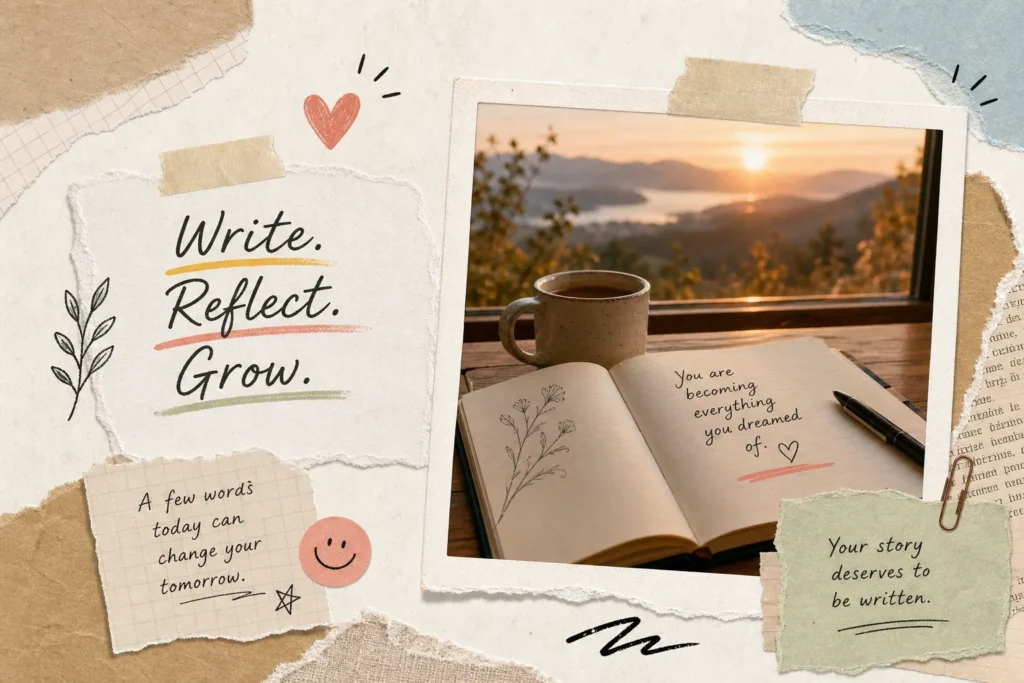
For longer, more reflective entries, dedicate an entire left-hand page to the quote, its attribution, and the paired journaling prompt. Leave the right-hand page completely blank for the entry itself. Many journalers find that this format signals intentionality and encourages slower, more honest writing than a crowded daily spread allows.
The easiest way to find quotes for journals before you write
Browse by mood so the quote actually fits the entry you need to write
The real problem with most quote searches isn’t volume. There are millions of quotes online. The problem is relevance: finding a quote that matches your exact emotional state in the moment, quickly enough that you don’t lose your journaling momentum before you even start. RainbowQuotes addresses this with mood-based filters including Hopeful, Healing, Focused, Calm, and Motivated, each of which maps directly to a journaling theme. No more scrolling through generic images hoping something resonates.
The platform offers a large, curated collection organized across hundreds of topics, with dedicated collections for journaling, morning motivation, healing, and more. The curated editorial collections are especially useful when you know the general territory, grief, ambition, gratitude, but can’t land on the exact line that fits the entry you’re about to write.
Copy or save as an image in one tap, then write
On RainbowQuotes, you can copy any quote directly into a digital journal or note app in one step. The save-as-image option creates a reference-ready visual you can keep open on your phone while you write longhand in a physical journal. Attribution is included on every quote card, so you can stay in the writing flow without stopping to track down a source. That small friction removal makes a genuine difference when momentum matters most.
Start with one line today
A blank journal page feels less intimidating when you already know the first line. The quotes that work best in a journal aren’t the ones that sound the most polished in general. They’re the ones that match where you actually are emotionally right now: reaching for resilience, rebuilding self-worth, setting a goal you’ve been afraid to name, or simply trying to show up consistently.
Think about which of today’s three themes fits where you are right now. If you’re navigating difficulty, the resilience quotes give you a starting place. If you’ve been hard on yourself lately, the self-worth and hope quotes offer a steadier frame. If there’s a goal you’ve been circling, the growth quotes will push you to name it. Each one comes paired with a prompt designed to pull an honest entry out of whatever the quote stirs up.
Pick one of the best inspirational quotes to write in your journal from the sections above, write for ten minutes without stopping, and see where it takes you. When you’re ready to find your next line, visit RainbowQuotes, filter by your mood, and let the words pull the rest of the entry out of you.