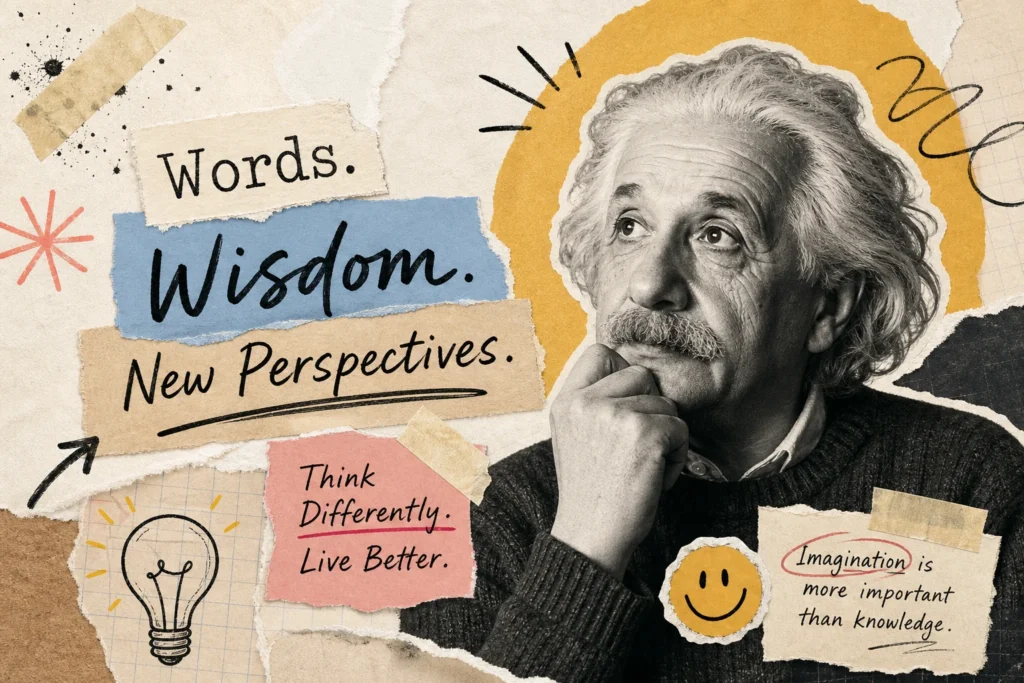
Albert Einstein died in 1955, yet his words show up on classroom walls, graduation speeches, Instagram feeds, and motivational slideshows every single day. That kind of staying power doesn’t happen by accident. These Albert Einstein quotes endure because Einstein had a rare and distinctive gift: the ability to compress big, uncomfortable truths into sentences simple enough to carry in your pocket. That’s one interpreter’s view, of course, but it’s hard to argue with 70 years of evidence.
This article doesn’t just list quotes. Each one comes with context, so you understand what Einstein actually meant, not just what sounds good in a caption. The 50 quotes are organized into four core themes: curiosity, imagination, education, and life philosophy. You’ll also find a short sourcing guide at the end, because knowing which quotes Einstein actually said makes the ones you use far more powerful.
Browse the full RainbowQuotes Albert Einstein collection to find all 50 quotes organized by theme, with shareable picture quote downloads ready to go.
Albert Einstein Quotes on Curiosity: His Most Defining Theme
Of all the ideas Einstein returned to across his life, curiosity was the one he never stopped defending. For him, it wasn’t a personality trait reserved for geniuses. It was a habit, a discipline, and a form of courage.
The “holy curiosity” quote and where it comes from
“The important thing is not to stop questioning. Curiosity has its own reason for existence.” This is one of Einstein’s most reliably sourced sayings, appearing in a LIFE magazine article published on May 2, 1955, titled “Old Man’s Advice to Youth: ‘Never Lose a Holy Curiosity.'” The article captured Einstein in interview form near the end of his life, and the longer passage most people abbreviate is worth reading in full. The phrase “never lose a holy curiosity” is actually the article’s title, not a standalone quote, but both the title and the passage come from the same verified context.
Questioning isn’t a distraction from intelligence, it’s the engine of it. Einstein believed curiosity had its own internal logic, independent of any goal or outcome. He returned to this idea in letters, interviews, and essays across decades, which is part of why the LIFE passage feels so much like a summation rather than an offhand remark.
More Albert Einstein curiosity quotes worth knowing
“I have no special talents. I am only passionately curious.” This is one of the most disarming things Einstein ever said about himself. He wasn’t downplaying his intellect; he was reframing where intellect comes from. Curiosity, not fixed genius, was his actual explanation for his achievements. For the most accurate wording, Alice Calaprice’s The Ultimate Quotable Einstein uses the plural “talents,” which appears to be the version closer to the verified source.
“It is a miracle that curiosity survives formal education.” Einstein wasn’t being dismissive of teachers. He was pointing out that systems built around testing and memorization can squeeze out the open-ended wondering that leads to real discovery. Two additional curiosity quotes worth bookmarking:
- “It is a miracle that curiosity survives formal education.”
- “The mind that opens to a new idea never returns to its original size.” (widely attributed to Einstein; exact primary-source documentation is uncertain, so treat as paraphrased rather than fully verified)
Albert Einstein Quotes on Imagination and Creativity
If curiosity is the engine in Einstein’s philosophy, imagination is the destination. His creativity quotes are among the most widely shared Einstein sayings on social media, and for good reason: they speak directly to anyone who has ever been told that logic is the only legitimate form of intelligence.
“Imagination is more important than knowledge”, what he really meant
This is one of the most robustly verified Einstein quotations. It traces to his 1929 essay “What Life Means to Einstein,” published in The Saturday Evening Post on October 26, 1929. The full version makes the logic clearer: “Knowledge is limited. Imagination encircles the world.” Einstein’s point was precise: knowledge only describes what already exists, while imagination reaches toward what doesn’t yet. That distinction matters in science, and it matters just as much in writing, design, entrepreneurship, and personal reinvention.
The logic vs. imagination contrast
“Logic will get you from A to B. Imagination will take you everywhere.” This quote is one of the most popular in the Einstein catalog, and it captures the same idea as the knowledge quote, but with more movement and energy. Its primary-source documentation is less clear than the 1929 essay, so treat it as widely attributed rather than fully verified.
Two more imagination quotes with solid standing in Einstein’s attributed writings:
- “The true sign of intelligence is not knowledge but imagination.”, positions creative thinking as the higher cognitive skill. (commonly attributed; cite Calaprice for the earliest located source)
- “I am enough of an artist to draw freely upon my imagination.”, Einstein describing how imaginative thinking shaped even his scientific work. (commonly attributed; cite Calaprice for the earliest located source)
These famous Einstein quotes are among the most shareable for content creators, educators, and anyone building a social media presence around self-improvement or creative work.
What Einstein Believed About Education and Learning
Einstein had complicated feelings about formal schooling. He valued learning deeply, but he was suspicious of any system that prioritized memorization over understanding. His education quotes carry that tension in almost every line.
His most quoted critique of formal education
“It is a miracle that curiosity survives formal education.” The spirit behind this is straightforward: schools often reward students for giving correct answers, not for asking better questions. Einstein spent his career doing the opposite. Pair this with “Intellectual growth should commence at birth and cease only at death,” and you get a fuller picture. Education, for Einstein, wasn’t a phase of life. It was life itself.
The fairy tale quote and what it reveals
“If you want your children to be intelligent, read them fairy tales. If you want them to be more intelligent, read them more fairy tales.” This surprises people coming from a physicist, but it fits perfectly with Einstein’s worldview. He wasn’t recommending fantasy over facts. He was making the case that imaginative thinking, the kind fairy tales develop, is the actual foundation of intelligence. This quote resonates strongly with parents, educators, and coaches because it reframes what “smart” really means.
Learning as a lifelong habit in his own words
Two shorter sayings compress the same principle into memorable form: “The measure of intelligence is the ability to change” and “Once you stop learning, you start dying.” Note that both phrasings lack clear primary-source documentation in the Einstein Archives or Calaprice, so treat them as widely attributed rather than fully verified. Even so, they reinforce the idea that runs through every education-themed quote in this collection: the goal is ongoing growth, not a credential. Einstein’s own life modeled this. He kept questioning, kept revising, kept learning until the end.
Life Philosophy: Purpose, Perspective, and Everyday Wisdom
Some of Einstein’s most beloved quotes have nothing to do with science. They’re about how to move through the world with purpose and perspective, and they’re among the most emotionally resonant for readers going through difficult transitions.
The bicycle quote and what resilience looks like
“Life is like riding a bicycle. To keep your balance, you must keep moving.” This one has a confirmed origin: a letter Einstein wrote to his son Eduard on February 5, 1930. The familiar English version is a translated paraphrase of the German original, but the meaning survives the translation beautifully. Motion as a metaphor for resilience is something nearly anyone can feel immediately. You don’t master balance by standing still; you find it by moving forward.
Success, value, and living for others
“Try not to become a man of success, but rather try to become a man of value.” This is one of Einstein’s most cited motivational quotes, and it holds up under scrutiny because it shifts the entire frame of ambition. Success is what you accumulate. Value is what you contribute. For a generation rethinking careers and purpose, this quote lands differently than it might have in a more status-driven era.
“Only a life lived for others is a life worthwhile” and “In the middle of difficulty lies opportunity” extend this theme. Both are commonly listed among Einstein’s life philosophy quotes, though readers wanting the most authoritative confirmation should cross-reference Calaprice or the Einstein Archives before citing them formally.
Wonder, miracles, and perspective
“There are only two ways to live your life. One is as though nothing is a miracle. The other is as though everything is a miracle.” Einstein wasn’t making a religious argument here. He was describing an orientation toward reality: choose wonder, and ordinary moments become significant. This quote resonates most with readers who are navigating grief, burnout, or any period where meaning feels hard to access.
A Quick Guide to Sourcing: Which Einstein Quotes He Actually Said
Using a quote with confidence means knowing whether Einstein actually said it. A handful of his most viral sayings turn out to have shaky or nonexistent ties to him, and knowing the difference protects your credibility whether you’re writing an essay, building a presentation, or posting on social media.
The “insanity” quote isn’t his
“Insanity is doing the same thing over and over and expecting different results.” This is one of the most-shared misattributed Einstein quotes on the internet, and Einstein had nothing to do with it. The earliest documented appearance comes from a 1981 newspaper article describing an Al-Anon meeting in Knoxville, Tennessee. Rita Mae Brown included the line in her 1983 novel Sudden Death, which helped spread it further, but neither source is Einstein. He died in 1955, well before this phrase entered circulation. For a deeper look at how phrases travel and get misattributed, see this investigation into the quote’s origins. Citing this as an Einstein quote undermines your credibility instantly with anyone who has done the research.
Other sayings to use with caution
“Not everything that counts can be counted, and not everything that can be counted counts.” This one is frequently plastered on classroom walls as an Einstein quote, but its authorship is actively debated among researchers. It has been linked to sociologist William Bruce Cameron (1963) and to economist E.F. Schumacher’s 1973 book Small Is Beautiful, among others. The origin remains disputed, so treat it as unverified rather than attributing it confidently to any single source. “Two things are infinite: the universe and human stupidity; and I’m not sure about the universe” is widely circulated but also lacks a confirmed primary source. “Logic will get you from A to B” is popular but similarly underdocumented. Being honest about what’s verified doesn’t weaken your use of these ideas, it makes your use of the confirmed quotes stronger.
How to verify an Einstein quote before you use it
Alice Calaprice’s The Ultimate Quotable Einstein is the most authoritative secondary source available. It tracks citation trails, documents earliest known appearances, and flags unverified attributions. For primary sources, the Albert Einstein Archives and his Collected Papers are the gold standard. As a quick practical test: if a quote doesn’t appear on Wikiquote with a cited source, treat it as unverified until you find documentation elsewhere. For more on how viral misquotes evolve and replicate, which often explains why false attributions feel so convincing, consult the research summarized in the linked analysis.
Explore and Share All 50 Albert Einstein Quotes on RainbowQuotes
RainbowQuotes has built a dedicated Albert Einstein author collection that organizes his most famous sayings by theme: curiosity, imagination, education, life, and success. Readers who want to go beyond the highlights covered here can browse the full set of 50 quotes, find verified attributions, and discover lesser-known Einstein sayings alongside his most iconic lines.
Every Albert Einstein quote in the RainbowQuotes collection is also available as a shareable picture quote, designed for Instagram, Pinterest, and Facebook. The image quotes use clean layouts with proper attribution and pin-ready formatting. Whether you’re a content creator looking for caption material, an educator building a classroom display, or someone who simply wants to send a friend the right words at the right moment, the picture quote library makes it straightforward to find and share exactly what you’re looking for.
Einstein’s words endure because they cover four themes that never go out of style: curiosity, imagination, education, and how to live with purpose. Understanding the context behind each quote makes them sharper and more useful, whether you’re citing them in a speech or reflecting on them privately. And knowing which Albert Einstein quotes are verified matters just as much as knowing what they say. The difference between a sourced Einstein quote and a viral misattribution is the difference between building credibility and quietly eroding it. The reliable ones are powerful enough on their own.
Head over to RainbowQuotes to explore the full collection, organized by theme and ready to share.
FAQ
Q: What themes organize the 50 Albert Einstein quotes in this article?
A: The quotes are organized into four core themes: curiosity, imagination, education, and life philosophy. Each section groups related sayings and provides context so you understand what Einstein actually meant rather than just a catchy caption.
Q: Where does the “never lose a holy curiosity” quote come from?
A: That phrasing comes from a LIFE magazine article published May 2, 1955, titled “Old Man’s Advice to Youth: ‘Never Lose a Holy Curiosity.'” The phrase is actually the article’s title, and the longer passage quoted in the piece provides the verified context for the saying.
Q: Did Einstein really say “I have no special talents. I am only passionately curious.”?
A: Yes — this is one of Einstein’s well-known self-descriptions, though wording can vary in sources. Alice Calaprice’s The Ultimate Quotable Einstein records a version using the plural “talents,” which appears closer to the verified source, so check quoted wording against trusted compilations when possible.
Q: What did Einstein mean by “Imagination is more important than knowledge”?
A: That quote is robustly verified and traces to his 1929 essay “What Life Means to Einstein,” published in The Saturday Evening Post. The article explains that for Einstein imagination was the destination of inquiry: it opens possibilities beyond existing facts and challenges the idea that logic or memorized knowledge are the only forms of intelligence.
Q: How can I tell if a popular Einstein quote is authentic or misattributed?
A: Use the article’s short sourcing guide and consult primary sources cited there, such as interviews in LIFE and authoritative compilations like Alice Calaprice’s The Ultimate Quotable Einstein. Be cautious with widely circulated lines (for example, “The mind that opens to a new idea never returns to its original size.”) because their exact primary-source documentation is uncertain and they may be paraphrases rather than verbatim quotes.
Q: Where can I find all 50 quotes and shareable images mentioned in the article?
A: The full RainbowQuotes Albert Einstein collection referenced in the article organizes all 50 quotes by theme and offers shareable picture quote downloads ready to use. The collection pairs each quotation with the contextual notes the article provides.
Q: Why do Einstein’s quotes still appear on classroom walls and social media today?
A: The article argues they endure because Einstein had a rare gift for compressing large, uncomfortable truths into simple, portable sentences. By pairing each quote with context, the piece shows why those short lines still resonate and how understanding their origins makes them more powerful.