Warren Buffett has never written a self-help book. He’s never hosted a podcast or sold a course. Yet his words show up in boardrooms, morning journals, and Instagram captions across the world because they cut through noise in a way that most financial commentary never does. These Warren Buffett quotes have earned their staying power: a single well-chosen Buffett line can genuinely reframe how you think about money, patience, and the life you’re building.
This list gathers 50 of his most powerful Warren Buffett quotes organized by theme: investing wisdom, success and business philosophy, life lessons, hidden shareholder-letter gems, and three concrete takeaways you can apply starting today. For a few of the most famous lines, you’ll find a note on the original source or a flag where the popular version is a slight paraphrase of what Buffett actually wrote. If you want to explore his full quote library alongside other legendary minds like Charlie Munger, Einstein, and Maya Angelou, RainbowQuotes’ author spotlight feature has everything organized for easy browsing and one-tap sharing.
Warren Buffett quotes on investing
These are the Buffett quotes that built his reputation. They didn’t go viral by accident. Each one captures a principle that runs counter to how most people instinctively behave with money, which is exactly why they’ve lasted.
Patience, price, and the long game
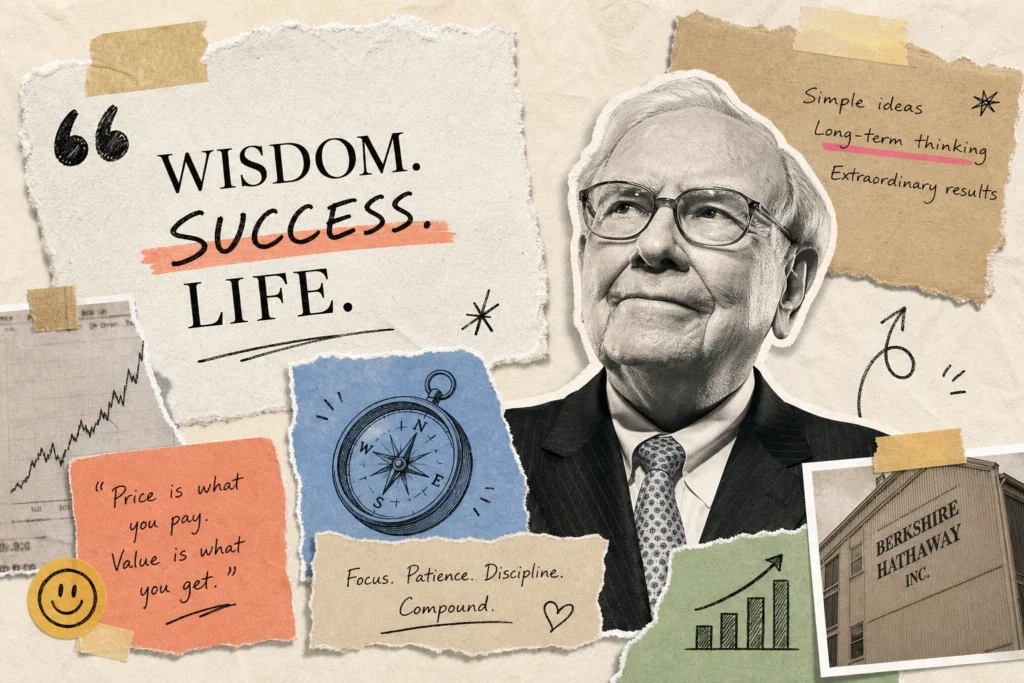
“Price is what you pay; value is what you get.” Buffett confirmed this in the 2008 Berkshire Hathaway shareholder letter, crediting the idea to his mentor Ben Graham. The distinction matters more than it sounds: the market tells you the price every day, but value is something you have to figure out yourself.
“It’s far better to buy a wonderful company at a fair price than a fair company at a wonderful price.” This line is widely attributed to Buffett’s Berkshire Hathaway shareholder letters, appearing in various forms across the 1989 and later letters, and it widely influenced how investors think about bargain hunting. The lesson isn’t to overpay for quality, but to stop chasing cheap mediocrity just because the multiple looks attractive.
“If you aren’t willing to own a stock for ten years, don’t even think about owning it for ten minutes.” This widely repeated Buffett aphorism is about conviction, not stubbornness. The point is that if you can’t articulate why a business will be worth more a decade from now, you don’t actually understand it yet. “Our favorite holding period is forever,” from the 1996 shareholder letter, reinforces the same compounding philosophy: outstanding businesses with outstanding management deserve permanent ownership, not a price target.
Fear, greed, and reading the crowd
“Be fearful when others are greedy, and greedy when others are fearful.” The original phrasing appeared in Berkshire’s 1986 shareholder letter, published in early 1987, though the quote gained its widest audience after Buffett used it in a New York Times op-ed during the 2008 financial crisis. The contrarian discipline it describes is simple to say and brutally hard to practice.
“The stock market is a device for transferring money from the impatient to the patient.” This widely attributed Buffett saying captures the psychological edge he prizes above any analytical formula. Most investors lose not because they’re wrong about a company’s value. They lose because they sell before the market agrees with them. “Only when the tide goes out do you discover who’s been swimming naked” works as a companion line, another widely circulated Buffett aphorism: overleveraged strategies look fine until conditions tighten, and then the exposure is sudden and obvious.
Warren Buffett quotes on success and business decisions
Buffett’s business philosophy is built on the same principles as his investing philosophy. Quality, honesty, and clear-eyed judgment over short-term convenience. These Buffett lines reflect that consistency.
On building something worth owning
“It takes 20 years to build a reputation and five minutes to ruin it.” This line is widely reported as something Buffett shared with his son Howie, though the exact original source has not been definitively pinned down. It applies equally to personal brands, companies, and professional relationships. The asymmetry is the point: you can’t deposit reputation in a lump sum, but you can erase it in a single moment of poor judgment.
“Don’t ask the barber whether you need a haircut.” This shareholder letter line is a compact warning about conflicted advice. Any decision-maker who relies on counsel from someone with a stake in the outcome needs to apply a significant discount to what they hear.
“Risk comes from not knowing what you’re doing” reframes the concept entirely: risk isn’t a market condition, it’s a knowledge deficit. This widely attributed Buffett idea holds that the more deeply you understand what you own, the less you’re actually exposed to. The more deeply you understand what you own, the sharper your real advantage becomes.
Watch the full quote when citing “Diversification is protection against ignorance.” The second sentence is the one that changes everything: “It makes little sense if you know what you are doing.” Most online versions drop that second half, turning a nuanced observation about competence into a blanket anti-diversification slogan. That misreads Buffett’s actual position completely.
On judgment, mistakes, and moving forward
“In the business world, the rear-view mirror is always clearer than the windshield.” This is the correct original phrasing, often smoothed into a generic driving metaphor in secondary sources. The real meaning is that hindsight feels definitive while foresight is always murky, which is why humility belongs in every business decision.
“It is madness to risk losing what you need in pursuing what you simply desire,” from the Berkshire letters, is perhaps the cleanest one-sentence definition of risk management ever written.
In the 2024 shareholder letter, Buffett reflected that he had used the words “mistake” or “error” 16 times across his letters from 2019 through 2023. That kind of public accountability is rare for someone of his stature, and it adds real weight to everything else he says. As a pattern, people who acknowledge errors clearly tend to course-correct faster than those who don’t.
Warren Buffett quotes on life, habits, and what money can’t measure
Some of Buffett’s most powerful lines have nothing to do with markets. They’re about how he spends his time, who he spends it with, and what he thinks success actually looks like when measured honestly.
On self-investment and daily habits
“The most important investment you can make is in yourself.” This tops any portfolio allocation strategy because the return compounds directly into every decision you make. “Chains of habit are too light to be felt until they are too heavy to be broken” captures the same compounding principle applied to behavior: the habits you ignore today are the patterns that define you in ten years.
“I insist on a lot of time being spent, almost every day, to just sit and think.” Buffett is well-documented as someone who reads extensively each day and protects his calendar with unusual discipline, a practice he has described in multiple interviews and shareholder letters. The lesson for anyone building a thinking practice: unstructured time for reflection isn’t idleness; it’s your sharpest competitive advantage.
On relationships, time, and what success actually looks like
“It’s better to hang out with people better than you. Pick out associates whose behavior is better than yours and you’ll drift in that direction.” Environment shapes behavior more reliably than willpower does. “You’ve got to keep control of your time, and you can’t unless you say no” connects directly to this: protecting your calendar is the same discipline as protecting the quality of your inner circle.
“If you get to my age in life and nobody thinks well of you, I don’t care how big your bank account is, your life is a disaster.” This is Buffett’s clearest definition of a life well-lived: not net worth, but the quality and depth of the relationships you built along the way. It belongs among the most valuable things he’s ever said, and it has nothing to do with a stock pick.
Hidden gems from Berkshire Hathaway’s shareholder letters
Most people know the greatest hits. These Berkshire Hathaway quotes from the annual letters deserve far more attention. They’re sharper, more specific, and harder to fake than the lines that spread on social media.
Lines that didn’t go viral but should have
“When it’s raining gold, reach for a bucket, not a thimble.” This is about opportunity sizing: when market conditions create genuine value, timidity is its own form of error. “The weeds wither away in significance as the flowers bloom. Over time, it takes just a few winners to work wonders,” from the 2022 letter, captures asymmetric compounding more cleanly than most textbooks manage in an entire chapter.
“Father Time is undefeated.” From Buffett’s later letters, this line stands out for its rare personal candor. It implies something important for organizations: build systems and cultures that outlast any single person, including the founder. “Look after those who, through no fault of their own, draw the short straw in life,” from the 2024 letter, positions Buffett as a thinker whose framework extends well beyond capital allocation.
What the most recent letters signal
The 2024 shareholder letter emphasized holding cash as a first line of defense and included a direct appeal on fiscal responsibility: “We rely on you to uphold a stable currency.” That kind of civic candor is unusual in a document aimed at shareholders. “Don’t beat yourself up over past mistakes, learn at least a little from them and move on,” from the same letter, is practical advice for anyone carrying regret about a past financial or life decision.
The shareholder letters are free to read on Berkshire Hathaway’s website. The writing is more quotable than most business books, and the source is primary. If you prefer to find and save your favorite Buffett lines without the archival digging, RainbowQuotes organizes his most notable quotes by theme, picture someone searching for exactly the right words before a big decision and finding them in seconds, with share-ready formatting already built in.
Three lessons from Buffett’s philosophy you can use starting today
Think in decades, not quarters
The single most transferable Buffett principle is the time horizon shift. Whether you’re weighing a career move, a relationship, or an investment, asking “how does this look in ten years?” filters out most bad choices before they cost you anything. The Buffett saying about not owning a stock for ten minutes if you wouldn’t hold it for ten years applies equally well to the job you’re considering, the business you’re starting, and the habits you’re forming right now.
Know what you know, and build around that edge
Pair “Diversification is protection against ignorance” with the idea that risk comes from not knowing what you’re doing, and the lesson becomes precise: identify your circle of competence, resist the pressure to expand it faster than your understanding actually grows, and make decisions from a position of knowledge rather than FOMO. Broad exposure to things you don’t understand isn’t safety. It’s a different kind of risk wearing a diversification label.
Guard your reputation and your time like capital
Reputation compounds exactly like an investment: it builds slowly through consistent behavior and can be erased in a moment. The “twenty years to build, five minutes to ruin” line isn’t just a warning about scandal, it’s a reminder that every small decision either strengthens or undermines what you’ve built. Connect that to the “say no” quote and the daily thinking habit, and you get a single discipline practiced two ways: protect what you’ve built, and protect the time you need to keep building it.
Why these Warren Buffett quotes still matter
Buffett says plainly what most people in finance overcomplicate. The three principles above aren’t abstract philosophy: they show up in the decisions he’s documented publicly, his well-known caution around technology stocks in the 1990s, his preference for holding cash through volatile markets, and his practice of admitting errors clearly in writing, year after year.
This collection covers 50 highlights, but his full body of wisdom runs much deeper. The RainbowQuotes author spotlight for Warren Buffett brings together his complete quote library, organized by theme, so you can find the right Buffett quote for exactly where you are right now, whether you’re grounding a business decision, starting a journaling practice, or looking for a caption that actually says something.
Words this precise don’t just sound good. They shift how you think, and as Buffett has shown us, that kind of shift compounds.