Affirmations vs quotes: you’ve done it. You scroll through a quote feed, something hits different, you screenshot it, save it to a folder you’ll probably never open again, and think: okay, that felt like self-improvement. But was it? And if not, what would the “real” version actually look like? This is one of the most common questions readers bring to RainbowQuotes, where we curate thousands of motivational quotes. It’s a genuinely good question, and the honest answer is that both affirmations and inspirational quotes work, just not in the same way, for the same purpose, or at the same time.
This article breaks down the actual difference between the two, explains what the research says about each, tells you when to reach for one versus the other, and gives you a working formula to write affirmations of your own. You’ll also find 20 ready-to-use examples organized by life area so you can start today without overthinking it.
Affirmations vs Quotes: What Actually Separates One From the Other
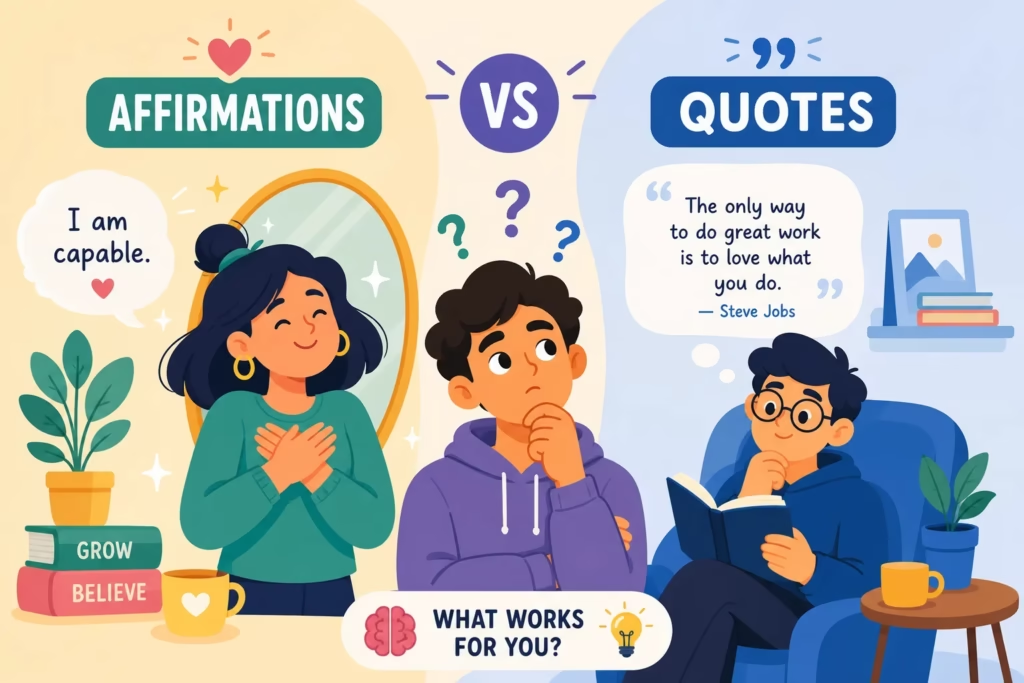
An affirmation is a short, personal, present-tense statement you repeat to assert something as true for yourself right now. “I am capable of doing hard things.” “I handle pressure well.” The subject is typically you, the tense is typically present, and the goal is always to claim a truth rather than discover one. An inspirational quote, by contrast, is someone else’s observation, usually written in general terms, that you read to gain perspective or feel a shift in your thinking. It describes; an affirmation declares. When you think about affirmations vs quotes at a structural level, that distinction is everything.
The personal versus general distinction
“I am enough” is an affirmation. It speaks directly to the person saying it and plants a present-tense claim. “Believe you can and you’re halfway there” is a quote. It offers advice from the outside looking in. Both carry the theme of self-belief, but they land differently in the brain. The affirmation asks you to claim something; the quote asks you to consider something. That structural gap is exactly why mixing them up leads to confusion about which one is “working.”
How each one functions in practice
Affirmations work through repetition. Stated consistently and with conviction, they condition the brain to accept a new self-narrative over time, gradually weakening old, limiting thought patterns, a process consistent with neuroplasticity research, though the timeline typically spans weeks to months rather than days. Quotes work through recognition and resonance: a well-chosen line from a writer like Viktor Frankl or Toni Morrison can reframe how you’re seeing a situation in a single reading in a way that’s difficult for a personal statement to replicate. Neither tool is better than the other; they serve completely different cognitive and emotional functions. Knowing which one to reach for, and when, is where real personal development happens.
What the Science Actually Says About Self-Affirmation
Self-affirmation is a legitimate, researched psychological intervention with measurable effects. It is not just feel-good repetition. Research by Creswell et al. (2005) showed that value-based affirmations reduce cortisol stress responses in undergraduates, meaning the stress-reduction effect is physiological, not just perceived. A meta-analysis of 52 studies found small but statistically significant gains in general well-being (effect size 0.29) and social well-being (0.26), and a separate meta-analysis across 144 educational studies found a mean effect size of approximately 0.41 on academic performance.
Key findings on mood, stress, and behavior change
The outcomes most relevant to daily practice include reduced anxiety symptoms, improved mood over time, increased openness to behavior change, and meaningful gains in follow-through on health and personal goals. “Small” in research terms still translates to real experience: people who practice affirmations consistently report noticeably less stress and a stronger ability to act on intentions. One implementation-focused study found reductions in social anxiety symptoms with an effect size of 0.42 after just two weeks of structured practice. That is a real shift, not a marginal one.
The conditions that make affirmations actually work
Affirmations are most effective when you are under genuine psychological pressure, when the statement is specific and believable, and when you practice in a calm mental state. Vague affirmations (“I am successful”) with no personal meaning attached, or wildly unrealistic ones that feel false, can actually backfire. The brain has a truth-checking function; if the gap between the affirmation and your felt reality is too wide, the statement registers as a lie and reinforces the negative belief you were trying to counter. Specific, grounded, growth-oriented language is what works.
Affirmations vs Quotes: When a Motivational Quote Does the Job Better
Quotes are not a lesser tool. They are a different tool, and there are specific situations where pulling up the right quote is genuinely the smarter move than reaching for an affirmation. The goal here is to stop treating quotes as “the lazy version” of a practice, because that framing misses what they actually do well.
Situations where quotes outperform affirmations
Social media content creation, motivating a team or group, getting an instant perspective shift during a hard moment, and processing universal challenges like grief or major change are all scenarios where a great quote tends to outperform a personal affirmation. A line from Brené Brown or Viktor Frankl carries external authority and earned weight that a personal statement often cannot replicate in those contexts, research on social influence supports the idea that attributed quotes feel more credible and shareable than self-generated statements. Quotes also travel: they’re shareable, relatable, and they work on first contact without requiring any existing practice from the reader. For curated lists of inspirational quotes, magazine roundups can be a helpful place to start when you need a quick, shareable line.
When to reach for an affirmation instead
Building a specific new self-belief, counteracting a recurring negative thought pattern, managing anxiety before a high-stakes moment, or working toward a long-term behavioral shift, like consistent exercise or reduced people-pleasing, these are the scenarios where an affirmation is the right instrument. A quote can inspire the intention; an affirmation does the internal conditioning work that actually shifts behavior over time. No quote replicates that effect through repetition alone.
How to Write a Personalized Affirmation That Actually Sticks
The formula is simpler than most people expect. Present tense. First person. Positive framing. Believable enough to feel like a stretch, but honest enough not to feel like a lie. The basic structure is “I am + quality” or “I am [quality] when I [action].” Start there and refine from your own experience, not from a generic list. This is also where the affirmation vs. mantra distinction matters: a mantra is often a word or phrase repeated for meditative focus, while an affirmation makes a specific identity claim. Both are useful, but they’re not interchangeable.
The simple formula to follow
Walk through it in four steps. First, identify a limiting belief you want to counter, for example, “I freeze under pressure.” Second, describe who you are at your best when that belief isn’t running the show. Third, draft a short present-tense “I am” statement using that description: “I approach pressure with clarity.” Fourth, refine it until it feels both true and aspirational. A statement that felt like a stretch six weeks ago and now feels completely natural has done its job. Update it and move on to the next one.
Words and phrases to avoid
Future tense is the most common mistake. “I will be confident” keeps confidence permanently in the future. Negatives are the second pitfall: “I am not anxious” causes the brain to focus directly on anxiety, which is the opposite of the intended effect. Vague generalities like “I am successful” with no personal meaning attached give the brain nothing concrete to work with. Replace these with process-oriented, present-tense language. “I’m learning to trust my decisions” is more effective than “I am confident” if confidence is genuinely not yet your felt reality.
How often and when to practice
Say each affirmation out loud multiple times per session, research typically recommends around five repetitions to reinforce the statement’s effect. Aim for three sessions daily: morning to set your intention, midday to reconnect, and evening to close. Speak with genuine conviction rather than rote recitation, and pair each session with 60 seconds of deliberate visualization: picture the version of yourself for whom this affirmation is simply true. Write your current affirmations down somewhere you’ll actually see them, not buried in a notes app. Expert guidance and structured studies consistently point to daily short sessions over infrequent longer ones, the habit of returning to your affirmations matters more than any single extended sitting.
Positive Affirmations Examples for Four Areas of Life
These are starting points, not final answers. Adjust the wording to match your specific situation and language patterns. An affirmation that sounds like you will land better than one that sounds like a self-help book.
For confidence and self-belief
These work best directly before situations that typically trigger self-doubt. The moments before a job interview, a presentation, or a difficult conversation are when your nervous system most needs a clear internal signal, which is exactly what a well-matched affirmation delivers.
- “I am capable of doing hard things.”
- “I trust myself and my intuition.”
- “Confidence is my birthright.”
- “I am enough exactly as I am.”
- “I bring real value to the people around me.”
For anxiety and stress
Pair these with slow, deliberate breathing for maximum effect. The physical regulation helps the affirmation land rather than bouncing off a nervous system that’s already on high alert.
- “I am not in danger; I am just uncomfortable, and this will pass.”
- “I have survived hard moments before, and I will again.”
- “I inhale calm and exhale tension.”
- “I am not my anxiety.”
- “I release the fear around this moment and focus on what I can control.”
For focus and productivity
Use these before a work session or when resistance kicks in. They work especially well as a brief reset between tasks, mid-task resets function differently from morning priming because you’re interrupting an existing mental state rather than building from stillness, so even a single focused repetition can shift momentum.
- “I have everything I need to handle today.”
- “I approach challenges with clarity.”
- “I manage my time with intention.”
- “I follow through on what I start.”
- “I can set goals and see them through.”
For additional focused lines you can use to prime a work session, see Best Focus and Success Quotes to Sharpen Your Mindset, RainbowQuotes.
For relationships and connection
Relationship affirmations are especially effective during periods of social anxiety, loneliness, or recovery from difficult relational experiences. They shift the internal narrative from scarcity to openness.
- “I am worthy of love and genuine respect.”
- “I attract people who support and uplift me.”
- “I am a good friend.”
- “I am kind, and I am kind to myself.”
- “I am open to real connection.”
Building a Daily Practice That Uses Both
Affirmations and quotes are not competing for the same job. Affirmations do the internal reprogramming work; quotes provide the external spark, the perspective, and a sense of connection to something larger than your own internal narrative. A sustainable practice makes room for both in under five minutes.
A simple morning routine structure
Start with one affirmation repeated out loud several times, sitting quietly or looking in a mirror. Then read one quote that aligns with the theme or goal you’re working on. The affirmation plants the internal seed; the quote reinforces it with external perspective and reminds you that the territory you’re moving into is real and recognized by others who’ve been there. Keep a small notebook with your current affirmations on one page and a handful of resonant quotes on the other. When either stops feeling useful, swap it out. Note that while this structure reflects expert-informed recommendations, the exact combination hasn’t been tested as a single protocol in controlled studies, what’s well-supported is that both tools independently produce real results when used consistently. For ideas on building a reliable morning routine that includes short daily practices, see resources on morning routines and habit design.
Where to find quotes that match your affirmation practice
The hardest part of a combined practice is finding the right quote for the right moment. Random scrolling gives you whatever the algorithm decides, which may have nothing to do with what you’re working on internally. At RainbowQuotes, the quote library is organized by mood, topic, and author, so if your current affirmation is about confidence, you can surface a focused set of self-belief quotes in seconds rather than hoping the feed delivers something relevant. It’s a practical way to keep the quote side of your practice intentional rather than passive. When you’re ready to expand that side of things, that’s exactly what RainbowQuotes is built for, see How to Build a Daily Quote Habit That Actually Sticks, RainbowQuotes for a step-by-step approach.
Start With One of Each, Then Build
Both tools have a real place in a personal development practice. The key, in the affirmations vs quotes conversation, is knowing what each one does and choosing deliberately rather than reaching for whichever feels easiest in the moment. Affirmations rewire internal narratives through repetition and personalization. Quotes offer external wisdom, earned perspective, and the kind of universal resonance that reminds you other people have navigated the same terrain. Used together, they cover both the inside and outside of mindset work in a way that neither does alone.
Start small. Pick one affirmation today from the examples above, whether it’s for confidence, anxiety, focus, or connection, or write your own using the four-step formula. Find one quote that aligns with the same theme. Say the affirmation out loud in the morning and read the quote alongside it. That’s a complete practice. For micro-actions that pair well with a short daily affirmation habit, check out Daily Habit Quotes: 40 Quotes with Micro-Actions to Act. The affirmations vs quotes question doesn’t need to be resolved in the abstract; it resolves itself the moment you put both to work.