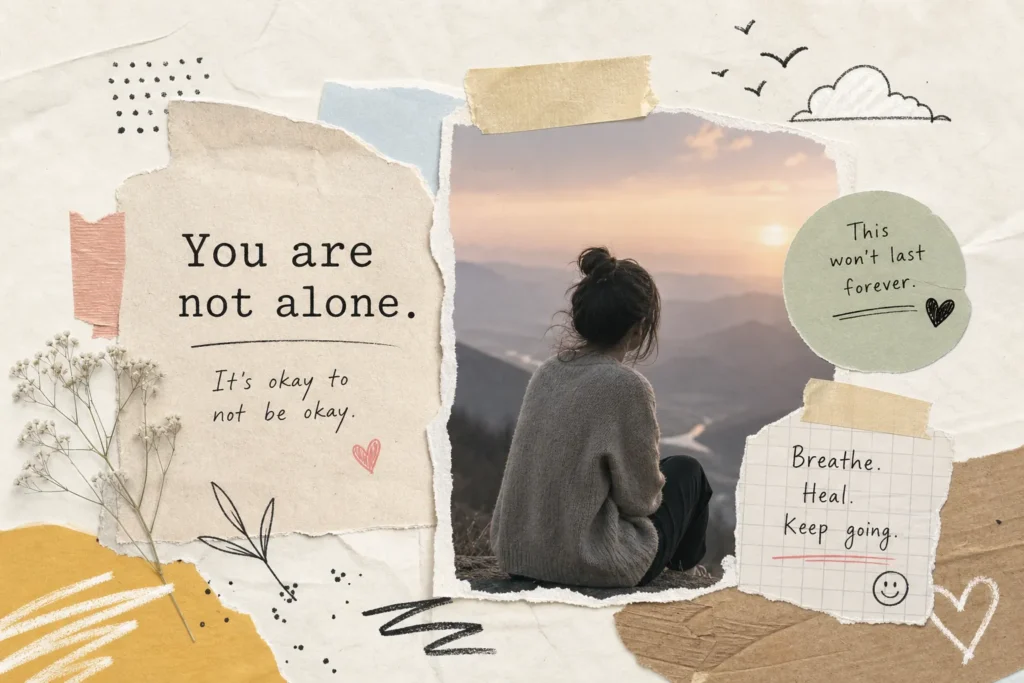
There’s a particular kind of quiet that settles in when you feel lost or broken. It’s not the peaceful kind. It’s the kind where you sit in a room and can’t recognize the version of yourself that used to make sense, where moving forward feels impossible because you’re not even sure which direction forward is anymore. If you’ve ever asked yourself what are the best quotes to read when feeling lost and broken, this guide organizes exactly that, comforting lines sorted by emotional stage, with reflection prompts to help you absorb them. If you’re in that place right now, this article was written for you.
Reaching for someone else’s words when you can’t find your own is not weakness. It’s instinct. Many people who have felt this way turn to the same thing: a line, a sentence, a fragment of language that names what they couldn’t say themselves. That’s why RainbowQuotes’ curated Healing and Hopeful collections exist, specifically for the moments when you need the right words but yours have gone quiet.
This article is organized by emotional stage, not by theme or author. That matters because “feeling lost” and “feeling broken by grief” are not the same thing, even when they show up together. Find the section that matches where you are right now and start there. You don’t have to read in order.
Best quotes to read when feeling lost and broken, for the fog of confusion
When your internal compass goes still
Some stages of feeling lost don’t come with a clear reason. You just wake up one day and the internal compass that used to point somewhere has gone still. These quotes name that disorientation without trying to fix it.
Henry David Thoreau captured this in Walden with a line widely paraphrased as: “Not till we are lost do we begin to find ourselves.” The context matters here: Thoreau wasn’t writing about crisis; he was writing about what becomes possible when familiar structures fall away. J.R.R. Tolkien’s commonly attributed “Not all who wander are lost“ carries a different energy entirely. Where Thoreau suggests that being lost opens something, Tolkien insists that movement without obvious direction is not failure. Both are worth sitting with.
Alex Ebert wrote something quieter: “To be lost is as legitimate a part of your process as being found.” That word “legitimate” does a lot of work. It makes space for where you are without rushing you out of it. George Bernard Shaw’s widely attributed line, “Life isn’t about finding yourself. Life is about creating yourself”, belongs here too, though it sits at the edge of this stage, pointing toward something slightly ahead.
Christine Caine offers the bridge between confusion and grounding: “Sometimes when you’re in a dark place you think you’ve been buried, but you’ve actually been planted.” The disorientation of feeling lost is not a dead end. It is the beginning of something you can’t see yet, and that distinction is more meaningful than it first sounds.
Reflection prompt for this stage: Ask yourself, “What changed recently that I haven’t fully let myself name yet?” Don’t try to answer it immediately. Sit with it for two minutes. Let the question breathe.
When grief breaks you open: quotes for a shattered heart
Healing quotes for a broken heart
Rumi’s writing on pain has endured for over 800 years because it doesn’t try to shortcut grief. It sits inside the ache with you. His most resonant lines on this subject, widely circulated in translation, are: “The wound is the place where the Light enters you,” “The cure for pain is in the pain,” and “Sorrow prepares you for joy. It violently sweeps everything out of your house, so that new joy can find space to enter.” Read them slowly. None of them ask you to feel better yet. They ask you to feel.
Brené Brown approaches the same territory from a modern, research-grounded perspective. In Rising Strong , she writes: “We run from grief because loss scares us, yet our hearts reach toward grief because the broken parts want to mend.” In the same body of work, she adds: “Our silence about grief serves no one. We can’t heal if we can’t grieve.” These two lines together function as permission, not instruction.
Khalil Gibran extends the conversation poetically in The Prophet: “The deeper that sorrow carves into your being, the more joy you can contain.” It doesn’t promise that joy is coming soon. It simply tells you that the capacity you’re building right now, through the ache, is real.
Reflection prompt for this stage: Ask yourself, “What part of this grief am I most afraid to look at directly?” This is not a question to answer quickly or completely. Sit with it. When you’re ready for more words, RainbowQuotes’ Healing mood filter surfaces quotes curated specifically for this emotional state.
Quotes to help when you feel alone even in a room full of people
When you feel unseen and unheard
This is a distinct layer that many “feeling broken” articles skip entirely, but it’s one of the most common experiences: the loneliness of not feeling understood, of being surrounded by people and still feeling invisible. It requires its own set of words.
Brené Brown’s writing on empathy speaks directly to this: “Empathy has no script. It’s simply listening, and communicating that incredibly healing message of ‘You’re not alone.'” Maya Angelou captured the flip side of isolation with a line from her poem “Human Family”: “We are more alike, my friends, than we are unalike.” That line doesn’t solve loneliness, but it quietly challenges the idea that your experience is as singular as it feels right now.
Sometimes another person’s words feel safer than a conversation because there’s no pressure to explain yourself. A quote meets you exactly where you are, without asking you to perform coherence. When you find the line that lands hardest in this section, screenshot it. Keep it somewhere you’ll see it.
Reflection prompt for this stage: Ask yourself, “What would I say to a close friend who came to me feeling exactly this way?” This prompt flips the self-compassion question. It often unlocks more honesty than asking directly about yourself.
When you start to accept the mess: quotes for the in-between
Acceptance is not resolution. It’s the moment when you stop fighting the reality of what happened, not the moment when it stops hurting. The quotes that belong here don’t promise an ending, just a next step.
Rainer Maria Rilke’s closing lines from The Book of Images belong exactly here: “Let everything happen to you: beauty and terror. Just keep going. No feeling is final.” Three short lines. None of them ask you to be okay. They just ask you to keep moving, even through the mess. Seneca’s “Every new beginning comes from some other beginning’s end” sits in the same emotional register: not hopeful exactly, but spacious.
Lao Tzu offers something softer: “Being deeply loved by someone gives you strength, while loving someone deeply gives you courage.” In the in-between stage, that courage is exactly what the next breath requires. Shaw’s line returns here too: “Life isn’t about finding yourself. Life is about creating yourself.” At this stage the quote shifts meaning. It no longer reads as challenge. It reads as invitation.
Reflection prompt for this stage: Ask yourself, “What part of me still feels steady, even if it’s small?” This question helps you locate your own interior anchor, the part that didn’t break, even when everything else felt like it had.
When hope starts to flicker: short uplifting quotes for hard times
What are the best quotes to read when feeling lost and broken but not yet ready to hope?
The problem with most “hope” quotes is that they feel like they were written by someone who has never actually been broken. The ones that work, the ones that feel earned rather than cheap, come from people who wrote from inside real hardship.
Maya Angelou: “You may encounter many defeats, but you must not be defeated. In fact, it may be necessary to encounter the defeats, so you can know who you are, what you can rise from, how you can still come out of it.” Viktor Frankl, drawing on his experience as a Holocaust survivor and the ideas he developed in Man’s Search for Meaning: “When we are no longer able to change a situation, we are challenged to change ourselves.” These aren’t motivational posters. They’re lines forged in actual suffering, and they carry that weight.
For the reader who has lost their sense of self, not just their circumstances, these lines speak most directly:
- “I don’t want to be saved. I want to be found.”
- “It’s okay to be lost sometimes. It often means you’re about to find something great.”
- Rumi: “Don’t get lost in your pain. Know that one day your pain will become your cure.”
These quotes don’t skip over the hard part. They acknowledge it and then gesture, gently, toward what’s still possible.
Reflection prompt for this stage: Ask yourself, “What would feeling 1% better look like in the next 24 hours?” Not healed. Not fixed. Just 1% easier. Start there.
How to use these quotes when you actually need them
Reading a quote and feeling it are two different things. If one of the lines in this article landed somewhere specific in your chest, don’t just scroll past it. Try this instead: write it by hand once, read it aloud once, and place it somewhere visible for the next 24 hours. That’s it. No journaling plan required, no pressure to understand why it hit you. Just let it stay in your field of vision.
RainbowQuotes’ mood-based browsing is designed for moments like this one. When you’re deep in grief, the Healing filter surfaces quotes curated for that emotional state. When something begins to shift and you feel ready for something a little lighter, switching to the Hopeful filter meets you at a different stage. The save-as-image and one-tap share features mean the quote that helped you can reach someone else who needs it, without requiring you to find the words yourself.
Some quotes are for you alone: a private anchor you return to on hard mornings. Others are worth sharing because someone in your circle is feeling the same thing and doesn’t know how to say it. The way to tell the difference is simple. If reading it made you feel less alone, keep it close. If reading it made you think of a specific person, send it to them. Both are the right answer.
You found this article for a reason
The fact that you searched for these words means you’re still reaching out, still looking for something to hold onto. That matters. If you’ve been wondering what are the best quotes to read when feeling lost and broken, the answer is the same one writers and thinkers have pointed to across centuries: the words that make you feel less alone in the dark. Feeling lost and broken is not a permanent state. It’s a stage that countless people have passed through before you, each of whom left behind exactly the words collected here. Thoreau wrote about self-discovery in Walden . Rumi explored suffering and longing throughout his poetry. Brené Brown built a research career helping others name vulnerability and grief in books like Rising Strong and Atlas of the Heart.
Save the quotes that resonated and come back to them. The ones that feel most true today might shift in a week or a month, and that shift is the point. RainbowQuotes’ Healing and Hopeful collections are updated daily, so wherever you are in this process next week, there will be something waiting that meets you there.
You don’t have to have this figured out. You just have to keep going. No feeling is final.