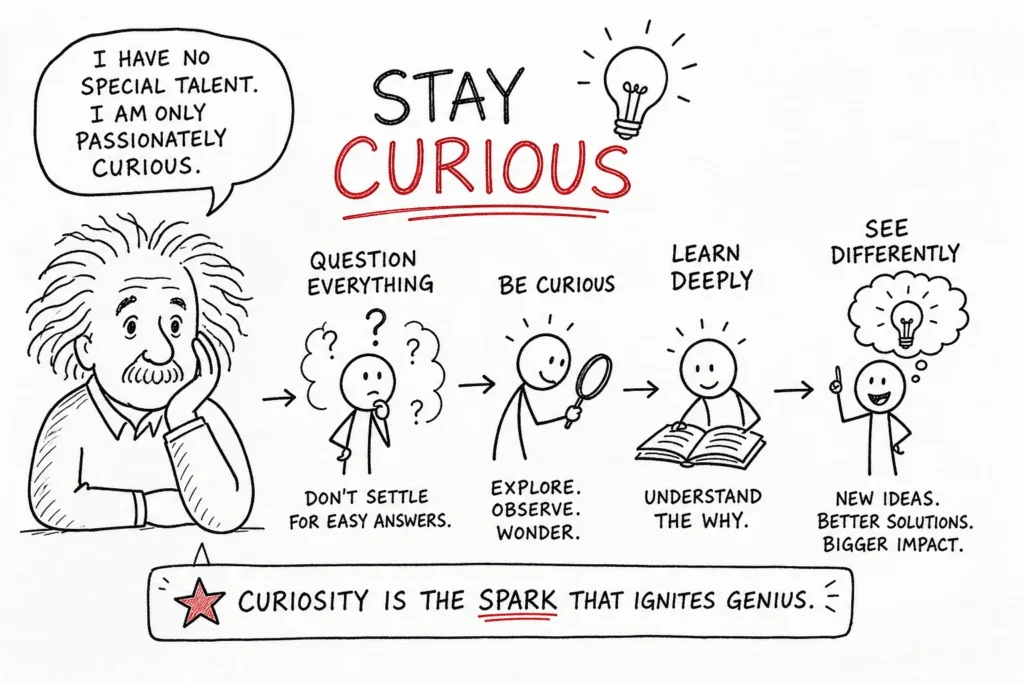
Einstein curiosity quotes are everywhere: on motivational posters, in graduation speeches, across millions of Instagram posts. But most people sharing them have never checked where those words actually came from. A significant number of the Einstein curiosity quotes circulating on social media are unverified, paraphrased, or flat-out misattributed, and when you cite them in a classroom, a keynote, or a caption without knowing the source, your credibility takes the hit, not Einstein’s.
This article gives you the real thing: verified quotes with their original sources, the fuller context most people have never read, and clear guidance on how to handle the quotes that remain unconfirmed. Whether you’re a teacher opening a lesson, a creator building a content library, or someone who just wants to use these words honestly, what follows is everything you need. And if you want these quotes in a shareable, beautifully formatted image, RainbowQuotes offers a dedicated Einstein author collection with picture quotes ready to save and post.
Einstein Curiosity Quotes: The One with a Verified Original Source
Before going further into Einstein’s words on curiosity, it’s useful to anchor everything to the one quote with a clear, traceable publication record. This is the quote you can cite with full confidence in any setting, and the benchmark against which every other Einstein curiosity quote should be measured.
The 1955 LIFE magazine quote in full
On May 2, 1955, just weeks after Einstein’s death, LIFE magazine published a piece under the headline “Old Man’s Advice to Youth: ‘Never Lose a Holy Curiosity.'” The full passage reads: “The important thing is not to stop questioning. Curiosity has its own reason for existing. One cannot help but be in awe when he [sic] contemplates the mysteries of eternity, of life, of the marvelous structure of reality. It is enough if one tries merely to comprehend a little of this mystery every day. Never lose a holy curiosity.” This is the complete, original text as published, not a paraphrase, not a later adaptation. Contemporary summaries and fact-checks reproduce this passage in modern reporting about the LIFE magazine quote (for example, see this modern account of the LIFE passage).
Many versions of this quote circulate online with minor wording variations, some with added sentences and some with lines removed. When you see those extended versions, treat them as expansions rather than faithful reproductions of the original printed text. For guidance on how and why quotes get misattributed or expanded online, the MLA’s roundup on commonly misattributed quotations is a useful primer.
Why “holy curiosity” is a deliberate choice of words
Einstein didn’t reach for “strong” or “relentless” or “deep.” He chose “holy,” and that word carries the full weight of his meaning. To Einstein, curiosity wasn’t a skill to develop or a habit to manage. It was something closer to sacred, a force that put humans in genuine contact with the mystery of existence. One plausible reading is that protecting it was a moral act, not just a practical one, though readers of the full LIFE passage will draw their own conclusions about the exact valence Einstein intended.
This framing connects directly to Einstein’s broader view of wonder as the foundation of all genuine scientific and philosophical inquiry. Wonder isn’t a nice-to-have attitude. In his worldview, it’s the engine that drives the entire enterprise of understanding. For a curated selection of Einstein’s remarks on curiosity and wonder, see a collection of his quotes on curiosity.
What this quote means for modern learners and students
For students in 2026, operating under constant performance pressure and information overload, the LIFE magazine quote is a direct reframe. The goal isn’t to accumulate answers. It’s to keep the questions alive. Einstein isn’t telling you to try harder; he’s telling you to stop treating curiosity as a means to an end and start treating it as the point itself.
That shift changes everything about how you approach a subject you find difficult. Instead of asking “how do I get through this,” the question becomes “what here is genuinely strange and interesting?” That’s a much more productive place to start.
Einstein Curiosity Quotes on Education and Learning: What He Actually Wrote
Most people have only seen the short quotes. Very few have read the longer passages where Einstein lays out a full philosophy of learning. His 1936 essay “On Education” is the clearest statement of that philosophy, and it holds up remarkably well.
His critique of fear-driven schooling
In “On Education” (1936), Einstein identified four motivators that drive students to do schoolwork: fear, ambition, pleasure in the work itself, and what he called “loving interest in the object” combined with “a desire for truth and understanding.” His argument was that only the last two produce real curiosity, and that formal education had a tendency to cultivate the first two while quietly destroying the others. A student who learns to pass a test out of fear learns how to avoid failure. A student driven by genuine interest learns how to think. Einstein argued throughout the essay that the motivation behind learning is critically important and can determine the depth of understanding, a challenging claim, but one he makes a strong case for.
“Divine curiosity” and the child who hasn’t been schooled yet
Einstein’s essay introduces the concept of “divine curiosity” as the natural state of every healthy child before formal instruction reshapes it. He believed schools should awaken and strengthen this force. Instead, he observed, many schools suppressed it in favor of obedience, memorization, and the steady accumulation of testable facts. The school’s main task, in his framing, was the awakening and strengthening of the “psychological forces” already present in the student, not the filling of an empty vessel.
This isn’t abstract idealism. Einstein was describing a real mechanism: curiosity either gets fed or it gets starved, and the conditions of the learning environment determine which.
What this means for educators and self-directed learners today
Einstein was arguing for intrinsic motivation decades before modern learning science formalized the concept. Self-determination theory, developed in the 1980s, reaches essentially the same conclusion: learners persist, create, and retain more when they’re driven by genuine interest rather than external pressure. For educators and coaches, this reframes the role from information deliverer to curiosity protector. For self-directed learners, it validates following genuine interest over chasing credentials.
The widely shared Einstein curiosity lines that deserve a fact-check
These are the quotes you’ve almost certainly seen. They resonate, they sound right, and they spread widely. They also lack verified original sources, which matters when you’re deciding how to use them.
“I have no special talent. I am only passionately curious.”
This is one of the most shared Einstein quotes in any curiosity collection, and it captures something genuinely aligned with his documented worldview. The quote appears in The Ultimate Quotable Einstein (Princeton University Press, 2010), compiled from his writings, but no specific original letter, dated interview, or manuscript has been publicly identified as the source for this exact phrasing. That doesn’t make it false. It means you should present it as a widely attributed Einstein quote rather than a verified verbatim line from a known document. You can find one commonly circulated instance of this line in online quote databases that collect widely attributed Einstein lines (a commonly referenced entry).
In practice: use it freely in casual talks, social posts, and creative contexts. For academic presentations or formal speeches, frame it as “widely attributed to Einstein” rather than citing it as a confirmed primary source.
“It is a miracle that curiosity survives formal education.”
This line is everywhere, and it sounds almost too perfectly Einstein to question. The irony is that no original source has been confirmed in scholarly records. It resonates because it fits seamlessly with what Einstein did write about education in his verified essays, but resonating with someone’s documented worldview isn’t the same as being something they actually said.
Use this quote with transparent framing: “often attributed to Einstein” signals to your audience that you’ve done your homework. There’s also a quiet lesson embedded in the uncertainty here. A quote about the importance of questioning knowledge turns out to require exactly that kind of questioning. Einstein would probably appreciate the irony.
How to handle unverified quotes without losing their value
Here’s a clean, practical framework. Verified quotes carry full citation authority and are ideal for academic presentations, formal writing, and any context where credibility is on the line. The LIFE magazine quote (“Old Man’s Advice to Youth,” May 2, 1955) is your anchor here. Widely attributed quotes work well in casual talks, social media, and coaching contexts when you frame them honestly. Misattributed quotes, those definitively traced to other authors or to no author at all, should be dropped entirely or re-attributed correctly.
This framework doesn’t eliminate the power of the quotes. It actually makes them more powerful, because your audience can trust your judgment.
The connection Einstein drew between curiosity, imagination, and discovery
Curiosity, for Einstein, wasn’t a standalone trait. It was part of a larger creative method that combined wonder, imagination, and a willingness to sit with uncertainty. Understanding that connection makes every curiosity quote land with far more force.
“Imagination is more important than knowledge” in its full form
This is one of Einstein’s well-attested quotes, but it’s almost always shortened. The fuller version reads: “Imagination is more important than knowledge. For knowledge is limited, whereas imagination embraces the entire world.” Cut to its first sentence alone, it sounds like a vague preference for creativity over facts. In its complete form, it’s a precise philosophical claim about the limits of what’s already known versus the boundless reach of what can be envisioned.
The curiosity philosophy and the imagination philosophy are inseparable. Curiosity generates the questions. Imagination explores beyond what existing knowledge can answer. Together, they describe Einstein’s actual method of discovery.
How curiosity powered Einstein’s thought experiments
Einstein’s scientific breakthroughs didn’t begin in laboratories. They began in his imagination. He famously described imagining himself riding alongside a beam of light, a curiosity-driven question that eventually led to the theory of relativity. The photoelectric effect, which earned him the Nobel Prize, emerged from a similarly questioning stance toward assumptions everyone else had accepted. His curiosity wasn’t a philosophical attitude layered on top of his science. It was his scientific method.
When he says “never lose a holy curiosity,” he’s describing the exact mental posture that produced his most important work.
The lesson for anyone building something new in 2026
The current environment rewards speed: faster iteration, faster content, faster answers generated by AI tools. Einstein’s curiosity philosophy points in the opposite direction. The competitive edge isn’t having more answers than everyone else. It’s asking better questions than everyone else. Better questions lead to better problems, and better problems lead to better solutions. That’s as true for a product designer or a content creator as it was for a theoretical physicist in 1905.
How to share and use these quotes without losing their meaning
A great quote used carelessly becomes noise. These specific suggestions are for creators, educators, and presenters who want to use Einstein’s words in ways that hold up.
Caption formats that keep attribution accurate and quotes shareable
For Instagram and Pinterest, the most effective format combines a shortened version of the quote with clear attribution and a brief engagement prompt. Use ellipses to remove middle material from longer quotes and keep the most striking phrase intact. Here are three concrete examples built from the verified LIFE magazine quote and widely attributed lines:
- Short caption: “The important thing is not to stop questioning… Never lose a holy curiosity.”, Albert Einstein, LIFE magazine, May 2, 1955. What question are you sitting with right now?
- Longer caption: Einstein’s last major piece of advice to young people: “Curiosity has its own reason for existing.” Not a grade. Not a credential. The curiosity itself. (Source: LIFE , May 2, 1955)
- For “passionately curious”: “I have no special talent. I am only passionately curious.”, widely attributed to Albert Einstein. A useful reminder when you’re comparing your starting point to someone else’s expertise.
Where to find Einstein quote images designed for social posts
A verified quote still needs strong visual presentation to travel well on social platforms. RainbowQuotes offers a dedicated Einstein author collection featuring his curiosity quotes formatted as high-quality, pin-ready images optimized for Instagram and Pinterest. The attribution is built into the design, the formatting is clean, and no additional design work is required. If you want these words in a format worth sharing, with the source intact, the Einstein collection at RainbowQuotes has the images ready to post.
Tips for teachers, coaches, and presenters using these quotes
Teachers can open a lesson with the full LIFE magazine passage and ask students to pick one line that resonates most and explain why. That single exercise builds both critical reading and self-awareness.
Coaches can use the “passionately curious” line as a reflection prompt: where in your work or life are you genuinely curious right now, and where are you just going through the motions?
Presenters should include the source citation when using the verified quote: “Einstein, LIFE magazine, May 2, 1955″ takes three seconds to say and significantly raises the credibility of your entire talk.
Curiosity is a philosophy, not just a quote
Einstein’s most powerful statement about curiosity isn’t any single line. It’s a philosophy that shows up consistently across his verified writing: in the LIFE magazine passage (“Old Man’s Advice to Youth,” May 2, 1955), in “On Education” (1936), and even in the spirit of the widely attributed lines that align so closely with his documented worldview. The through-line is the same everywhere. Questions matter more than answers. Protecting curiosity is the most important thing a learner can do. And wonder, treated seriously, is the starting point for everything worth discovering.
Take the LIFE magazine quote and save it with its full source. Use it with confidence in your next lesson, talk, or post, because you now know exactly where it came from and what Einstein meant by it. Let it shift how you approach the next hard problem or the next blank page in front of you. The question isn’t whether you’re smart enough. The question is whether you’re curious enough to keep asking.
These einstein curiosity quotes are most powerful when the context travels with them. If you want these words in a format worth sharing, the full Einstein collection at RainbowQuotes has the images ready, attribution intact, formatting clean, and ready to post the moment you need them.
FAQ
Q: Where did the quote “Never lose a holy curiosity” originally appear?
A: The verified source is a May 2, 1955 article in LIFE magazine published under the headline “Old Man’s Advice to Youth: ‘Never Lose a Holy Curiosity.'” That LIFE passage includes the line “Curiosity has its own reason for existing,” and is the one reliably traceable to Einstein.
Q: Is the line “Curiosity has its own reason for existing” genuinely from Einstein?
A: Yes — that sentence appears in the full LIFE magazine passage published weeks after Einstein’s death. Many online variations add, remove, or reword lines, so the LIFE 1955 text is the safest version to cite.
Q: Why did Einstein use the word “holy” to describe curiosity?
A: According to the article, Einstein chose “holy” deliberately to convey that curiosity is closer to something sacred than merely a skill or habit. The framing suggests curiosity is a moral or existential stance that connects humans to the mystery of existence and underpins scientific and philosophical inquiry.
Q: How should teachers and speakers cite Einstein’s curiosity quotes to avoid misattribution?
A: Cite the 1955 LIFE magazine passage when using that wording and avoid extended online versions unless you can trace their source. If a quote can’t be verified, label it as paraphrase or unattributed and consult resources like the MLA roundup on misattributed quotations for guidance.
Q: What should I do if I find a popular Einstein curiosity quote online but can’t confirm its origin?
A: Treat unverified versions as expansions or paraphrases rather than authentic Einstein words and avoid presenting them as direct citations. Look for primary sources (newspaper archives, original publications) and rely on the LIFE 1955 passage when you need a provable quotation.
Q: Where can I get shareable images of verified Einstein quotes?
A: The article mentions that RainbowQuotes offers a dedicated Einstein author collection with picture quotes ready to save and post. Using a curated source like that makes it easier to share verified wording in a visually polished format.
Q: What does the verified LIFE quote mean for students learning in 2026?
A: The article argues the quote reframes learning: the priority is keeping questions alive rather than accumulating answers. For students under performance pressure and information overload in 2026, treating curiosity as an ongoing stance encourages inquiry over endpoint-driven studying.