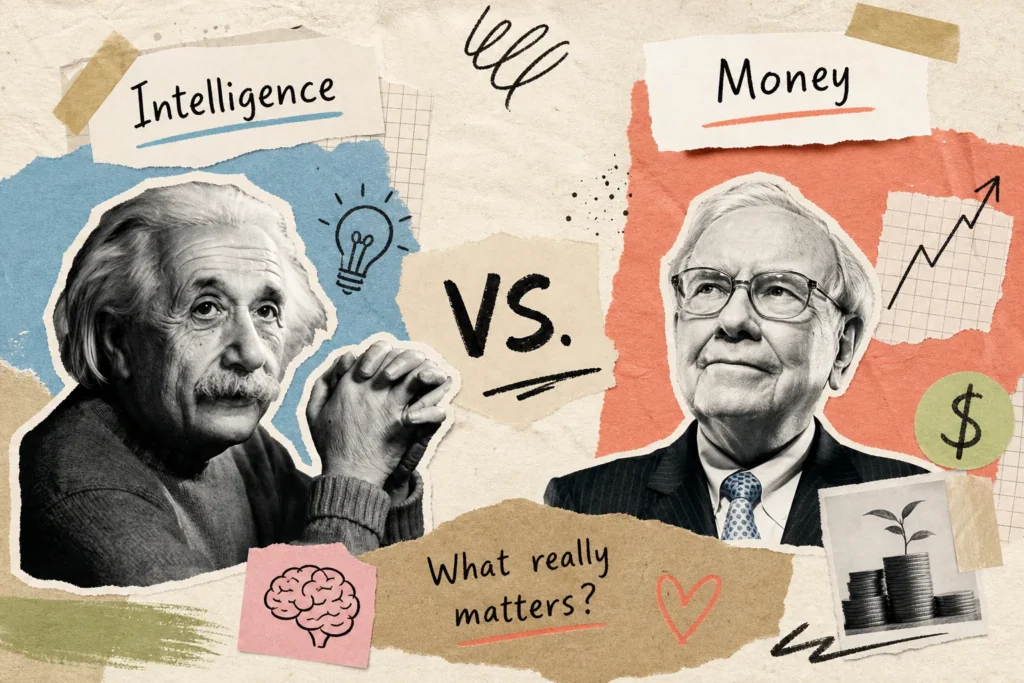
Einstein quotes on intelligence vs Buffett quotes on money reveal two distinct philosophies about curiosity, discipline, and what leads to lasting success. One man spent his life chasing the nature of the universe. The other spent his life building one of the greatest fortunes in history. There is no known record of a conversation between Albert Einstein and Warren Buffett, but their words have shaped the way millions of people think about knowledge, wealth, and what actually matters. Comparing Einstein’s lines on curiosity and learning with Buffett’s wisdom on money and discipline isn’t just an interesting exercise; it’s a lens for understanding two very different paths to lasting impact.
Over at RainbowQuotes , both authors have dedicated pages packed with curated lines you can explore by theme and mood. Here’s what each man actually said and why it still matters.
What Einstein’s most quoted lines on intelligence are really saying
Einstein’s most-quoted lines aren’t really about being smart. They’re about staying open. “The important thing is not to stop questioning. Curiosity has its own reason for existing”, widely attributed to Einstein and cited in major quotation references, is less a compliment to intellectuals and more a call to anyone willing to keep asking why. Based on his letters and interviews, Einstein treated curiosity as a discipline, not a gift; something you practice rather than something you’re born with.
The line “Imagination is more important than knowledge” is probably his most popular quote, and it still confuses people. He wasn’t dismissing knowledge. He was pointing out its limits: knowledge tells you what exists; imagination tells you what could. His follow-up makes it clearer: “Knowledge is limited. Imagination encircles the world.” This phrasing is widely attributed to Einstein and appears in major compilations, though scholars note the primary-source trail is not fully established. Even so, it captures the spirit of his published thinking. For Einstein, intelligence without creative thinking was just memory.
He also drew a firm line around how understanding is built. “The only source of knowledge is experience” and “Anyone who has never made a mistake has never tried anything new” are both commonly attributed to Einstein; researchers note they circulate widely in quote collections, though secure primary-source documentation for each is limited. Taken together, they reflect a philosophy that runs throughout his verified writing: formal learning only gets you so far. True comprehension comes from doing, testing, and sometimes failing. For Einstein, curiosity starts the process, imagination widens it, and experience is what finally makes it stick.
Einstein quotes on intelligence vs Buffett quotes on money: the core differences
Buffett’s sharpest lines on money, discipline, and long-term thinking
Buffett’s investing philosophy starts with loss aversion, not return-chasing. His most famous formulation: “Rule No. 1: Never lose money. Rule No. 2: Never forget Rule No. 1.” The line was said publicly during a 1985 PBS interview on Adam Smith’s Money World and has been repeated in Berkshire Hathaway shareholder letters since. The point isn’t to be fearful; it’s to recognize that recovering from a major financial setback costs far more time than avoiding it in the first place. Staying in the game matters more than winning any single hand.
Where Einstein celebrated curiosity, Buffett celebrates waiting. “The stock market is designed to transfer money from the Active to the Patient” sounds simple but lands differently when you watch people panic-sell in a downturn. In Buffett’s telling, most people can’t sit still, and that inability is your opportunity if you can resist the same impulse.
Some of Buffett’s best lines on money have nothing to do with money. “We can afford to lose money, even a lot of money. But we can’t afford to lose reputation, even a shred of reputation” reframes wealth entirely. Capital is recoverable. Trust isn’t. His line on hiring carries the same logic: “He looks for integrity, intelligence, and energy. But if they lack the first, the other two will kill you.” These aren’t motivational poster lines; they’re a framework for how he has run Berkshire Hathaway for decades.
Where these two minds unexpectedly agree
The most surprising bridge between Einstein and Buffett is the idea of compounding. The quote often attributed to Einstein, “Compound interest is the eighth wonder of the world; he who understands it, earns it; he who doesn’t, pays it”, aligns almost perfectly with Buffett’s own obsession with letting gains build on gains. It’s worth noting that Quote Investigator has found no solid evidence Einstein actually said this; the phrase traces back to anonymous advertising copy from the early 1920s. Still, the concept fits Einstein’s worldview on cumulative learning just as naturally as it fits Buffett’s approach to cumulative wealth. Whether it’s intellectual growth or financial growth, both men trusted the idea that small, consistent gains build into something extraordinary over time.
Their agreement runs even deeper on what money can’t buy. Einstein wrote in a letter to Heinrich Zangger dated March 26, 1920 (cited in the Einstein Papers): “I am absolutely convinced that no wealth in the world can help humanity forward. Money only appeals to selfishness.” Buffett echoes this from a different angle: “If you get to my age in life and nobody thinks well of you, I don’t care how big your bank account is, your life is a disaster.” Separated by decades and disciplines, both men arrived at the same conclusion about what actually counts.
Head-to-head: knowledge vs. wealth as paths to lasting success
Einstein’s framework for success is internal: stay curious, stretch your imagination, and treat every experience as a teacher. Buffett’s framework is behavioral: preserve capital, choose patience over impulse, and build a reputation worth more than any single return. The former is about how you think; the latter is about what you do consistently over time. Neither is more “correct,” but they’re not the same road.
The quotes that reveal the real divergence are telling. Einstein’s “The measure of intelligence is the ability to change” implies that adaptability is the highest cognitive skill. Buffett’s “Price is what you pay; value is what you get”, a maxim that originated with his mentor Ben Graham and that Buffett popularized through his Berkshire shareholder letters, implies that clarity of judgment is the highest practical skill. Put them side by side and the contrast sharpens: Einstein values transformation; Buffett values discernment.
One quote dares you to evolve; the other dares you to see clearly when everyone else is emotional. Both stances are necessary for a meaningful life, yet they pull in different directions. The best version of either philosophy borrows from the other: Einstein without discipline becomes scattered, and Buffett without intellectual openness becomes rigid. Read together, they form a more complete picture of what it takes to succeed over a lifetime.
How to actually use these quotes in your life
Not every Einstein or Buffett line works in every context, and forcing the wrong quote into a moment can dilute its impact. For a career decision or a big financial choice, Buffett’s “Risk comes from not knowing what you’re doing” hits precisely because it reframes risk as ignorance, not volatility. For a creative block or a learning challenge, Einstein’s “I have no special talent. I am only passionately curious” is the right reminder that persistence beats innate ability.
For social posts, speeches, and journaling, Einstein’s lines tend to work better for themes of curiosity, education, and personal growth. Buffett’s lines land harder in conversations about money, leadership, and long-term thinking. A few that translate especially well as captions or journaling prompts:
- “Someone’s sitting in the shade today because someone planted a tree a long time ago”, for a post about delayed gratification or patience
- “The true sign of intelligence is not knowledge but imagination” (commonly attributed to Einstein; primary source uncertain), for anything tied to creativity, learning, or personal reinvention
- “Anyone who has never made a mistake has never tried anything new” (commonly attributed to Einstein; widely circulated but not securely primary-sourced), for a caption about resilience or taking risks
- “Price is what you pay; value is what you get” (originated with Ben Graham; popularized by Buffett), for content on investing, career decisions, or relationships
Both quote libraries are rich enough that you’ll never run short of options. The key is matching the quote to the emotional context of the moment rather than reaching for the first famous line that comes to mind.
Go deeper with RainbowQuotes: Einstein and Buffett in one place
If this article sparked curiosity about either thinker, RainbowQuotes is the natural next stop. The platform has dedicated author pages for both Einstein and Buffett, with curated collections organized by theme so you’re not hunting through a generic database. You can browse Einstein’s quotes by curiosity, imagination, or knowledge, and move through Buffett’s catalog by investing, discipline, or character, all updated regularly with fresh editorial picks.
What sets RainbowQuotes apart from a standard quote site is the mood-based discovery layer. If you’re working through a tough decision, the “Focused” filter surfaces lines built for clarity. If you’re in a growth phase, “Motivation” brings both Einstein’s intellectual fire and Buffett’s patient discipline into view at the same time. Every quote can be copied instantly or saved as a share-ready image for Instagram, Pinterest, or your morning reflection practice.
RainbowQuotes offers a catalog of over 10,000 curated quotes spanning 200+ topics and 500+ authors. The platform also provides multilingual access across 12 languages, making it easy to discover great minds regardless of your primary language. And the “Born On This Day” feature connects you to historical figures on the anniversary of their birth, the kind of discovery that makes learning feel effortless rather than overwhelming.
The takeaway from two very different kinds of genius
Reading Einstein quotes on intelligence vs Buffett quotes on money side by side gives you a fuller toolkit for thinking and acting over a lifetime. Together, they sketch a more complete picture of what success actually requires: the intellectual honesty to stay curious and keep growing, and the behavioral discipline to act wisely over time. Einstein reminds you that imagination outlasts any fixed body of knowledge. Buffett reminds you that patience and integrity outlast any hot tip or market trend.
Read them as a pair and you have a practical philosophy for almost any decision you’ll face. Start with the quotes that hit closest to where you are right now, use them to anchor your thinking, and let them compound, just as both men, in their very different ways, would tell you to.