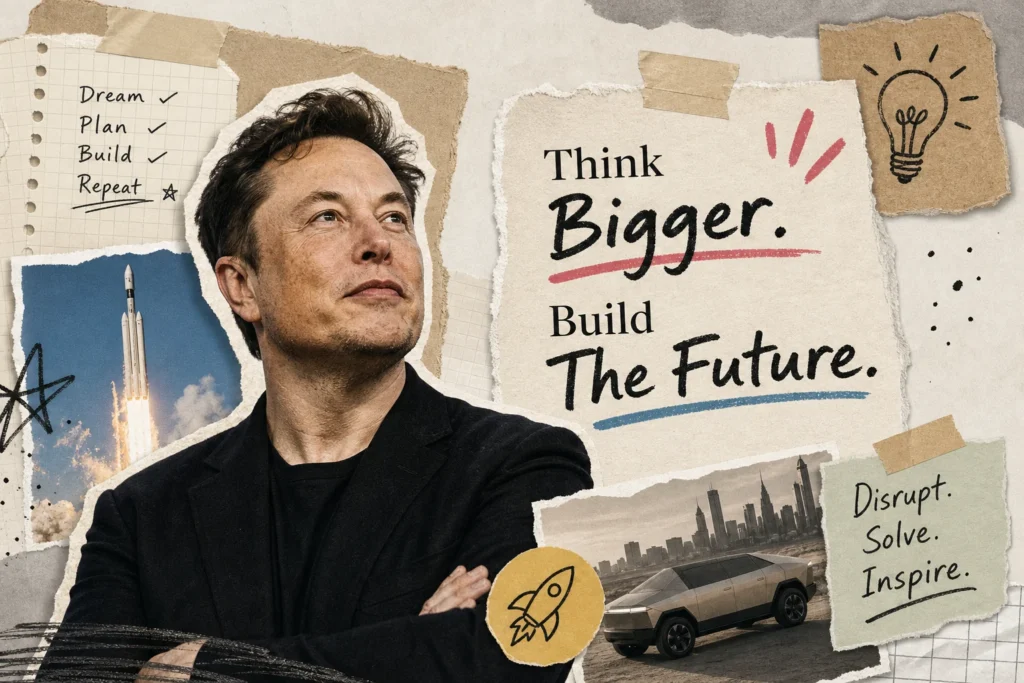
Most founders hit a wall somewhere around month 14. The initial energy fades, the revenue isn’t where it needs to be, and the generic “stay positive” quotes on your feed start to feel insulting. You don’t need platitudes. You need words from someone who has built companies from scratch, watched them nearly die, and kept building anyway.
This collection of Elon Musk inspirational quotes for entrepreneurs and innovators is curated to give you exactly that. At RainbowQuotes, the quotes that get saved, shared, and revisited most by founders cluster around a few recurring themes: failure as data, conviction in the face of bad odds, and the discipline to build something genuinely better. This article organizes Musk’s sharpest lines by theme, gives each one real context, where he said it and why it mattered, and closes with a takeaway you can apply this week.
Why Musk’s words hit differently for founders
Most quote lists strip away the “why.” A quote without context is just a meme: easy to scroll past, easy to forget, and useless when your startup is actually in trouble. The reason Musk’s words carry weight isn’t just the words themselves. It’s that you can picture exactly where he was standing when he said them.
When you know Musk described entrepreneurship as “eating glass and staring into the abyss of death” while speaking honestly about startup psychology, not from a stage covered in success, the quote lands differently. When you know SpaceX nearly went bankrupt in late 2008 after three consecutive rocket failures, and Musk pressed forward anyway with his last available cash, his quotes about persistence stop sounding like inspiration and start sounding like a field report.
Entrepreneurs searching for Elon Musk motivational quotes are often looking for something more specific than motivation: they want proof that someone credible took the same risk and survived. Musk’s story provides that. RainbowQuotes curates his full quote collection alongside innovators like Steve Jobs and Jeff Bezos precisely for this reason, contextual, founder-relevant wisdom organized so you can find what you need at the exact moment you need it.
Q: Why do founders save and share Elon Musk quotes like the ones on RainbowQuotes?
A: Founders save these quotes because they come with real context—Musk spoke them while building companies and surviving near-failure, not from a podium of untested success. That credibility makes lines about failure, conviction, and discipline feel like actionable field reports rather than empty platitudes.
Q: What does Elon Musk mean by “Failure is an option here. If things are not failing, you are not innovating enough.”?
A: Said during a SpaceX Q&A in 2007, the line reframes failure as a necessary data point in experimentation rather than a final verdict on ability. The article’s takeaway is practical: if nothing in your business is failing, you probably aren’t experimenting enough—pick a risky decision you’ve been avoiding and try it this week.
Q: What did Musk mean when he said being an entrepreneur is “like eating glass and staring into the abyss of death”?
A: Spoken at the MIT Aeronautics and Astronautics Centennial symposium in 2013, Musk used the metaphor to describe the grinding, painful reality of startup life and the constant awareness your company could die. The point is to remove romanticized expectations: difficulty is the job, not a sign that you picked the wrong path.
Q: How can I apply Elon Musk’s quotes to my startup this week?
A: Use his framing to prioritize experiments: identify one decision you’ve avoided because it might fail and run it as a controlled test. Embrace failures as data, keep conviction when odds look bad, and focus on the disciplined work that makes your product meaningfully better.
Q: Where does RainbowQuotes place Musk’s quotes in relation to other leaders like Steve Jobs and Jeff Bezos?
A: RainbowQuotes curates Musk’s quotes alongside innovators such as Steve Jobs and Jeff Bezos to provide founder-relevant wisdom organized by theme and context. The goal is to make the quotes searchable and immediately useful when a founder needs specific guidance.
Q: Why do Musk’s quotes ‘hit differently’ for entrepreneurs compared with typical motivational memes?
A: The article argues they hit differently because you can picture where he was and what he was facing—SpaceX nearly went bankrupt in late 2008 after three rocket failures, for example—so his advice reads as lived experience. Context transforms his lines from catchy slogans into practical lessons for high-stakes building.
Q: Where can I find a broader list of Elon Musk’s memorable lines mentioned in the article?
A: The article points readers to Business Insider for a broader collection of Elon Musk quotes. RainbowQuotes highlights a curated, context-rich selection, while Business Insider compiles a more exhaustive list for general reading.
Elon Musk Inspirational Quotes for Entrepreneurs and Innovators: Failure & Risk
1. “Failure is an option here. If things are not failing, you are not innovating enough.”
Musk made this remark during a SpaceX Q&A session in 2007, during the period when the company was burning through its early funding and pushing the boundaries of private spaceflight. The quote reflects his core belief that a risk-averse team can’t push technical limits: if every bet is safe, every outcome is mediocre. This reframes failure not as a verdict on your ability, but as a data point in an ongoing experiment.
Takeaway: If nothing in your business is failing right now, you’re probably not experimenting enough. Look for the decision you’ve been putting off because you’re afraid it won’t work, and make it this week.
For a broader list of his memorable lines, see Business Insider’s collection of best Elon Musk quotes.
2. “Being an entrepreneur is like eating glass and staring into the abyss of death.”
Musk said this at the MIT Aeronautics and Astronautics Centennial symposium in 2013, in a conversation about the psychological reality of building startups versus the version people imagine from the outside. He described “eating glass” as the experience of grinding through painful, unglamorous problems instead of the exciting ones you wanted to solve. “Staring into the abyss” meant the constant awareness that your company could die at any time.
This quote is deliberately uncomfortable, and it should be. Founders who walk into a startup with a romanticized view of the process tend to make worse decisions when things get hard, because the difficulty feels like a sign something is wrong. Musk’s framing prepares you: the difficulty is the job, not the exception.
3. “The risk of something bad happening is small relative to the risk of actually doing nothing.”
This reflects Musk’s reasoning when he bet heavily on SpaceX at a time when private spaceflight was considered commercially unviable. It’s a useful counterweight to the “what if it fails” thinking that stalls so many launches. Inaction has a cost that rarely gets calculated honestly. Map both risks before you decide to wait. The cost of not launching, not hiring, or not pivoting is just as real as the cost of doing those things badly.
Persistence, Elon Musk Inspirational Quotes for Entrepreneurs and Innovators
4. “When something is important enough, you do it even if the odds are not in your favor.”
This quote is most often connected to Musk’s explanation of why he invested roughly $100 million of his PayPal acquisition proceeds into SpaceX, a company that most aerospace experts predicted would fail. It wasn’t naïve optimism. It was mission-anchored decision-making: the importance of the goal justified the risk of the attempt. The quote shifts the core question from “what are my odds?” to “how much does this matter to me?” Most genuinely important things start with unfavorable odds, which makes that a more honest filter for hard decisions than probability alone.
5. “Persistence is very important. You should not give up unless you are forced to give up.”
Musk has repeated this across multiple interviews as his core operational philosophy for building companies. The key part isn’t the first sentence. It’s the qualifier: “unless you are forced to give up.” That separates this from blind stubbornness. He isn’t talking about pushing through discomfort. He’s talking about continuing until a genuine structural constraint makes continuation impossible.
Before you pivot or quit, ask whether you’re hitting a real wall or just a hard stretch. Most founders can’t tell the difference in the moment, which is exactly why this question needs to be asked explicitly.
6. “I could either watch it happen or be a part of it.”
Musk has referenced this mindset when discussing his decision to bet on the internet economy in the 1990s and later on clean energy and space. It’s one of the clearest expressions of his participatory, action-first orientation. The choice he’s describing isn’t between success and failure, it’s between being an observer and being a builder. Many founders are watching an industry shift happen from the sidelines, waiting for more certainty before they commit to a direction. At some point, watching becomes a decision in itself.
Innovation and building something genuinely better
7. “You shouldn’t do things differently just because they’re different. They need to be better.”
Musk has said this in product design conversations at Tesla and SpaceX, pushing back on novelty for its own sake. Startup culture tends to celebrate disruption as a goal, but Musk treats it as a result: you don’t set out to disrupt, you set out to build something better, and disruption follows if you succeed. These Elon Musk innovation quotes are a useful corrective for founders who confuse “different” with “valuable.”
Audit one feature or product decision this week: is it genuinely better for the user, or just different from what already exists?
If you want to apply Musk’s approach to continuous improvement in product development, read Elon Musk on the improvement process.
8. “Great companies are built on great products.”
This is Musk’s consistent pushback on the idea that marketing, fundraising, or distribution strategy can substitute for product quality. He’s paired this with his view that the path to leadership in a company should run through engineering and design, not finance or marketing. If you’re currently spending more resources on selling a product than improving it, that imbalance will surface eventually in churn, reviews, or reputation.
9. “The first step is to establish that something is possible; then probability will occur.”
Musk used this framing when discussing SpaceX’s early pitches to NASA and private investors, and it reflects his first-principles approach to problem-solving. He doesn’t start from budget constraints or historical benchmarks. He starts from physics: can this work at all? If yes, work backward to cost, timeline, and probability. The takeaway for founders is practical: before you run the numbers on a new idea, verify the underlying assumption first.
Vision and leadership: mission before money
10. “I don’t create companies for the sake of creating companies, but to get things done.”
Musk said this in response to questions about whether he’s a serial entrepreneur by design. The answer separates vision-led founders from status-led ones. His companies have unusually tight product-mission alignment because each one exists to accomplish something specific, not to exist for its own sake. These Elon Musk leadership quotes share a common thread: clarity of purpose drives everything else. Write down the specific thing your company exists to get done. If the answer is vague, the strategy will be too.
11. “People work better when they know what the goal is and why.”
Musk has repeated this in multiple interviews about SpaceX’s internal culture, and it functions as a practical leadership principle rather than an inspirational one. Withholding context from your team isn’t just a communication failure, it’s a performance problem. People who don’t understand the “why” behind a decision can’t make good micro-decisions in service of it. Share the reasoning behind your next major call with your team before you implement it.
12. “If you’re entering a company to get rich, I think it’s a bad idea. If you’re doing it because you believe in it, then I think it’s a good idea.”
This quote works as a filter for co-founder decisions, early hires, and honest self-assessment. It’s not moralistic: Musk isn’t saying money doesn’t matter. He’s making a durability argument. The belief-led people on your team will still be there in month 18, when the compensation isn’t enough reason to stay and the work is at its hardest.
How to actually use these quotes
Don’t try to absorb all of them at once. Pick the three to five that speak to your current stage of building and put them to work immediately. Pin one to your desk and use another as a decision-making filter this week. The quotes that hit hardest right now are usually pointing at exactly the problem you’re circling.
Musk’s words are powerful, but they’re part of a larger conversation among people who’ve actually built things. RainbowQuotes hosts his full Elon Musk startup quotes collection alongside author-based collections from Steve Jobs, Jeff Bezos, Warren Buffett, and dozens of other founders and thinkers, organized by topic so you can find what you need when you need it. Whether you need a quote card for a presentation, a caption for a LinkedIn post, or a line to open your next team meeting, the collection is attribution-accurate and share-ready in one place.
For related curated lines geared toward business leaders, check out inspirational business quotes that founders often use.
If you want to build a daily inspiration habit around innovation and entrepreneurship, start with Musk’s full collection on RainbowQuotes and branch out from there.
The honest truth about what makes these quotes useful
Musk’s quotes work because he actually did the hard things. He didn’t theorize about eating glass. He described a lived experience of building companies through near-bankruptcy, public failures, and industry skepticism. That’s not common in the motivational quote landscape, where most wisdom comes packaged in abstractions that sound good but apply to nothing specific.
For perspective on how those risks have fed into the market and possible future outcomes, see this analysis of a potential SpaceX IPO.
The most useful quotes aren’t the ones that make you feel good about where you are. They’re the ones that make you honest about what you’re avoiding, what you’re overcomplicating, and what you already know needs to happen next. Pick a few from this article, apply them this week, and return to them when the work gets hard again.
Explore more Elon Musk inspirational quotes for entrepreneurs and innovators, and the full RainbowQuotes library, when you need a sharper read on where you’re stuck and what to do next.