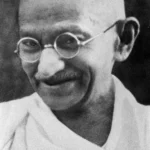

Gandhi’s wisdom quotes have never felt more relevant than they do right now. “There is more to life than simply increasing its speed”, Gandhi wrote those words decades ago, and yet they read like a direct response to 2026. Notifications, deadlines, content feeds, back-to-back schedules: modern life has become an exercise in acceleration. Gandhi stands apart from that current. He lived at a deliberate pace, owned almost nothing, and changed the course of history through sheer moral force. That combination makes him far more than a historical figure. He is a working philosopher for anyone trying to live with more intention.
His wisdom has found a lasting home on platforms like RainbowQuotes , where Gandhi inspirational quotes sit alongside other global philosophical voices, the Dalai Lama, the Stoics, Buddha, Swami Vivekananda. The placement is fitting. Gandhi belongs in that conversation. This article organizes his most powerful teachings around three practical pillars: simplicity, inner strength, and compassion. It also tackles something most quote roundups skip: which Gandhi lines are actually his, and which ones are viral inventions. By the end, you’ll know what Gandhi really meant, which quotes are worth sharing, and how to make his wisdom part of your daily practice.
Why Gandhi wisdom quotes cut through modern noise
The philosophy behind the most-shared lines
Gandhi’s quotes aren’t standalone aphorisms. They’re fragments of a deeply consistent philosophy built on three pillars: Satya (truth), Ahimsa (nonviolence), and Seva (selfless service). Once you understand the framework, each quote becomes richer and more precise. “My life is my message” isn’t humility, it’s a declaration that philosophy without practice is meaningless. “Truth is my God. Non-violence is the means of realizing Him” ties his entire political career to a spiritual foundation. “I have nothing new to teach the world. Truth and Non-violence are as old as the hills” reflects a man who saw himself not as an innovator but as a reminder.
These aren’t the words of someone performing wisdom. They’re the outputs of a life organized around a few non-negotiable principles. That consistency is why Gandhi sayings endure long after the moment that produced them.
Why self-improvement seekers keep returning to Gandhi
Gandhi’s focus on internal transformation before external action mirrors what today’s mindset coaches, therapists, and meditation teachers preach. “A man is but the product of his thoughts. What he thinks, he becomes” could appear on the opening page of any contemporary habit-building book without feeling out of place. His relevance isn’t nostalgia. It’s utility. Research in positive psychology suggests that daily engagement with values-based philosophical writing supports attention training, cognitive reappraisal, and habit reinforcement, precisely the mechanisms Gandhi was describing in plain language more than a century ago.
Gandhi wisdom quotes on simplicity: lessons that challenge how you live
Slowing down as a radical act
Gandhi’s sharpest quotes on simplicity aren’t gentle suggestions, they’re challenges to the way modern consumer culture operates. “Earth provides enough to satisfy every man’s needs, but not every man’s greed” came from a man who spun his own cloth, refused imported goods, and framed material restraint as moral clarity. His critique of speed and consumption wasn’t an embrace of poverty; it was protest and principle. In his Harijan writings, he was even more direct: “High thinking is inconsistent with complicated material life based on high speed imposed on us by Mammon worship.” He connected the pace of acquisition directly to the degradation of thought.
These aren’t abstract observations. They describe a specific choice Gandhi made every single day: to live at human scale rather than industrial scale.
Applying Gandhian quotes on simplicity in 2026
The modern minimalism movement, digital detox culture, and intentional living practices are all, in a sense, catching up to Gandhi. Consider what he would make of a 12-hour screen day, a person surrounded by more information than any previous generation, absorbing none of it with depth, acting on even less. His response is already written: “An ounce of practice is worth more than tons of preaching.” Consumption without application is the exact trap he warned against.
Here’s a practical reflection to try today: pick one Gandhi simplicity quote and ask what one concrete action it points toward. Not a lifestyle overhaul, just one choice. That’s the scale at which Gandhi believed change actually starts.
Inner strength in Gandhi’s own words
The will that no outside force can break
Gandhi was imprisoned multiple times, subjected to physical violence, and watched people he loved suffer for a cause he led. His quotes on inner strength don’t come from comfort; they come from that biography (see Biography.com’s collection of Gandhi quotes). “Strength does not come from physical capacity. It comes from an indomitable will” is not motivational decoration. It’s a description of how Gandhi survived what he survived. “Nobody can hurt me without my permission” and “Even if you are a minority of one, the truth is the truth” reflect a man whose inner life was genuinely unbreachable, not because nothing touched him, but because daily, disciplined practice had made his convictions structurally sound.
His inner strength was the result of sustained work, not natural personality. That distinction matters enormously for anyone trying to build their own resilience. Character, Gandhi showed us, is something you construct.
Forgiveness as strength, not surrender
“The weak can never forgive. Forgiveness is the attribute of the strong” is one of the most clinically relevant Gandhi quotes in circulation today. Contemporary research on emotional regulation supports exactly this framing: forgiveness is not passivity; it is an active choice that requires more courage than retaliation. Gandhi reinforced this in his Young India writing from September 1920: “I have learnt through bitter experience the one supreme lesson to conserve my anger.” He wasn’t suppressing emotion. He was directing it. That’s the distinction between emotional mastery and emotional avoidance, a distinction worth sitting with.
Compassion and service: the heart of Gandhi’s teaching
Love as a force, not a feeling
For Gandhi, compassion was never passive. It was the engine of social change. “You must not lose faith in humanity. Humanity is an ocean; if a few drops of the ocean are dirty, the ocean does not become dirty” is a quote about moral resilience as much as it is about human nature. It asks you to hold complexity without collapsing into cynicism. “Love is the strongest force the world possesses and yet it is the humblest imaginable” reframes love not as sentiment but as strategic moral power. “The day the power of love overrules the love of power, the world will know peace” is a diagnosis of every conflict, large and small.
These quotes by Mahatma Gandhi recast love as active, courageous, and world-shaping, the opposite of the soft, decorative version the word often gets reduced to.
Service as the path to self-discovery
“The best way to find yourself is to lose yourself in the service of others” and “Man becomes great exactly in the degree in which he works for the welfare of his fellow-men” form the practical core of Gandhi’s ethics. For mindfulness practitioners, service functions as a form of meditation in action: it dissolves the ego’s grip by redirecting focus outward. For anyone moving through burnout, loss, or stagnation, service offers something that self-focused recovery often cannot, immediate, tangible evidence that your actions matter. Gandhi lived this principle. It wasn’t theory.
Not all Gandhi quotes are real, and that matters
The most famous lines that aren’t actually his
Three of the most widely shared “Gandhi quotes” deserve serious skepticism. First: “Be the change you wish to see in the world.” The New York Times has reported that there is no reliable documentary evidence for this phrasing, and it does not appear in the 98-volume authorized Collected Works of Mahatma Gandhi (see a detailed quote-sourcing analysis). Second: “First they ignore you, then they ridicule you, then they fight you, and then you win.” Researchers have traced this specific wording to screenwriter John Briley’s dramatic adaptation in the 1982 film, not to any Gandhi text. Third: “An eye for an eye will only make the whole world blind.” This appears in Louis Fischer’s 1950 biography as Fischer’s own description of Gandhi’s philosophy, not as a verified verbatim quotation.
None of this diminishes Gandhi’s actual legacy. It means the real quotes deserve more attention than the invented ones.
How to tell a well-sourced Gandhi wisdom saying from a viral invention
The most reliable Gandhi quotations are those tied to Young India , Harijan , or the Collected Works of Mahatma Gandhi , complete with a date and publication reference. Quotes from his September 1920 Young India column, his February 1946 Harijan pieces on renunciation, and his March 1921 writings on Satyagraha all carry both emotional power and verifiable origin. Any quote that floats without a date, publication, or context deserves skepticism before it gets shared.
This is where thoughtfully curated platforms like RainbowQuotes earn their value: responsible curation means presenting attribution clearly, not just copying whatever is trending on social media. The best Gandhian quotes lose nothing from being properly sourced. They gain authority.
Making Gandhi wisdom quotes part of your daily life
Simple rituals that keep these teachings alive
For anyone who wants to use Gandhi’s teachings as daily anchors, three practical applications are worth building into your routine. Start with morning reflection: read one Gandhi quote before you check anything else, pair it with two minutes of journaling, and write one action you can take that day that reflects it. From there, use Gandhi’s quotes on peace as anchors during stressful moments, not as platitudes, but as actual reframes. “In a gentle way, you can shake the world” is a useful reminder when you’re tempted to escalate rather than de-escalate. And before a difficult decision, read one Gandhi wisdom saying and sit with it for sixty seconds. The pause alone changes the quality of the choice.
These rituals work because they do what practitioners of mindfulness describe: they interrupt autopilot thinking, support cognitive reappraisal, and attach values to concrete action (see research on mindfulness and mental health). That’s the difference between consuming quotes and actually using them.
Where to explore Gandhi’s full collection and share it
RainbowQuotes hosts Gandhi’s full quote library, organized by theme so you can move from his writing on truth to his writing on service to his writing on courage without losing the thread. His collection sits alongside other global philosophical voices, the Dalai Lama, Buddha, Swami Vivekananda, Marcus Aurelius, which is exactly the kind of comparative context that makes Gandhi inspirational quotes richer. For social media creators, educators, and coaches, the platform offers share-ready Gandhi quote images with proper attribution built in, formatted for the platforms where these ideas travel furthest, and you can also consult Wikiquote’s Mahatma Gandhi page for another curated compilation.
Great wisdom deserves great curation. Gandhi’s words are worth getting right: the sourcing, the attribution, the context. RainbowQuotes is built around that standard.
Simplicity, inner strength, and compassion, Gandhi didn’t treat these as separate virtues. He treated them as a unified practice. Strip away excess, build the will that cannot be broken, and direct that will toward others. That framework applies directly to how you work, how you relate to people, and how you move through difficulty in 2026. “The main purpose of life is to live rightly, think rightly, act rightly.” That line carries the weight of everything else he wrote. Return to these Gandhi wisdom quotes often, share the ones worth living, and let RainbowQuotes be the place where that practice begins.