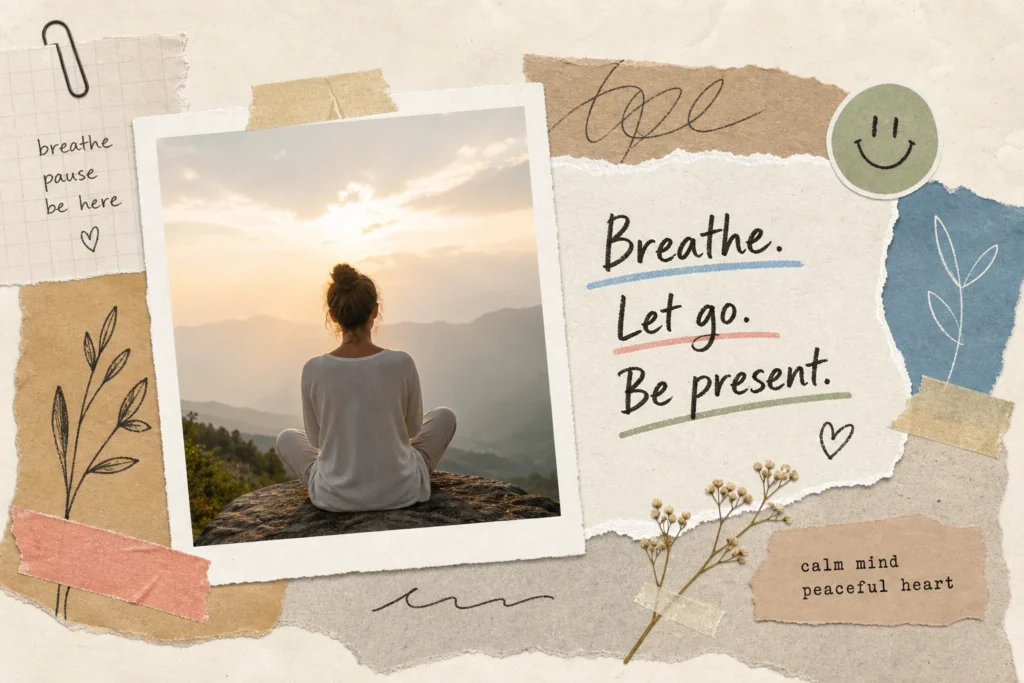
If you’ve ever wondered what are the most powerful mindfulness quotes to help ease anxiety and find calm, you’re asking exactly the right question. Anxiety doesn’t wait for a convenient moment. It shows up mid-meeting, at 2 a.m., or in the cereal aisle when nothing has gone obviously wrong. What most people don’t realize is that the right sentence, read or repeated at the right moment, can help interrupt a spiral for some people before it takes hold. This isn’t wishful thinking; it’s exactly what mindfulness teachers have practiced and passed down for generations.
This article gives you a curated selection of the most powerful mindfulness quotes for anxiety, organized by when and how to use them, plus four practical methods to turn each quote into an actual coping tool. You’ll also find a path to RainbowQuotes’ dedicated Healing and Calm mood categories for anyone who wants to keep browsing after reaching the end of this list.
Why a single sentence can stop an anxiety spiral
Short, focused verbal cues work because they activate the same present-moment attention that formal meditation does, with zero barrier to entry. Writing in Psychology Today, psychologist Ellen Hendriksen observed that “sometimes it takes only a sentence or two to get on the other side of anxiety”, direct guidance that brief calming language can redirect the mind before a spiral locks in. The mechanism is simple: anxiety lives in the future. A well-chosen quote pulls you back to now, and now is almost always more manageable.
A growing body of neuroscience research suggests that present-moment awareness is associated with reduced amygdala reactivity and improved prefrontal regulation of emotional stress, though researchers note that effects on physiological markers like cortisol are variable across individuals. You don’t need to understand the biology to benefit. What matters is that calming language, especially when paired with a slow breath, appears to shift attention in ways that support the nervous system and give your mind somewhere grounded to land.
One honest note before going further: quotes work as low-effort situational prompts, not as a substitute for therapy. They are most effective when paired with breathing, a short pause, or a grounding technique. That’s exactly what the practical methods section below will cover.
What are the most powerful mindfulness quotes to ease anxiety and find calm?
The quotes in this section come from teachers whose entire life’s work was learning to sit with difficulty without being consumed by it. Each one is included because it does something specific to an anxious mind, not merely because it sounds good.
Jon Kabat-Zinn: working with difficulty instead of against it
Kabat-Zinn founded Mindfulness-Based Stress Reduction (MBSR) in 1979 at the University of Massachusetts Medical School, which gives his words clinical weight beyond the inspirational. His quotes tend to reframe anxiety as something to navigate rather than eliminate, and that shift alone can reduce its grip.
- “You can’t stop the waves, but you can learn to surf.” His most recognized line for a reason. It replaces the exhausting goal of eliminating anxiety with the achievable goal of riding it.
- “Like it or not, this moment is all we really have to work with.” When worry spirals forward into worst-case scenarios, this sentence draws attention back to the only moment where anything can actually happen.
- “Mindfulness is the awareness that arises through paying attention, on purpose, in the present moment, non-judgmentally.” Reading this slowly is itself a grounding exercise. It reminds you that the practice is a choice you can make right now.
- “As long as you are breathing, there is more right with you than wrong with you.” During acute anxiety, this reframes the body as fundamentally okay rather than fundamentally broken.
Thich Nhat Hanh and Eckhart Tolle: breath and presence as anchors
Thich Nhat Hanh’s quotes work especially well because they are instructions disguised as poetry. Eckhart Tolle’s lines work because they cut straight to where anxiety originates: the thinking mind running unchecked.
- “Feelings come and go like clouds in a windy sky. Conscious breathing is my anchor.” The metaphor of impermanence is psychologically precise. Anxiety tells you the feeling is permanent; this quote tells the truth.
- “Breathing in, I calm body and mind. Breathing out, I smile.” A complete breathing practice in fourteen words. It pairs directly with the inhale-exhale method described below.
- “Peace is every step.” Three words that remind you calm doesn’t require a retreat or a meditation cushion. It’s available in the next ordinary action you take.
- “Realize deeply that the present moment is all you ever have.” Tolle’s most quoted line grounds attention in the only moment where relief is actually possible.
- “All problems are illusions of the mind.” This works best as a perspective shift when worry is stacking hypothetical scenarios. It interrupts the loop.
Short grounding mantras for the middle of a panic moment
The quotes above invite a moment of reflection. The phrases below do not. These anxiety calming affirmations are all under fifteen words, which matters because anxiety disrupts recall. The fewer words you need to remember, the better a phrase performs under pressure. These are designed to be repeated, not contemplated.
- “Be Here Now.” Three words that redirect attention to the present with no ambiguity.
- “One breath at a time.” Reduces the overwhelming to the immediate and achievable.
- “I am safe in this moment.” Gives the nervous system a direct signal that the threat is not immediate.
- “This moment is enough.” Counters the anxiety-driven pressure to fix everything at once.
- “Inhale peace, exhale worry.” Works as a literal breathing instruction and a mental image simultaneously.
- “This too will pass.” Reintroduces impermanence at the exact moment anxiety insists the feeling is permanent.
- “Breathe and release.” A complete two-step instruction that requires nothing more.
Phrases that pair with a breath cycle
Split a short quote across the in-breath and the out-breath to give the mind a rhythm to follow. For “Inhale peace, exhale worry,” breathe in slowly on the word “peace” and breathe out on the word “worry.” For “One breath at a time,” inhale on “one breath” and exhale on “at a time.” The pairing keeps attention anchored to the body rather than drifting back to whatever is driving the anxiety.
The three to memorize first
If you take nothing else from this section, commit these three to memory this week: “One breath at a time,” “Be Here Now,” and “I am safe in this moment.” These three phrases address what an anxious brain tends to need most: a narrowed focus, a return to presence, and a cue toward physical safety. Choose one as your default and repeat it the next time anxiety rises, before you even think about what to do next.
Quotes for self-compassion and sitting with hard feelings
Not every anxious moment calls for a grounding mantra. Some days, what you need is not to stop anxiety in its tracks but to build a gentler, less combative relationship with it over time. Tara Brach, Pema Chödrön, and the Buddha offer language for exactly that.
Tara Brach and Pema Chödrön on resistance and weather
Tara Brach’s work centers on what she calls Radical Acceptance, a willingness to experience yourself and your life as it is. Her quote “The most basic form of suffering is resisting what is” is psychologically precise: anxiety is painful, but the effort to push it away often amplifies it. Brach’s framing gives you permission to stop fighting, which is itself a form of relief.
Pema Chödrön’s sky-and-weather metaphor does something slightly different. “You are the sky. Everything else, it’s just the weather.” This separates the observer from the anxious state. You are not the anxiety; you are the awareness watching it pass through. That distinction is worth sitting with. Her other frequently cited line, “Nothing ever goes away until it has taught us what we need to know,” encourages patience with difficult feelings rather than panic about their presence.
The Buddha on the mind as the root of experience
“Peace comes from within. Do not seek it without.” This is not a platitude. It reflects a core insight about where anxiety is generated and where its relief is found. Searching for external conditions to feel calmer is the anxiety trap; this quote redirects the search inward. “The mind is everything. What you think you become” reinforces the same point: the quality of your attention shapes the quality of your experience, and that is something you can begin to influence right now.
How to use the most powerful mindfulness quotes to ease anxiety and find calm
Reading a quote once is a start. Using it as a real coping tool takes one small extra step. These four methods take any quote from this article and turn it into something that works beyond the moment you first encounter it.
1. Inhale-exhale pairing and spoken mantra
Choose a short stress relief quote, sit or stand still, and split the phrase across your breath: first half on the inhale, second half on the exhale. Repeat for four to five slow breath cycles, saying the words either silently or aloud. The best quotes for this method are the short grounding mantras above, particularly “Inhale peace, exhale worry” and “One breath at a time.” Saying the words aloud during a rising panic moment is especially effective because speaking requires controlled breath, and controlled breath interrupts the physiological anxiety response.
2. Phone wallpaper and lock screen
Visible, repeated exposure is more effective than reading a quote once. Choose a meditation quote or calming quote that feels personally true rather than merely inspiring, set it as your lock screen, and you’ll encounter it dozens of times a day without any extra effort. The best candidates are short enough to read at a glance: “Be Here Now,” “One breath at a time,” or Kabat-Zinn’s “This moment is all we really have to work with.” RainbowQuotes’ save-as-image feature makes this a one-tap step: browse the Calm or Healing category, find a quote that resonates, and save a formatted image directly to your phone.
3. Journaling with a quote as the prompt
Write the quote at the top of a notebook page. Then answer three questions below it: What does this mean to me right now? How does it apply to what I’m currently facing? What is one small action I can take today that aligns with it? This turns a passive line of text into a structured reflection tool. A Pema Chödrön or Tara Brach quote works especially well here because their language tends to open questions rather than close them.
4. The pre-sleep spoken mantra
Anxiety peaks at night for many people because the absence of daytime distraction leaves the mind to run its loops unchecked. Choose one calming quote, lie down, and repeat it slowly for three to five minutes while breathing at a comfortable pace. The goal is not to analyze the quote but to let its rhythm replace the rumination cycle. Thich Nhat Hanh’s “Breathing in, I calm body and mind. Breathing out, I smile” was built for exactly this kind of practice.
How to find the right quote for exactly how you feel right now
The quotes in this article are a strong starting point, but anxiety is not one-size-fits-all. Some moments call for a grounding mantra; others call for a self-compassion quote or something about healing. Searching by keyword or author works fine when you know what you want, but it’s harder when anxiety is already making clear thinking difficult. That’s where mood-based browsing solves a real problem.
RainbowQuotes organizes its library of 10,000+ quotes by mood, with dedicated Healing and Calm categories built for moments exactly like this. You don’t need to know the author or the topic. You browse by how you feel right now, which is precisely what an anxious mind can manage. The platform updates its editorial collections daily, so it works as an ongoing practice resource rather than a one-time visit. The save-as-image feature means that once you find a quote that lands, it goes straight to your lock screen in seconds.
The next step is smaller than you think
Anxiety is uncomfortable, but it is not permanent. Every quote in this article, from Kabat-Zinn’s surfing metaphor to the three-word instruction “Be Here Now,” works because it reminds you of that fact in the fewest words possible. The feeling is real, and it passes. The moment is hard, and it is manageable. These insights draw on contemplative traditions that are centuries old, articulated by contemporary teachers in language we can actually reach for mid-spiral.
This week, choose two or three quotes that felt most true to you while reading and write them somewhere you’ll actually see them. Set one as your lock screen using RainbowQuotes’ save-as-image tool. Try the inhale-exhale pairing with the shortest one before bed tonight. Small, repeated practice is how a quote moves from something you read once to something your mind reaches for automatically when it needs it most.
Still searching for the right words? RainbowQuotes’ Calm and Healing categories are organized by mood and updated daily. Browse the most powerful mindfulness quotes for anxiety, save what resonates, and return whenever you need something new. The right words are already there waiting for you.