
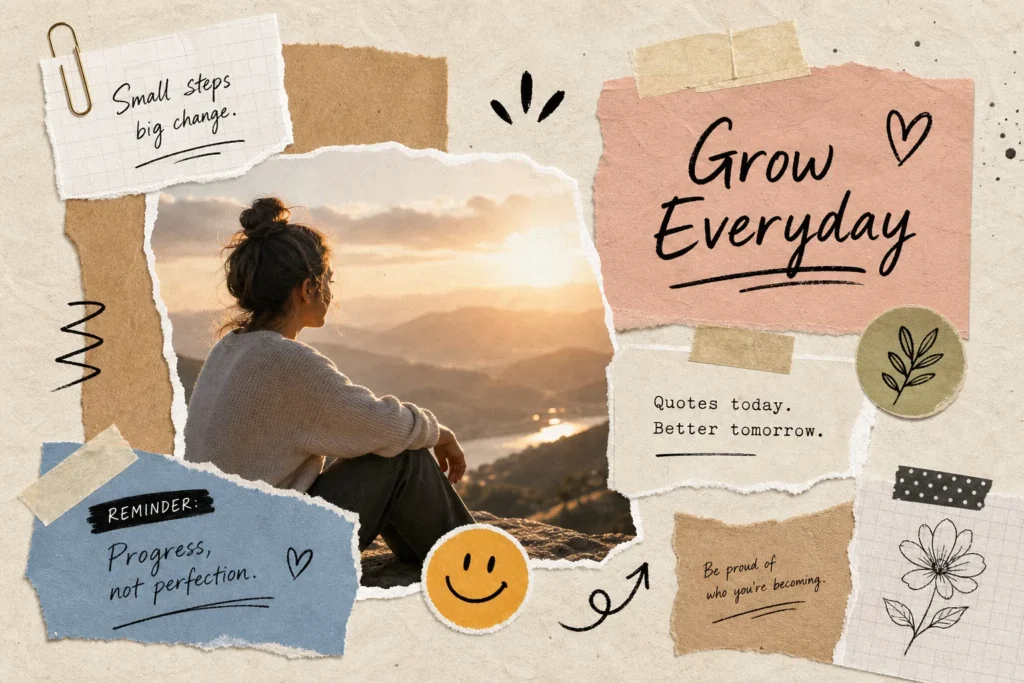
Quotes for personal development have a way of stopping you mid-scroll, one sentence surfaces and names exactly what you’ve been carrying. It doesn’t fix anything instantly, but something in how those words land makes the problem feel workable instead of impossible. That moment isn’t luck. It’s what happens when the right quote finds you at the right point in your growth journey.
Personal growth quotes aren’t wall art for people who like inspirational fonts. When you choose the right words for the right challenge and then actually do something with them, they become a lever. The difference between a quote that scrolls past and one that changes your week comes down to intention: matching the message to your specific growth need, and pairing it with a real next step. That’s the principle behind RainbowQuotes, a platform built around mood-based discovery and curated collections designed to meet you exactly where you are, not somewhere vague and general.
Why a quote can genuinely shift how you think and act
How a resonant line interrupts your default thinking
Your brain runs on patterns. Most of the time, when you hit a setback, you interpret it through whatever mental script you’ve built up over years. A well-chosen quote delivers a reframe in seconds: it takes a situation you’ve been reading one way and names it differently. Psychologists call this cognitive reframing, and the mechanism is real. When language matches your emotional state but repositions the meaning, it creates a small but genuine pattern interruption that makes space for a different response.
Repetition is what turns a quote into a belief
One read changes nothing. Daily exposure to the same line, through a phone wallpaper, a morning routine, or a journaling practice, can gradually strengthen how you interpret setbacks and opportunities. Self-affirmation research supports this: repeated engagement with credible, personally relevant statements tends to increase their accessibility over time, making supportive thoughts easier to retrieve when you need them. Effects vary by person and context, and this kind of mental shift typically unfolds over weeks to months rather than overnight. The rest of this article is about making that repetition intentional rather than accidental.
Quotes for personal development matched to your growth theme
Growth mindset: quotes that reframe how you see your own potential
Growth mindset quotes work by shifting self-perception from fixed to developing. When you read a line that frames ability as something you build rather than something you’re born with, it quietly challenges the internal voice that says your ceiling is already set. Carol Dweck, whose research at Stanford defined the growth mindset framework, put it simply in her book Mindset: “Becoming is better than being.” A complementary anchor comes from a line commonly attributed to Ralph Waldo Emerson: “The only person you are destined to become is the person you decide to be.” Both quotes move the locus of control from fate to choice, which is exactly where growth starts.
Resilience and confidence: words for the moments when you almost give up
Confidence-building quotes work best when they validate the struggle instead of pretending it doesn’t exist. Carrie Fisher said it directly: “Stay afraid, but do it anyway. You don’t have to wait to be confident. Just do it and eventually the confidence will follow.” That’s not optimism for its own sake; it’s a practical instruction. Maya Angelou reinforces it from a resilience angle: “You may not control all the events that happen to you, but you can decide not to be reduced by them.” Both quotes acknowledge the difficulty and point forward, without asking you to pretend the hard part isn’t hard.
Purpose and habit change: quotes about change and growth for the long game
During the low-motivation phase of any new habit, purpose-anchored quotes act as a re-centering tool. Jim Rohn’s line cleanly cuts through excuses: “Your life does not get better by chance; it gets better by change.” Confucius offers the long-game reminder that keeps people from quitting too soon: “It does not matter how slowly you go so long as you do not stop.” When you’re three weeks into a new habit and the initial motivation has worn off, these are the lines worth keeping close.
How to put each quote to work the moment you read it
The micro-action method: from reading to doing in under two minutes
Reading a quote and feeling inspired is step one. Pairing it with a micro-action converts that feeling into behavioral momentum. A micro-action is any task small enough to finish in under two minutes. Habit-formation research is clear on this: tiny actions paired with existing routines build automaticity faster than ambitious plans that collapse under their own weight. For the Carrie Fisher resilience quote, the micro-action is writing down one setback you didn’t let stop you. For the Jim Rohn purpose quote, it’s writing one sentence about what you’re choosing to change this week. The action doesn’t have to be big; it just has to be real.
Journaling prompts that help you go deeper with a quote
A journaling prompt turns passive reading into active reflection. Even a single sentence of reflective writing can anchor an insight more effectively than passive rereading for many people, and it’s the most underused tool in any self-improvement quotes practice. For a growth mindset quote like Dweck’s “Becoming is better than being,” try: What belief about myself am I ready to let go of today? For a resilience quote, use: What’s one hard thing I navigated recently that proved I’m more capable than I thought? For purpose and habit quotes: What’s the smallest change I’m avoiding, and why? It costs nothing but a few minutes of honest attention.
Attribution matters: how to share quotes with confidence
The most common misattributions you’ll want to avoid
The internet has a consistent problem with quote accuracy, and the pattern is predictable: the more perfectly wise a quote makes a famous name sound, the more likely it is to be a later paraphrase. The “insanity is doing the same thing over and over” quote is routinely credited to Einstein, but no verified Einstein source exists. The line “I disapprove of what you say, but I will defend to the death your right to say it” is attributed to Voltaire, but it was actually written by Evelyn Beatrice Hall as a summary of his views. And Gandhi’s famous “be the change” line is better understood as a popular paraphrase of his ideas rather than a documented original sentence. None of this makes these quotes less useful; it just means they deserve accurate framing before you share them.
A simple standard for citing quotes accurately
The practical rule is straightforward: if you can’t trace the quote to a specific book, speech, or verified biography, say “attributed to” rather than treating it as confirmed. This matters for more than accuracy alone. Correct attribution respects the thinker, builds your credibility as a sharer, and actually adds depth to the quote rather than flattening it into generic inspiration. A quote from Viktor Frankl’s Man’s Search for Meaning carries more weight when you name the context; the source becomes part of the meaning.
Finding quotes for personal development that match where you are right now
How mood-based discovery changes the way you find the right quote
Many quote libraries categorize by topic, which tends to be broad. Mood-based discovery is what makes the search feel personally relevant. When you’re burnt out, a “success” quote can feel tone-deaf; a “healing” or “calm” quote reorients you without adding pressure. RainbowQuotes is built around this distinction, with mood-based browsing filters including Hopeful, Focused, Healing, Calm, and Motivation, so you find the inspirational quote for growth that fits how you feel right now rather than a generic category that may or may not land.
Beyond mood filters, the platform’s curated editorial collections, including morning motivation, journaling quotes, and healing quotes, add another layer of personalization. You’re not just searching a database; you’re navigating a library organized around real growth moments. According to RainbowQuotes’ catalog, the platform features more than 10,000 quotes spanning over 200 topics and 500 authors, which means the depth is there, and the mood filters are simply how you navigate it without drowning in options.
Saving and revisiting your favorites builds a personal growth record
Saving quotes over time creates something more than a collection: it becomes a record of your mindset at different points in your path. Looking back at what you saved six months ago reveals which themes you kept returning to and shows you how your perspective has shifted. RainbowQuotes’ save-as-image feature means your favorite quotes are already formatted for social sharing or a phone wallpaper the moment you find them, streamlining the entire sharing process. Revisiting saved favorites adds a reflection layer to quote discovery that most platforms skip entirely, turning a single moment of inspiration into an ongoing conversation with yourself.
Daily quotes for personal development that actually stay
Share-ready captions that work on Instagram and LinkedIn
A quote on its own is a statement. A quote paired with a question becomes a conversation. On Instagram, the most effective caption format is the quote plus a direct question: “Progress over perfection. What are you focusing on this week?” invites engagement rather than passive scrolling. For LinkedIn, a slightly more reflective format lands better: “Consistency beats intensity. Here’s what that’s looked like in my own practice.” That format fits the platform’s preference for thought leadership without losing the warmth of the original quote. RainbowQuotes’ save-as-image feature means the graphic is already ready before you write a single word of the caption.
A five-minute morning routine that anchors the habit
Here’s a structure that works: open RainbowQuotes each morning, use the mood filter to find a quote that fits where you are today, write one sentence in response to a journaling prompt, and complete one micro-action tied to the quote before noon. That’s five minutes of intentional practice. Habit research supports this approach: small actions paired with a stable daily cue, like morning coffee or a commute, build automaticity over weeks rather than months. The key is connecting the quote to an action before you close the tab. Inspiration that stays on the screen stays a feeling; inspiration attached to a step becomes a shift.
Quotes become tools when you use them with intention
A quote that scrolls past is decoration. A quote chosen for the right growth theme, paired with a micro-action and a journaling prompt, is a tool. That’s the difference this article is built around. You don’t need fifty quotes on your wall; you need one well-chosen quote that fits today’s challenge and a clear next step to take before the feeling fades.
The framework is repeatable: match the quotes to inspire personal growth to your current need, verify the attribution before you share, and anchor the quote to a real action within two minutes of reading it. With consistent practice over time, self-improvement quotes can help reshape accessible thought patterns and reinforce developing beliefs, though how quickly that happens depends on the person and how personally relevant the words feel.
If you’re ready to find quotes for personal development that fit exactly where you are right now, RainbowQuotes is built for that search. Use the mood filters, browse a curated collection, and let the right words meet you at the right moment. Find your quote now.