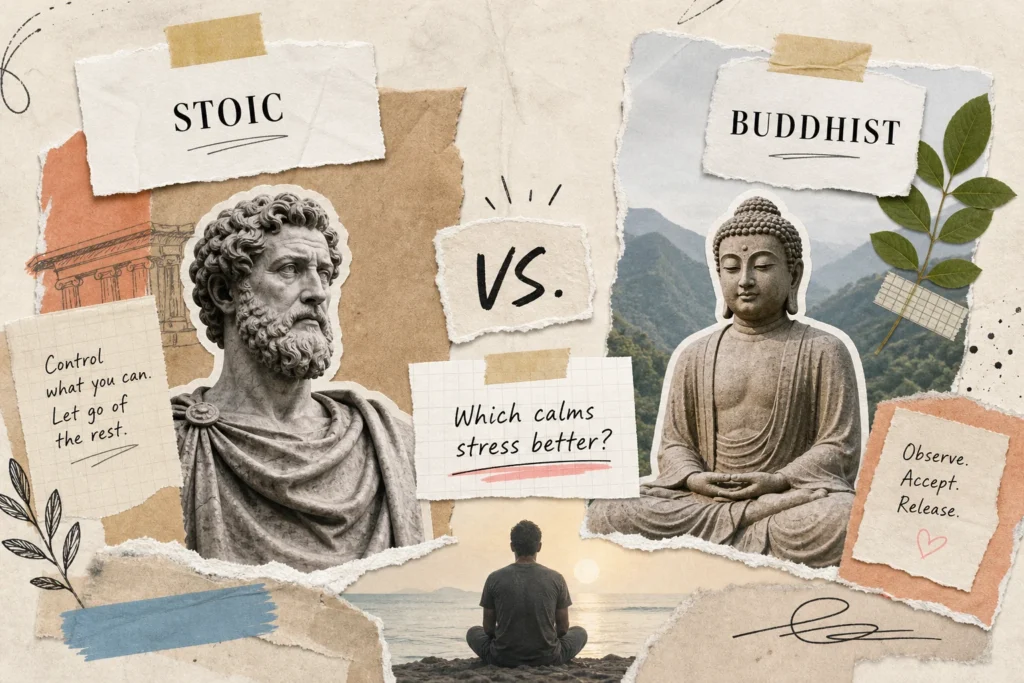
Stress-management advice fills every corner of the internet, and yet most of it feels shallow. Breathe deeply. Take a walk. Think positive. None of it addresses the reason stress keeps returning: the problem lives in the mind, not in the situation. Comparing stoic vs Buddhist wisdom for dealing with stress reveals two traditions that developed enduring strategies for that internal problem over two thousand years ago, and their answers remain surprisingly practical today.
Stoicism, shaped by Marcus Aurelius, Epictetus, and Seneca, and Buddhism, grounded in the Buddha’s original teachings and kept alive by modern voices like the Dalai Lama, are among the most historically applied and clinically studied bodies of wisdom on emotional resilience ever developed. At RainbowQuotes, we curate quotes from both traditions side by side: Marcus Aurelius sits next to the Dalai Lama in our author collections, and looking at them together reveals something most people don’t expect. These two philosophies agree far more than they disagree, an observation supported by comparative scholars who note shared mechanisms like decentering and non-reactivity, but they diverge in exactly the right places to help you figure out which approach fits your mind. By the end of this article, you’ll have a clear map of both traditions and a daily practice you can start this week.
How each tradition diagnoses the root of stress
Both philosophies begin with the same premise: stress is not caused by events. It is caused by how the mind relates to events. That shared starting point is significant. It means both traditions are pointing at something internal, not something you need to fix in the world around you.
The Stoic verdict: your judgment is the problem
Marcus Aurelius put it plainly: “If you are distressed by anything external, the pain is not due to the thing itself, but to your estimate of it; and this you have the power to revoke at any moment.” Epictetus sharpened that insight into one operating principle: suffering arises from trying to control what is uncontrollable. For Stoics, stress is a judgment error. You have misplaced your concern on something outside your will, and the fix is to redirect it back toward what is actually yours, your choices, your actions, your response.
The Buddhist view: craving and clinging create suffering
Buddhism names the problem differently. The First Noble Truth states that conditioned life contains dukkha, a word often translated as suffering or dissatisfaction. The Second Noble Truth identifies the cause: craving and clinging. Where Stoicism points to a faulty judgment, Buddhism points to a faulty attachment. The mind suffers because it reaches for permanence in a world where nothing lasts. The Dalai Lama captures this consistently: “If a problem is fixable, there is no need to worry. If it’s not fixable, there is no benefit in worrying whatsoever.” Both traditions are telling you to stop grasping. They just describe the grasping differently.
Stoic vs Buddhist wisdom for dealing with stress, core techniques
Stoic stress management is active, cognitive, and incremental. For practical Stoic stress-relief techniques, see Stoic stress-relief techniques. The tools most practitioners return to are the dichotomy of control, negative visualization, and reflective journaling. Each one is a skill you build over time, not a one-time insight. Buddhist practice works through a different mechanism: rather than reframing a judgment, you train awareness to observe thoughts and feelings without being pulled by them.
The dichotomy of control in practice
When a stressor hits, Epictetus’ method is straightforward. Split the situation into two columns: what is up to you (your choices, your preparation, your response) and what is not (other people’s reactions, outcomes, the past). Write both sides down. Put your energy only into the first column. This is not denial of reality; it is a focused redirection of cognitive effort toward what is actually actionable. A morning routine built around this single practice can change the tone of an entire day, because you start by anchoring yourself to what you can actually do.
Negative visualization and daily journaling
Seneca’s line “we suffer more often in imagination than in reality” is the foundation of negative visualization, or what the Stoics called premeditatio malorum. You briefly rehearse a feared outcome, identify what you could control if it happened, then release the rest. The goal is not catastrophizing; it is reducing the shock of setbacks by preparing the mind in advance. Pair this with an evening journal where you separate the event from your interpretation of it, and you build a feedback loop that tightens your equanimity over weeks. A Birkbeck, University of London study on structured online Stoic training found that this kind of practice reduced rumination by 13 to 18 percent compared to controls, suggesting the technique does more than feel good in the moment. These Stoic mindfulness techniques work precisely because they give the anxious mind a structured task rather than an open-ended question.
Mindfulness and breath awareness (Vipassana-style)
Vipassana-style mindfulness asks you to sit with whatever is present, anxiety, restlessness, tension, and observe it as an event in awareness rather than as “me.” When the mind wanders into worry, you note it simply as “thinking” and return to the breath. Over time, this builds the capacity to watch stress arise and pass without automatically reacting to it. A body of neuroimaging research suggests that consistent mindfulness practice is associated with changes in amygdala activation, the brain’s core threat-processing region, and preliminary findings indicate that even short daily breath-awareness sessions may produce measurable shifts in stress reactivity. The practice is not about clearing the mind. It is about changing your relationship to what the mind produces.
Loving-kindness (metta) meditation
The two practices most people start with in Buddhist stress reduction are breath awareness and metta, or loving-kindness. Metta works by deliberately cultivating goodwill, beginning with yourself. The phrases are simple: “May I be safe. May I live with a peaceful heart.” You repeat them slowly while breathing naturally, and the effect is a gradual interruption of the tight, contracted mental state that stress produces. Researcher Barbara Fredrickson’s work on loving-kindness meditation, along with related studies, has associated the practice with lower heart rate, reduced stress-induced inflammatory markers, and increases in positive affect. The Dalai Lama consistently frames compassion practices as the foundation of a stable mind: “From my own limited experience, I have found that the greatest degree of inner tranquility comes from the development of love and compassion.” Research gives it a biological basis.
Stoic vs Buddhist wisdom for dealing with stress, where the two paths converge and divide
Common ground: non-reactivity and present-moment focus
Both Stoicism and Buddhism train the mind to pause between stimulus and response. Both emphasize that most suffering is mentally constructed rather than externally imposed. Both include some form of present-moment focus: the Stoic attention to one’s current judgment, the Buddhist attention to what is happening right now in the body and breath. This convergence is one reason why modern stress reduction programs often combine cognitive reframing techniques, rooted in Stoic-influenced thinking, with mindfulness-based practices drawn from Buddhist traditions. The stress reduction meditation approaches in each lineage are not competing; they work on different layers of the same problem.
The key split: reframing control vs. releasing attachment
Stoicism wants you to assert inner mastery. Identify what is yours, take ownership of it, and release the rest through an act of reasoned will. Buddhism takes the opposite angle: there is no “inner citadel” to defend, only patterns of clinging to release. One tradition strengthens your sense of agency; the other dissolves the need for it. As an interpretive generalization, Stoicism tends to be sharper in moments that require a clear decision, while Buddhism tends to run deeper for ongoing emotional states that have no clear resolution. Knowing this distinction is what makes both traditions more useful than either one alone.
Honest limitations practitioners report
When Stoic techniques feel like suppression
The inner-citadel framing can tip into rigidity. When emotion has already flooded the system, reaching for rational reframing can feel less like correction and more like force, useful when the mind is calm enough to engage with reasoning, but exhausting when it is not. Stoic techniques work best as an immediate cognitive corrective. As a complete emotional practice on their own, they can feel tight and effortful over time, particularly when processing grief, fear, or overwhelm rather than simply managing them.
When Buddhist observation feels too slow for acute stress
Buddhist practices lower baseline reactivity steadily over months, but the approach can feel unfocused once a strong emotion has already hit. For someone already inside an acute stress moment, a difficult conversation, a sudden crisis, the non-reactive observation approach can feel too abstract to be immediately useful. Leaning into an unpleasant feeling to observe it can also feel like wallowing rather than resolving. Buddhist practice is a long-arc investment; it changes who you are over time, not necessarily how you respond in the next five minutes.
Building your daily stress practice using quotes as anchors
The most effective approach for many people is not to pick one tradition and ignore the other, but to use each where it fits best. Acute, problem-solvable stress often responds well to Stoic reframing. Diffuse, ongoing emotional tension frequently responds better to Buddhist mindfulness.
A 7-day experiment: stoic vs Buddhist wisdom for dealing with stress
Spend the first three days working only with Stoic tools: morning dichotomy-of-control journaling, a brief negative visualization before a known stressor, and an evening reflection on your judgments that day. Days four through six, switch to Buddhist practices: ten minutes of breath awareness in the morning, a short metta session before bed. On day seven, notice which approach felt more natural, more sustainable, and more resonant. Many practitioners come out of it using both, finding that Stoic tools sharpen their response to concrete stressors while Buddhist practice softens their baseline reactivity. Think of your observations as personal feedback rather than a scientific result; this is a self-experiment, not a diagnostic test, and its value lies in what it reveals about your own patterns.
Using curated quotes as daily anchors
A practical way to keep both traditions alive in daily life is to read one quote from each school each morning before stress arrives. RainbowQuotes curates author-based collections from Marcus Aurelius, Epictetus, the Dalai Lama, and the Buddha, all in one place, with shareable image quotes ready to use as phone wallpapers or journal headers. Starting the day with one Stoic quote and one Buddhist quote is a low-effort ritual that takes under two minutes and primes the mind before the first difficult moment of the day. The wisdom is already there; it just needs to be placed in your path consistently.
Both traditions are pointing at the same door
Weighing stoic vs Buddhist wisdom for dealing with stress is not a competition with a winner. It is a map that helps you understand your own mind better. Stoicism offers a framework for immediate, judgment-level stress management: when something hard hits, you have a cognitive tool to reach for. Buddhism offers a longer-arc practice for reducing emotional reactivity at the root: over weeks and months, the things that once spiked your stress stop landing as hard. Used together, they cover ground that neither covers alone.
The 7-day experiment described above is the simplest next step. It costs nothing, takes about fifteen minutes a day, and gives you direct, personal information about which approach resonates with your mind. Many people find themselves drawing on both traditions by the end of the week, and that combination is the point.
If you want a daily anchor while you build the practice, visit the Marcus Aurelius, Epictetus, and Dalai Lama collections at RainbowQuotes. The quotes are carefully sourced, attributed, and formatted for daily use. That is two thousand years of tested wisdom on stress, all in one place. All you have to do is show up each morning and read.