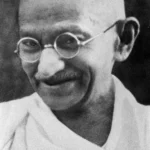
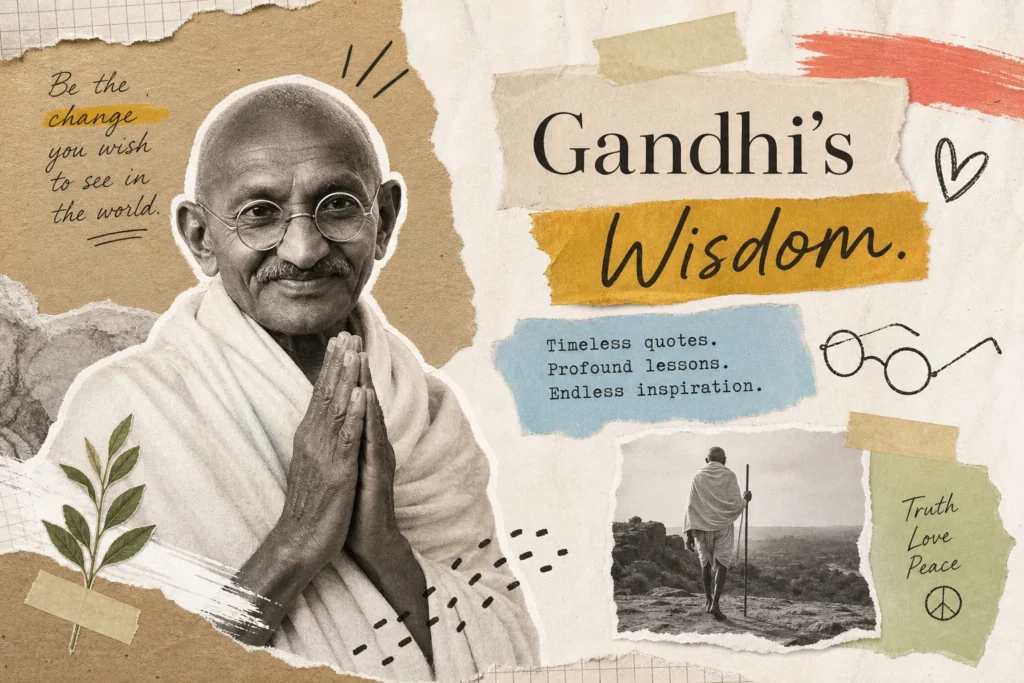
This collection of Mahatma Gandhi quotes demonstrates why his words have endured long after the British Empire fell, outlasted three generations of political movements, and remain more widely read than most self-help bestsellers. That staying power is not accidental. Mohandas K. Gandhi was a lawyer, independence leader, and philosopher of nonviolence who spent decades turning abstract moral principles into mass political action. His quotes carry unusual weight because they were not written from comfort. They came from a man who went to prison for his beliefs, led millions through suffering, and staked his life on the conviction that truth and restraint were stronger than weapons.
This article organizes 40 of his most famous sayings into four clear themes: truth, nonviolence, courage, and change. Each section gives you the historical context behind the words so you know exactly when and why to use them. If you want to explore his broader collection alongside other philosophical voices like the Dalai Lama, Marcus Aurelius, and Confucius, RainbowQuotes curates a Gandhi collection alongside dozens of other thinkers in one place.
One more thing worth knowing before you start: several of the most viral “Gandhi quotes” circulating online are not actually his. This article flags the biggest ones so you can share wisely and speak with credibility.
Mahatma Gandhi quotes on truth: his most philosophical sayings
Gandhi’s concept of Satyagraha literally means “truth-force” or “soul-force.” For him, truth was not just a personal virtue. It was the operating principle behind every act of resistance he organized. His philosophy drew from Hindu scripture, what scholars commonly identify as Tolstoy’s Christian pacifism, and Thoreau’s civil disobedience, influences Gandhi himself acknowledged in his writings and correspondence, which is exactly why his words on truth resonate across so many cultures and belief systems.
“Truth never damages a cause that is just.” Gandhi applied this principle directly in his dealings with British authorities. He consistently refused to obscure or soften his demands, arguing that transparency was itself a form of power. This line remains a touchstone in journalism ethics and courtroom advocacy because it makes a clear claim: honesty is strategic, not naive.
“My religion is based on truth and non-violence. Truth is my God. Non-violence is the means of realizing Him.” This quote comes from Gandhi’s own writings clarifying that his activism was spiritual, not merely political. It reframes the entire independence movement as a moral project rather than a nationalist one.
“Morality is the basis of things and truth is the substance of all morality.” This line fits naturally in leadership training, ethical coaching, and academic discussions about integrity. In classrooms and boardrooms alike, it cuts through abstraction and gives people a concrete foundation for ethical decision-making.
Mahatma Gandhi quotes on nonviolence and peace: his defining legacy
Ahimsa, the principle of non-harm, was the cornerstone of Gandhi’s entire worldview. He did not invent it. Rooted in Jain and Hindu thought, ahimsa was centuries old before Gandhi was born. What he did was apply it politically with extraordinary discipline. The Salt March of 1930 and the Quit India Movement of 1942 proved that organized, sustained nonviolence could shake a colonial empire. That historical context gives these quotes by Gandhi their moral weight.
“Non-violence is the greatest force at the disposal of mankind.” Gandhi articulated this claim during an era that included two world wars. Calling nonviolence a greater force than any weapon was not naivety. It was a deliberate challenge to the logic of military power that dominated his era.
“Non-violence is not a garment to be put on and off at will. Its seat is in the heart.” This line is one of the richest for classroom discussion and social sharing because it directly addresses the most common objection to nonviolence: that it is situational or conditional. Gandhi’s answer was that it cannot be. It is a disposition, not a tactic.
Two more verified Mahatma Gandhi sayings on nonviolence
“Non-violence and truth are inseparable and presuppose one another” draws a direct link between this theme and the previous one, showing that Gandhi’s philosophy was a unified system rather than a list of disconnected principles.
“Non-violence is the summit of bravery” is a short, caption-ready line that reframes courage entirely. It is also deeply relevant to contemporary anti-war movements and mental wellness content, where the language of strength is being actively redefined.
Mahatma Gandhi quotes on courage, forgiveness, and inner strength
Gandhi consistently flipped conventional ideas about power. For him, restraint, forgiveness, and endurance were not weakness. They were the hardest disciplines a person could practice. His quotes on inner strength came from lived experience: historical accounts document his multiple imprisonments across South Africa and India, and he was present in Bengal and Delhi during the violence surrounding Partition in 1947. These were not words written from a safe distance.
“The weak can never forgive. Forgiveness is the attribute of the strong.” This is one of the most widely cited Gandhi sayings in contexts ranging from conflict resolution to restorative justice. It resonates because it inverts the cultural assumption that forgiveness is a concession. Gandhi positioned it as a demonstration of power.
“Non-violence is my first article of faith. It is also my last article of creed.” This line is drawn from Gandhi’s courtroom address at his 1922 sedition trial, a speech in which he accepted responsibility for his writing and invited the judge to impose the harshest sentence available. Knowing the context transforms the words. He was not speaking from safety. He was stating his position directly to the court that was about to imprison him.
“To lose patience is to lose the battle.” Short, direct, and universally applicable. Whether you are managing a difficult project, navigating a tense conversation, or working through grief, this line delivers. It speaks to the instinct to retaliate or give up, and that psychological tension is exactly why sayings like this travel so well across social media and coaching content.
Gandhi quotes on change, service, and action
Gandhi’s most-searched quotes cluster around personal responsibility and action. His philosophy of change was explicitly about self-reform as the engine of social reform. He did not believe in waiting for systems to change while individuals stayed the same. This is also where many misattributions live, so context here is especially important.
“The future depends on what you do today.” This is a reliably attributed Gandhi saying with consistent citation across major collections. It is also one of the most straightforward lines he ever produced, which explains its longevity. No metaphor, no complexity. Just a direct statement about cause and effect.
“The best way to find yourself is to lose yourself in the service of others.” This line is widely circulated and deeply associated with Gandhi’s philosophy. Be aware, however, that it lacks a confirmed primary source in his collected works. It reflects his worldview accurately, but treat it as “commonly attributed to Gandhi” rather than a verified direct quote when using it in formal contexts.
“Non-cooperation with evil is as much a duty as cooperation with good.” This one is historically tied to his Non-Cooperation Movement of 1920 and is well-documented. It is a powerful line for speeches on policy, civic responsibility, and ethical leadership.
“I object to violence because, when it appears to do good, the good is only temporary; the evil it does is permanent.” This quote is equally strong for policy discussions and deserves far more use than it currently gets. Both lines are worth keeping in your toolkit.
Short Mahatma Gandhi sayings for social captions and speeches
Some of Gandhi’s most enduring lines are under 12 words. These are built for Instagram graphics, Pinterest boards, speech openers, and classroom posters. They work because they are complete thoughts that need no explanation. Here are the most useful, with confirmed or widely reliable attribution:
- “My life is my message.”, Four words. The most powerful leadership statement he ever made.
- “Peace is its own reward.”, A natural fit for wellness and mindfulness content.
- “Full effort is full victory.”, Strong for academic motivation and sports coaching.
- “Where there is love there is life.”, Evergreen for relationship and grief content.
- “Truth never damages a cause that is just.” , Ideal for advocacy and journalism captions.
- “To lose patience is to lose the battle.” , One of the most universally shareable lines he produced.
A quick note: some ultra-short versions of Gandhi quotes circulating online are compressed paraphrases, not direct quotes. “Be the change,” for instance, is a fragment of an already disputed attribution. Finding the fuller version is easier than it sounds. When in doubt, use the complete phrasing or add a qualifier. RainbowQuotes offers a dedicated Gandhi author collection with shareable picture quotes designed for Instagram, Pinterest, and Facebook, organized alongside other philosophical leaders so you can find what you need without digging through scattered search results.
Famous “Gandhi quotes” that are not actually his
Gandhi’s moral authority is so high that people attach his name to powerful-sounding wisdom to give it instant credibility. Researchers who cross-reference the Collected Works of Mahatma Gandhi (CWMG) have documented this pattern extensively. The same phenomenon happens with Einstein, Lincoln, and Twain, but Gandhi’s cross-cultural appeal makes misattribution especially common.
These three widely shared lines deserve honest flags:
“Be the change you wish to see in the world.” This is the most famous Gandhi quote on the internet, and no verified primary source for it appears in his Collected Works. The sentiment reflects his philosophy of self-reform, and the phrasing has been traced by some researchers to a 1974 self-help book by Arleen Lorrance. Gandhi-adjacent in spirit? Absolutely. A direct Gandhi quote? No reliable evidence supports it.
“An eye for an eye will make the whole world blind.” Researchers trace the specific wording to Louis Fischer’s 1950 biography, where it appears as Fischer’s description of Gandhi’s views, not as a direct quotation. No primary text source in Gandhi’s own writing has been confirmed. The idea is genuinely his; the exact phrasing is not.
“Live as if you were to die tomorrow. Learn as if you were to live forever.” Versions of this line appear in print as early as 1867, before Gandhi was even born. Attribution to him is almost certainly incorrect.
These lines still carry wisdom worth sharing. The honest solution is straightforward: use them with a “commonly attributed to Gandhi” qualifier rather than quotation marks with his name. This actually builds credibility with educated audiences rather than eroding it.
The coherence behind the quotes
Mahatma Gandhi quotes on truth, nonviolence, courage, and change are not a random collection of memorable lines. They form a coherent worldview in which each principle reinforces the others. Truth requires courage. Nonviolence requires truth. Change requires both. Understanding that architecture makes every individual quote more powerful, not less, because you can explain the reasoning behind it.
Knowing which quotes are verified also makes you a more credible sharer and speaker. At a time when misinformation travels quickly, accuracy is its own form of authority. For a quick attribution reference, see Wikiquote’s Mahatma Gandhi page.
To explore Gandhi’s author collection alongside the Dalai Lama, Marcus Aurelius, Confucius, and dozens of other philosophical voices, visit RainbowQuotes. The author spotlight feature, daily Quote of the Day, and share-optimized image quotes make it a reliable destination for curated wisdom.
Verified Gandhi quotes are worth more than viral ones. Pick one from this article, share it with proper attribution, and let it start a conversation worth having.