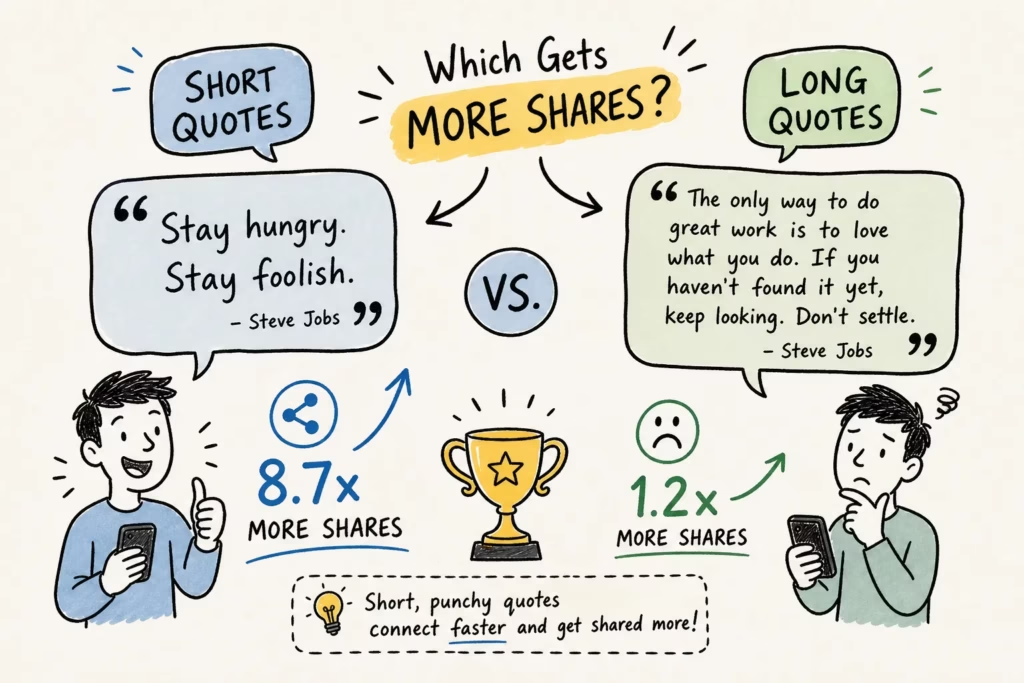
Are short or long quotes better for social media sharing? You saved a perfect quote. Now you’re staring at the caption box, cursor blinking, wondering whether two punchy words hit harder than two full sentences. Every creator and quote lover faces this exact moment, and most of them guess. This article gives you something better: platform-specific character ranges, psychology-backed reasoning, and a repeatable test you can run on your own account starting this week.
The honest answer is that both short and long quotes win, just not on the same platform or for the same goals. A six-word line can stop a scroll on Instagram Reels; a paragraph-length Confucius proverb earns saves on a static post. Knowing which format fits which context is what separates creators who grow from those who plateau. RainbowQuotes is a useful sandbox for this kind of experiment, with a curated library spanning hundreds of topics, mood-based browsing, and one-tap save-as-image tools that let you generate both a punchy one-liner and a longer wisdom quote without any design work.
Why quote length is the most underrated shareability factor
Most creators obsess over posting time, hashtag count, and visual aesthetics while treating caption length as an afterthought. That’s a mistake. Quote length directly shapes how a reader’s brain processes and responds to content, and the platform context amplifies or kills that response entirely.
Think of it as a one-glance test: if your full quote registers at a single glance, it wins the scroll. If it requires mental effort to parse, it needs the right environment to land. Short quotes trigger instant emotional recognition. Long quotes invite reflection and create a reason to pause. Both responses are valuable, but only when matched to where the reader’s head is at on a given platform.
The first line or two of any quote carries most of the weight, regardless of total length. Instagram captions truncate at 125 characters, which means the hook must land before the “more” button appears. That 125-character cutoff previews everything that follows in this article: platforms impose their own constraints, and your quote format has to work within them or its performance will likely suffer.
Are short or long quotes better for social media sharing? How each major platform answers that question
Each platform has a dominant consumption mode, and that mode determines which quote format performs. Here’s the practical breakdown you can bookmark and reference every time you post.
Instagram and Pinterest: visual platforms with strict visual constraints
Instagram captions truncate at 125 characters, so your most important words need to appear before that cut. For quote cards and image quotes specifically, keep on-image text under 50 characters for mobile readability; anything longer forces smaller fonts and clutters the frame. Industry benchmarks place the caption sweet spot at roughly 138 to 150 characters, or about 25 to 30 words, enough to deliver a complete thought without losing readers before they hit “more.” (Verify current figures against the latest platform data, as these benchmarks shift.)
Pinterest functions almost entirely as a visual discovery platform. Quote pins perform best with concise, bold overlay text of 10 words or fewer, positioned in the upper two-thirds of the frame where the platform UI won’t obscure it. Pin descriptions between 100 and 300 characters with a natural call to action drive the highest repin rates. Overlay text beyond 10 words reduces readability and directly hurts engagement on mobile screens.
For Instagram-specific guidance and caption ideas focused on growth, creators often find useful starting points in curated lists of motivational quote captions for Instagram growth, which show how short hooks and slightly longer reflective captions perform in different contexts.
Facebook and TikTok: where context and speed split the room
Research consistently shows Facebook posts under 80 characters generate significantly higher engagement than longer ones, but that doesn’t mean short always wins here. Facebook’s algorithm prioritizes meaningful interactions: comments, shares, and replies. A longer narrative caption that sparks a conversation will outrank a short post that generates no response. The key is a compelling opening hook that earns the “see more” click.
TikTok is audio- and video-first. Text overlays are a secondary layer, not the primary content delivery mechanism. Keep overlays between 3 and 8 words, introduce them within the first one to three seconds of the video, and position them in the center of the frame with high contrast. Studies on TikTok video performance indicate that well-placed text overlays can boost overall engagement meaningfully compared to videos without them, and short overlays specifically push completion rates well above 60%, a critical signal for the algorithm.
Short vs. long quotes: when brevity wins the scroll
There are specific contexts where brevity doesn’t just perform well, it dominates. Instagram Reels, TikTok video overlays, Pinterest pin text, and X (formerly Twitter) all favor short, instantly digestible quote formats. On these surfaces, the visual or audio content carries the weight while the text punctuates the moment. A short quote in this context functions like a caption on a photograph: it frames the emotion without competing with it.
The data reinforces this clearly. Research on X/Twitter indicates tweets under 100 characters earn around 17% higher engagement than longer ones. On Instagram Reels, short captions generate higher likes and reach than their longer counterparts, a trend explored in a Reels caption length experiment that tests how caption length affects engagement.
Brevity alone doesn’t create shareability, though. A short quote needs to deliver a recognizable emotional truth, something the reader wants to claim as their own voice. The formats that consistently perform are self-affirmation and punchy wisdom distilled to a single declarative line. Think “Stay wild” versus a three-sentence reflection on the nature of freedom. Both might be beautiful; only one stops the Reels feed scroll.
When long quotes earn saves and deeper engagement
On Instagram static posts and Facebook, long captions with a strong hook generate higher overall engagement, more saves, and richer comments than short captions. Saves are the highest-intent engagement metric on Instagram: they signal that a reader wants to return to this content. Short quotes earn likes; long, wisdom-dense quotes earn saves. That distinction matters enormously for how the algorithm treats your content over time.
Long quotes work best when they require time to absorb: a Confucius proverb with historical context, a multi-sentence reflection on grief and healing, or a paragraph-length excerpt from a speech that gains meaning as it unfolds. These are not formats for the Reels feed. They belong on the static grid or in a Facebook post where a reader has already paused.
Structure matters just as much as length when writing a long quote caption. The first two sentences must deliver an emotional or intellectual hook before Instagram cuts off the preview. After that hook, break the remaining text into visual breathing room with line breaks. A wall of text kills engagement even when the words are genuinely beautiful. White space is not wasted space; it’s what keeps the reader moving through the quote instead of abandoning it.
Design rules that make any quote format more shareable
A six-word quote on a cluttered background fails. A 40-word quote with clean typography on a simple image can stop a scroll. Quote length and visual execution are inseparable, and the design principles that make quote cards and image quotes shareable apply regardless of whether you’re working with a one-liner or a longer passage.
Visual best practices for quote images
Font size should be a minimum of 24 to 36pt for body text to ensure readability on mobile screens. Contrast matters just as much as size: WCAG accessibility guidelines recommend a 4.5:1 ratio between text and background. Use light text on dark or dark text on light backgrounds, no workarounds on quote cards. Decorative or script fonts might look beautiful in a design mockup, but they sacrifice legibility on small screens and consistently underperform clean sans-serif options.
Increase letter and line spacing so the quote breathes. Tight text reduces legibility and discourages saves because the reader has to work too hard. Make the author’s name visually distinct, either bolder or slightly larger, to add credibility and create a clear visual hierarchy. Attribution that’s immediately visible reinforces the quote’s authority rather than burying it at the end in a small font.
Accessibility basics that also boost shareability
Always write alt text for quote images. A concise description followed by the exact quoted text keeps your content accessible and indexable by search engines. Start with a brief visual description, include the full quote text, and avoid phrases like “image of” or “picture of.” For longer quotes that exceed alt text character limits, supplement with a visible paragraph in the post body containing the full text.
This is exactly where shareable quote images remove the friction. The platform’s one-tap save-as-image feature generates clean, formatted quote images designed around these visual principles: readable fonts, strong contrast, proper attribution, and proportions optimized for Instagram, Pinterest, and Facebook. You don’t need a design background to produce a shareable quote image; you need the right tool. For practical tips on styling quote graphics, resources on how to design a creative quote for social media are especially helpful for creators learning layout and typography basics.
How to run a simple format test for your own audience
No analytics dashboard required. This is a two-week, two-post test you can run on any platform where you already post consistently.
Post the same core message in two formats over two weeks. Version one: a short, punchy caption paired with a clean quote image. Version two: a longer wisdom-style quote with a detailed caption that opens with a strong hook. Keep every other variable identical, posting time, hashtag count, visual style, and topic. Run this on one platform at a time, starting with whichever platform you post on most consistently, so your results reflect your actual audience rather than algorithmic noise.
When you evaluate the results, track three metrics specifically:
- Saves: The clearest signal of intent. A save means the reader wants to return to this content.
- Shares: The clearest signal of trust and resonance. Someone sharing your quote is vouching for it with their own audience.
- Reach: The algorithmic reward signal. Higher reach means the platform is distributing your content more broadly.
Likes are a useful but shallow metric. They tell you someone appreciated a post for a second; they don’t tell you the post changed anything. Saves and shares are the real indicators of quote shareability. After two weeks, you’ll have clear directional data that no general article, including this one, can give you: what your specific audience responds to, on your specific platform, in your specific niche. If you need additional caption ideas to populate your test, Caption Inspiration: 40 Quotes to Boost Social Posts offers immediate prompts you can adapt for both short and long formats.
The format question has a practical answer
So, are short or long quotes better for social media sharing? There’s no universal winner. The platform, the content type, and the reader’s consumption mode all shape the outcome. Short quotes drive reach and instant likes on fast-scroll surfaces like Reels, TikTok, and Pinterest. Long quotes earn saves and meaningful engagement on static posts and Facebook, where readers arrive ready to pause and absorb.
A deliberate content strategy uses both formats intentionally, not interchangeably. A short quote serves a different moment than a long one, and matching the format to the moment is what creates consistent engagement over time. The creators who grow steadily aren’t guessing; they’re testing, measuring, and adjusting based on what their audience actually signals. For additional context on how captions can affect engagement, see analysis on the broader impact on engagement that captions can have.
Head to RainbowQuotes, browse topic categories by mood, pick a quote that works in both a short and long format, and generate shareable images for both with one tap. The content is already curated, the images are already formatted, and the test is ready to run. If you want a deeper look at quote-specific best practices for Instagram, articles about Instagram quotes are a convenient reference. Your audience will tell you exactly what they want.